Black Houseplants: Dark Foliage Plants, Care, and Colour Science
Black houseplants bring instant contrast to a plant collection, but the colour is more complex than a simple “black leaf” label suggests. Most dark-leaved indoor plants are not truly black. They usually combine dense chlorophyll, red-purple or brown pigments, thick tissues, surface texture, and the way light moves through the leaf. The result can look matte, glossy, metallic, burgundy, chocolate, charcoal, or almost jet-black depending on species, cultivar, leaf age, and growing conditions.
This guide explains what makes dark foliage look black, why some plants invest in those pigments, how care affects colour indoors, and which black foliage plants are worth growing if you want strong contrast without choosing by colour alone.
Raven ZZ is one of the easiest black houseplants, with new leaves that emerge bright green before maturing to glossy near-black.
1. What makes leaves look black?
In most houseplants, “black” leaves are actually very dark green, purple, burgundy, bronze, or brown. Human eyes read those colours as black when several traits overlap: dense pigment, thick leaf tissue, low surface reflection, and enough contrast against pale veins, stems, pots, or walls.
Anthocyanins are often part of the story. These red-purple plant pigments can sit above or around chlorophyll and change how much light reaches the photosynthetic tissues below. When anthocyanins are dense enough, green chlorophyll becomes visually muted and the leaf can look black from a normal viewing distance.
Surface texture also matters. Velvety leaves, such as Alocasia reginula ‘Black Velvet’, scatter light differently from glossy leaves such as Zamioculcas zamiifolia ‘Raven’. Metallic begonias add another layer because the surface catches light at different angles, revealing plum, bronze, olive, or charcoal tones that disappear when viewed straight on.
That is why a black houseplant may look almost obsidian in one position and more burgundy, olive, or deep green in another. The plant has not necessarily changed overnight. The viewing angle, light intensity, leaf age, and background all change how the colour reads.
Simple rule
Black foliage is usually an optical effect, not a true black coating. Dense pigments, chlorophyll, leaf thickness, and surface texture work together until the eye reads the leaf as black.
2. Why some plants invest in dark pigments
Dark pigmentation is not just decorative. In many plants, extra pigments help leaves cope with challenging light, cold, drought, ageing tissue, or other stress. They can act as light filters and antioxidants, reducing damage when more energy reaches a leaf than it can safely use.
That does not mean every black houseplant comes from an extreme habitat. Many dark indoor plants are cultivars selected by growers because a naturally dark tendency looked useful, beautiful, or commercially distinctive. The biology still matters, but the plant on a shelf is often a selected clone, hybrid, or horticultural form rather than a direct copy of a wild survival strategy.
Dark pigmentation also has costs. Producing extra pigments uses energy, and heavily pigmented leaves can grow more slowly than plain green leaves under some conditions. This is one reason many black foliage plants feel compact, deliberate, or slower than brighter green relatives.
Situation
What darker pigmentation can do
Indoor takeaway
Sudden bright light
Extra pigments can help filter excess light before it reaches sensitive tissues.
Bright filtered light is safer than harsh direct sun through glass.
Cooler nights or stress
Some plants increase red-purple pigments under stress or temperature shifts.
Do not use stress deliberately as a care method; steady health matters more than forcing colour.
Leaf ageing
Pigments may protect tissue while nutrients are moved out of older leaves.
One older yellowing leaf is not automatically a care failure, especially on compact Alocasia.
Cultivar selection
Growers select plants with stronger or more stable dark colour.
Name and cultivar matter. A dark cultivar behaves differently from a random stressed green plant.
3. How dark leaf colour develops
Dark colour is controlled by genetics first, then shaped by environment. A cultivar must have the capacity to produce or hold those dark tones. Care can support typical colour expression, but it cannot turn a plain green plant into a stable black cultivar.
Leaf age is one of the most visible parts of the process. Raven ZZ is a clear example: new leaves open bright green, then gradually darken as they mature. Ficus elastica ‘Abidjan’ often pushes new growth in burgundy before leaves harden to a deeper, glossier tone. Philodendron ‘Black Cardinal’ also changes as each leaf matures, shifting through bronze, burgundy, and blackish-green stages.
Care affects that process indirectly. Weak light, cold roots, compact substrate, or overfeeding can push some plants toward softer, greener, weaker growth. Strong direct sun can bleach, scorch, or mark dark leaves instead of improving them. The target is not maximum light. The target is enough light for healthy growth, with stable roots and no extremes.
Philodendron ‘Black Cardinal’ shows a typical dark-leaf colour shift: new leaves emerge burgundy and mature toward deep bronze-black.
Do not treat colour as a light dial
Better light can support stronger growth and typical colour, but harsh sun is still damaging. Dark foliage often absorbs heat quickly, so filtered light is usually safer than direct summer sun through glass.
4. Black leaves vs. green leaves indoors
Green leaves and dark leaves both photosynthesise. The difference is not that black leaves are “better” or “worse”; they are built with different trade-offs. A plain green leaf often prioritises efficient light capture and fast growth. A very dark leaf may carry extra pigments that influence light filtering, tissue temperature, and stress response.
Indoors, this usually translates into slower growth, stronger visual contrast, and a little less tolerance for poor root conditions. A dark, thick leaf does not save a plant from stale wet substrate. In fact, cold wet roots are one of the quickest ways to weaken many dark aroids, begonias, and peperomias.
Trait
Green-leaved plants
Black or dark-leaved plants
Growth pace
Often faster when light, water, and nutrients are strong.
Often slower, especially compact cultivars and jewel-type plants.
Light response
Can tolerate a wider range depending on species.
Usually look best with bright filtered light and protection from direct burn.
Heat absorption
Less visual heat load from dark surfaces.
Dark surfaces can warm faster in strong sun through glass.
Indoor styling
Blends easily into mixed plant groups.
Adds contrast, shadow, and a stronger silhouette.
Care priority
Species-specific basics still matter most.
Species-specific basics still matter most; colour alone does not define care.
5. Black houseplant care: light, water, substrate, and humidity
There is no universal “black plant care” recipe. Raven ZZ, Goeppertia ‘Dottie’, Alocasia infernalis ‘Black Magic’, Begonia rex ‘Black Mambo’, and Hoya krohniana ‘Black Leaves’ all look dark, but they do not want the same watering rhythm or substrate. Colour gives a useful clue, but plant family and growth habit matter more.
Light: bright filtered light for most, not direct scorch
Most black foliage plants look strongest in bright indirect or filtered light. This keeps growth compact and supports normal colour development without the heat and burn risk of hard direct sun. Dark leaves can mark quickly under strong midday or afternoon sun through glass.
If natural light is weak, a quality full-spectrum grow light can help. Keep distance and duration sensible, and watch the plant rather than chasing a number blindly. Stretching, weak petioles, small leaves, or slow drying substrate usually mean light and root conditions are not balanced.
Watering should follow root type, pot size, substrate structure, light, and temperature. Raven ZZ and Dracaena ‘Black Coral’ need the mix to dry thoroughly. Goeppertia ‘Dottie’ and Geogenanthus ‘Midnight Pearl’ prefer more even moisture. Alocasia and Begonia sit between those extremes: they need moisture, but they decline fast in stale wet substrate.
Substrate: dark foliage still needs breathing roots
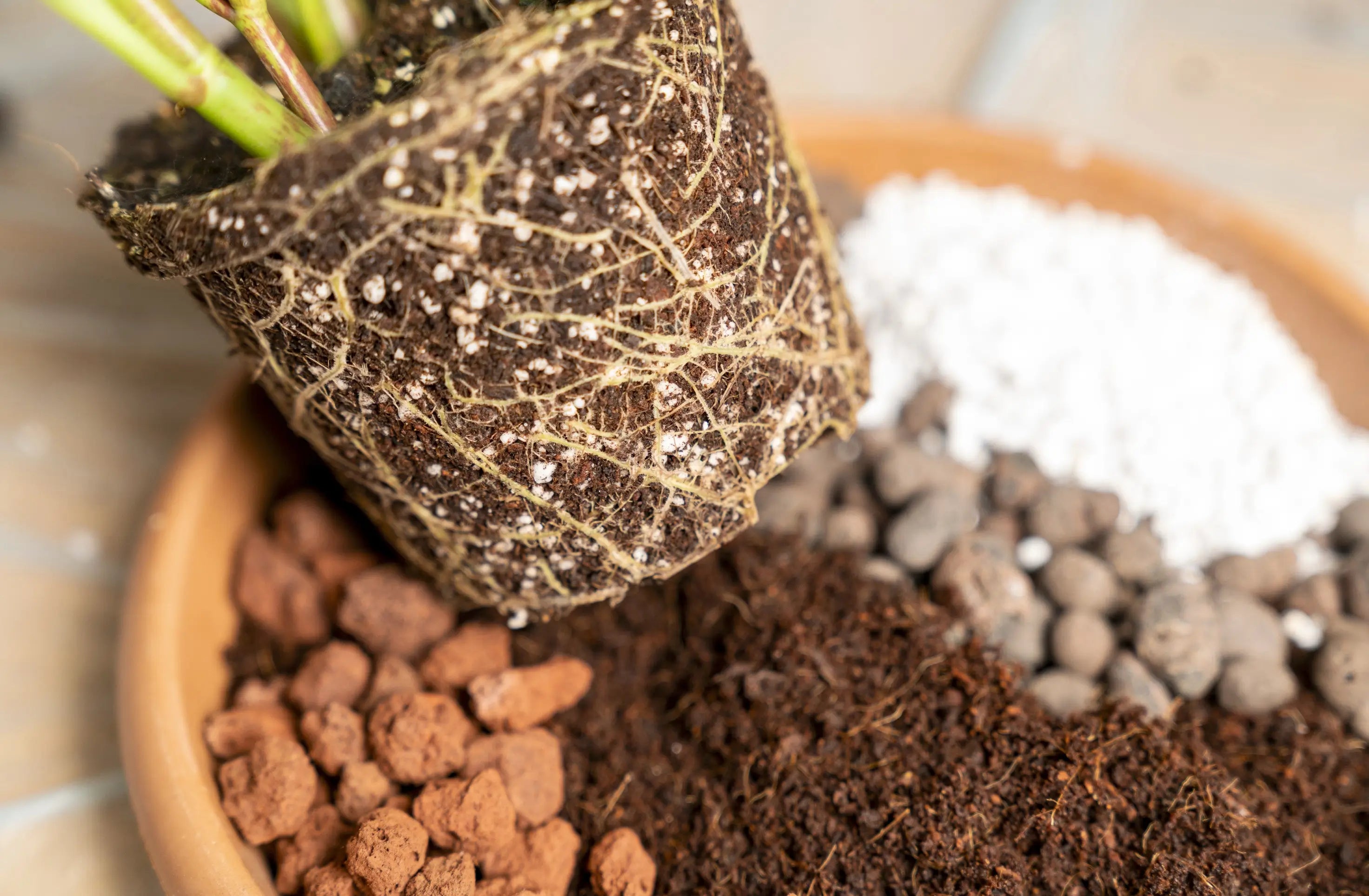
Dense, cold, wet mixes are a common failure point. Aroid types such as Alocasia, Philodendron, Anthurium, and Scindapsus usually need a more aerated mix with bark, mineral particles, and a moderate moisture buffer. Begonia, Peperomia, and Geogenanthus prefer finer mixes, but still need air around the roots.
Heavy fertilising does not make black foliage better. Too much nitrogen can push soft, fast growth in some plants, while root stress from excess salts can weaken leaf quality. Use a balanced, diluted fertiliser at a moderate rate and flush mineral build-up when needed.
Humidity: important for some, irrelevant for others
Humidity matters most for plants with thin, sensitive, or unfurling leaves. Goeppertia ‘Dottie’, jewel Alocasia, Geogenanthus, and many begonias usually look cleaner with stable higher humidity and gentle airflow. Raven ZZ, Dracaena ‘Black Coral’, Ficus elastica ‘Abidjan’, and many Hoyas are less dependent on high humidity.
Use a humidifier, a cabinet, or grouping where it genuinely improves conditions. Avoid stagnant air and do not rely on pebble trays as a serious humidity solution.
Why black plants turn greener indoors
Possible causes include immature leaves, not enough growing light, excessive fertiliser, cold or damaged roots, or simply cultivar behaviour. Check the plant’s own care needs before assuming one universal colour problem.
Black foliage is not ideal when...
Your only free spot is a cold, dim corner where the substrate stays wet for a long time.
You want very fast growth; many dark cultivars are naturally slower or more compact.
You have strong direct midday or afternoon sun through glass and no way to filter it.
You need every plant to be pet-safe; several dark aroids, Ficus, ZZ, and Dracaena are toxic if chewed.
6. 16 black and dark foliage houseplants worth growing
Black houseplants range from forgiving floor plants to small collector species that need warm, humid, stable growing conditions. The list below keeps the claims conservative: some are genuinely near-black, while others are deep burgundy, chocolate, bronze, or dark green with a strong dark presence.
Quick picks before you scroll
Easiest dark foliage: Raven ZZ, Ficus elastica ‘Abidjan’, and Dracaena ‘Black Coral’.
Pet-friendly dark foliage: Goeppertia ‘Dottie’, Peperomia metallica ‘Colombiana’, Geogenanthus ‘Midnight Pearl’, and Hoya krohniana ‘Black Leaves’.
Best for humid cabinets: Geogenanthus, Peperomia ‘Colombiana’, Begonia rex ‘Black Mambo’, and jewel Alocasia.
Glossy new leaves emerge bright green and mature to a deep black-green. Raven ZZ is the easiest starting point for dark foliage because it tolerates drying, lower humidity, and ordinary indoor conditions better than most plants in this list.
Best for: beginners, low-maintenance collections, sculptural contrast.
Compact matte leaves and pale veins make this jewel Alocasia one of the classic black houseplants. It stays small and slow, with roots that need warmth, oxygen, and careful watering.
Best for: collectors who can provide bright filtered light and an airy mix.
Small, glossy leaves shift from violet-purple to near-black as they mature. This is a more advanced jewel Alocasia because compact growth and dark leaves leave little margin for stale wet roots.
Best for: warm cabinets, high-humidity setups, experienced Alocasia growers.
Near-black, softly furred leaves give this compact Alocasia a tactile look. It reads darker through texture than through strong vein contrast, so it works well beside silver or chartreuse plants.
Best for: collectors who like compact, moody, close-view plants.
Dark matte leaves and pale vein relief give ‘Ninja’ a sharper, more graphic version of the small jewel Alocasia look. Colour is not the only feature here; outline, texture, and proportion matter just as much.
Best for: small displays, shelves, and growers who prefer compact forms.
A historic hybrid with metallic cuprea tones, lobed edges, and dark sculptural presence. It is not flat black, but the bronze-black surface makes it a strong dark-foliage bridge plant.
Best for: collectors who want dark leaves with a metallic finish.
New leaves open in warm red to bronze tones before maturing through deep green-brown shades that can read almost black in the right light. Treat it as a dark foliage Anthurium, not a black-flowered plant.
Best for: collectors who want colour-shifting Anthurium foliage with a moody finish.
New foliage emerges burgundy and matures toward bronze-black in a self-heading rosette. It is easier than many jewel Alocasias and does not need a pole, making it a strong compact statement plant.
Best for: growers who want dark aroid colour without climbing support.
Large glossy leaves emerge burgundy and harden to very dark green-black. Ficus elastica ‘Abidjan’ becomes more architectural with age and suits anyone who wants dark foliage at a larger scale.
Best for: floor plant structure, glossy contrast, easier care.
Near-black leaves with vivid pink patterning make ‘Dottie’ one of the strongest visual contrasts among pet-friendly dark plants. It needs even moisture, high humidity, and stable warmth to avoid crisp edges.
Best for: pet-friendly collections and humid, stable setups.
Compact rex Begonia with dark spiral leaves that show plum, burgundy, olive, and charcoal tones depending on the angle. It is best viewed up close where the surface texture can be seen properly.
Best for: bright cabinets, shelves, and textured plant groups.
Thick lance-shaped leaves become so deep green they read as black in many indoor positions. Slow growth and clean lines make it feel sculptural, especially when trained upward.
Best for: patient growers, supports, and minimal dark foliage.
A compact, dark, metallic Peperomia sold under a horticultural name that is not fully taxonomically settled. Treat it as a small humidity-loving understory plant with shallow roots and slow growth.
Best for: terrariums, small pots, pet-friendly dark foliage.
Glossy rippled leaves shift between deep plum, purple-black, and dark green depending on light and angle. Warmth, high humidity, and evenly moist but aerated substrate are key.
Best for: humid cabinets, terrariums, pet-friendly contrast.
Small heart-shaped leaves darken to bronze-black or black-green tones under brighter filtered conditions. It keeps the easier rhythm of many Hoyas: airy substrate, warmth, and drying between waterings.
Best for: trailing displays, Hoya collectors, pet-friendly dark vines.
Tall sword-like leaves in very dark green with subtle banding give this snake plant cultivar a monolithic look. It is not a delicate black-leaf plant; it is a tough structural plant with a strong dark presence.
Best for: low-maintenance vertical structure and dry-down care.
Best black houseplants at a glance
Plant
Care level
Dark effect
Pet safety
Zamioculcas zamiifolia ‘Raven’
Beginner
Glossy black-green mature leaves
Toxic if chewed
Alocasia reginula ‘Black Velvet’
Intermediate
Matte black-green leaves with pale veins
Toxic
Alocasia infernalis ‘Black Magic’
Advanced
Mirror-gloss purple-black jewel leaves
Toxic
Alocasia ‘Antoro Velvet’
Advanced
Near-black softly textured leaves
Toxic
Alocasia reginula ‘Ninja’
Intermediate
Dark matte leaves with graphic pale veins
Toxic
Alocasia ‘Chantrierii’
Intermediate to advanced
Metallic bronze-black hybrid foliage
Toxic
Anthurium ‘Queen of Hearts’
Intermediate
Red-bronze new leaves maturing to deep green-brown
Toxic
Philodendron ‘Black Cardinal’
Beginner to intermediate
Burgundy new leaves maturing to bronze-black
Toxic
Ficus elastica ‘Abidjan’
Beginner
Large burgundy-black glossy leaves
Toxic sap
Goeppertia roseopicta ‘Dottie’
Intermediate
Near-black leaves with vivid pink markings
Pet friendly
Begonia rex ‘Black Mambo’
Intermediate
Plum, charcoal, and metallic dark spirals
Toxic if chewed
Scindapsus treubii ‘Dark Form’
Intermediate to advanced
Deep green leaves that read black
Toxic
Peperomia metallica ‘Colombiana’
Intermediate
Metallic maroon-black compact leaves
Pet friendly
Geogenanthus ciliatus ‘Midnight Pearl’
Intermediate
Glossy deep purple-black rippled leaves
Pet friendly
Hoya krohniana ‘Black Leaves’
Beginner to intermediate
Small bronze-black to black-green trailing leaves
Pet friendly
Dracaena trifasciata ‘Black Coral’
Beginner
Dark upright banded leaves
Toxic if chewed
Begonia rex ‘Black Mambo’ shows why “black” houseplants are often more interesting up close: the leaf reveals plum, burgundy, charcoal, and metallic tones as the light changes.
7. Designing with black houseplants
Black foliage works like shadow in a planting arrangement. It gives the eye a resting point and makes brighter colours look cleaner. A single dark plant can sharpen a shelf of green houseplants, while several dark plants grouped together create a calmer, more architectural mood.
Use contrast deliberately. Pale ceramic pots make dark leaves stand out. Terracotta adds warmth. Smoked glass, charcoal planters, or dark mineral top dressings create a quieter tone-on-tone look. Silver plants, lime-green foliage, pink leaves, and white-variegated plants all become stronger beside black foliage.
Placement matters. Dark plants need visible edges. Against a very dark background or in a dim position, the shape can disappear. Against a pale wall, beside a window with filtered light, or next to silver and chartreuse leaves, the silhouette becomes much clearer.
Good companion colours
Silver: Scindapsus, Pilea, and silver Anthurium types sharpen black foliage without shouting.
Chartreuse: Lime-green Philodendron, Syngonium, or Epipremnum types make dark leaves look deeper.
Pink: Pink-leaved plants echo the red-purple pigment side of many black leaves.
White variegation: White sectors create clean contrast, but care needs can differ widely.
Possible causes include immature leaves, not enough growing light, overfeeding, cold roots, or cultivar behaviour. Start by checking light level, substrate drying speed, root health, and recent fertilising before changing everything at once.
Do black houseplants need more light than green plants?
Not automatically. Many dark plants look best in bright filtered light, but direct summer sun through glass can burn them. Care depends on species: Raven ZZ and Dracaena ‘Black Coral’ tolerate lower light better than Begonia rex ‘Black Mambo’ or most jewel Alocasia.
Are black plants slower growing?
Often, yes, but not always. Many black cultivars are compact or slow by nature, and producing dense pigments can be part of that slower rhythm. Raven ZZ, jewel Alocasia, Scindapsus treubii ‘Dark Form’, and Begonia rex types are better judged by steady leaf quality than speed.
Are black houseplants harder to care for?
Colour alone does not decide difficulty. Raven ZZ, Ficus elastica ‘Abidjan’, and Dracaena ‘Black Coral’ are beginner-friendly. Alocasia infernalis ‘Black Magic’, Alocasia ‘Antoro Velvet’, and Geogenanthus ‘Midnight Pearl’ need more stable warmth, humidity, and substrate control.
Which black houseplants are pet-friendly?
Good pet-friendly dark foliage options include Goeppertia roseopicta ‘Dottie’, Peperomia metallica ‘Colombiana’, Geogenanthus ciliatus ‘Midnight Pearl’, and Hoya krohniana ‘Black Leaves’. Always check the individual product page before buying, because pet safety differs by plant family and cultivar.
Do black houseplants need special soil?
No. They need substrate that suits their roots. Aroid types usually need a chunky, aerated mix. Begonia and Peperomia need finer but still breathable mixes. ZZ and Dracaena need fast-draining, dry-down-friendly substrates. There is no one “black plant mix”.
Can grow lights keep black leaves dark?
Grow lights can help when natural light is too weak, but they should support healthy growth rather than force colour. Use full-spectrum light, avoid heat stress, and adjust duration gradually. Dark foliage can still burn or fade under excessive intensity.
Are black leaves actually black?
Usually no. Most are very dark green, purple, burgundy, bronze, or brown. They look black because pigment density, chlorophyll, tissue structure, and surface reflection combine in a way that absorbs or hides much of the visible colour.
9. Next steps: choose dark foliage by care style
If you want low-maintenance contrast, start with Raven ZZ, Ficus elastica ‘Abidjan’, or Dracaena ‘Black Coral’. If pet safety matters, look first at Goeppertia ‘Dottie’, Peperomia metallica ‘Colombiana’, Geogenanthus ‘Midnight Pearl’, or Hoya krohniana ‘Black Leaves’. If you enjoy collector plants and can manage warmth, humidity, and substrate carefully, jewel Alocasia, Anthurium ‘Queen of Hearts’, and Scindapsus treubii ‘Dark Form’ give you more texture, slower growth, and stronger close-up interest.
Shop dark foliage
Black foliage plants change by availability, but the care notes stay useful.
Use the collection filters and each product page to compare current sizes, light needs, watering rhythm, humidity level, and pet-safety notes before choosing. Rare Alocasia, Scindapsus, and Anthurium batches can change quickly.
Most houseplants don’t rot because you “overwatered” once — they rot because their potting mix can’t breathe. This guide breaks down the real physics behind drainage vs aeration, perched water tabl...
“Low-light plant” is mostly a marketing label. This guide shows you the real lux and DLI numbers behind indoor light, how fast intensity drops with distance from a window, which species genuinely t...
I received perfectly heathy and absolutely beautiful plants, even bigger than expected. The delivery within Europe was really fast. I think Foliage Factory has one of the best plant web shops in the internet. It‘s just great to get so much informations about the plants. I will definitely order again :)
Walkerova
★★★★★
Die Pflanzen waren prima verpackt und ein heatpack war im Paket enthalten. Die Lieferzeit hat 2 bis 3 Tagen gedauert, was aus meiner Sicht wirklich gut ist. Alle drei Pflanzen haben die Lieferung gut überstanden. Ich habe mich auf Hoyas spezialisiert und habe schon die nächsten Pflanzen meiner Wunschliste auf der Website gefunden. Daher wird die nächste Bestellung nicht lange auf sich warten lassen.
Marion
★★★★★
Envoie très rapide (2 jours), plantes parfaitement emballées et super offres ! Je suis une habituelle j'ai passé 6 ou 7 commandes et je n'en peut être plus satisfaite du service client et de la qualité et variété des plantes offertes
Iris
★★★★☆
Die Sendung kam leider in keinem guten Zustand bei mir an, kann passieren. Habe mich darauf hin sofort an Foliage Factory gewandt und habe selten einen so guten, schnellen, freundlichen und kulanten Kundendienst erlebt.
Frauke
★★★★★
The plants have arrived in perfect condition, the roots and the foliage so so healthy! I had problem with 1 plant out of 16 and they have responded to my email almost instantly and the issue was resolved straight away. I'm really impressed and satisfied, definitely getting more plants from them again!
Patricija
★★★★☆
Very healthy and well packed plant. Unfortunately there was one plant that ordered couldn’t be delivered as it was out of stock hence 1 star less.
Sam
★★★★★
Everything arrived in good condition and very well packed - it wasn't easy with a fragile plant and a heavy bag of substrate. I recommend it!
Lia
★★★★★
Bester online-Pflanzenhandel den ich kenne (habe davor 4 andere ausprobiert). Eine teure Pflanze wurde beim Transport beschädigt und mir ersetzt. Der Kontakt dabei war auch sehr nett (danke Jan) und hat mir gut geholfen. Die anderen Pflanzen sind in einem sehr guten Zustand, keine Schädlinge, super Bewurzelung. Nur zu empfehlen! :)
C L
★★★★★
Super Service, Gute Auswahl, Preise sind fair. Eine Pflanze kam kaputt an, hab sofort Ersatz bekommen. Danke an den unkomplizierten (und blitzschnellen) Kundenservice!!
Sarah
★★★★★
The plants are carefully packaged and arrive in great conditions (I’m based in Spain) and they’re always there to help in any way they can with your purchase.I have and will always recommend Foliage Factory to every friend I can. I’m not only satisfied with their plants and prices, but their customer service is exceptional.





Leave a comment
This site is protected by hCaptcha and the hCaptcha Privacy Policy and Terms of Service apply.