
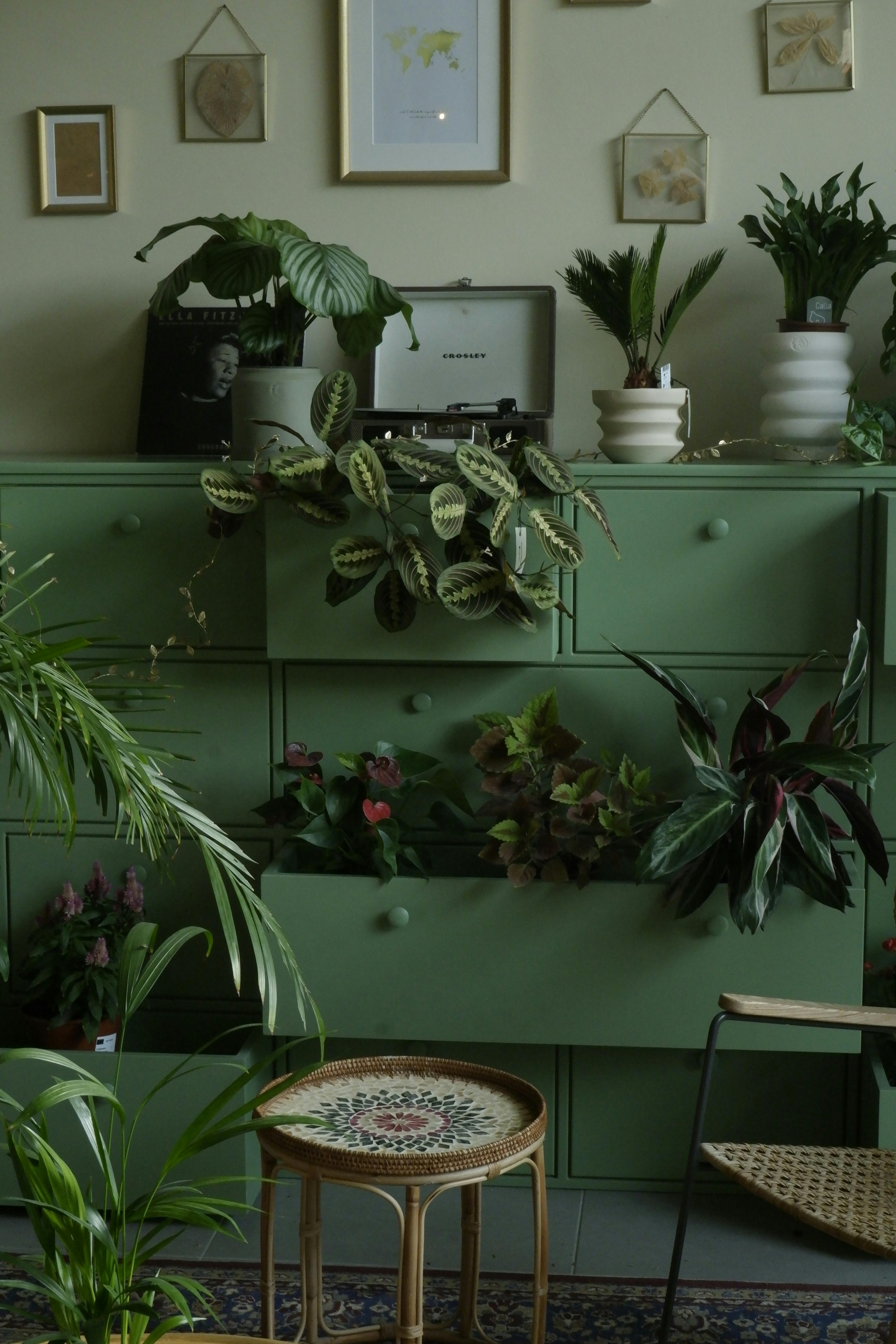
Prayer plants are not moody by default. Learn how Goeppertia, Maranta, Ctenanthe, and Stromanthe grow, what their leaf movement means, and how to prevent common care problems.
Read more
Living with cats does not mean giving up houseplants. It does mean being stricter about what comes into your home. Some plants are genuinely dangerous, some are mostly irritants, and some are widely listed as non-toxic but still make poor choices for homes with pets that chew, swat, rub against foliage, or crash into floor pots.
This guide is built to be practical rather than vague. It covers why some plants are risky for cats, how to check a plant properly before buying, how to set up a home where cats and plants can coexist with less drama, eight safer houseplants worth growing, what to do if your cat chews the wrong plant, and how our Non-Toxic Houseplants and Pet-Friendly Houseplants collections differ.
One warning belongs right at the top: true lilies and daylilies are an urgent risk for cats. That warning is not about "mild stomach upset" or "watch and wait." It is a veterinary issue.
Quick plant check: jump straight to the plant safety lookup table.

Plant safety is often described too simply. In real homes, there are at least four different questions hiding behind the phrase safe for cats:
That is why a single yes-or-no list is rarely enough. A plant can be non-toxic and still be a poor fit for a busy home with curious pets. A plant can also be sold under a harmless-sounding common name while hiding under a very different botanical identity.
True lilies (Lilium) and daylilies (Hemerocallis) are in a category of their own for cats. This is not a "wait and see" situation. Leaves, petals, pollen and even vase water can be dangerous. If there is any chance your cat has chewed a lily, brushed pollen onto its coat, or drunk from lily vase water, contact a vet immediately.
Common names are part of the problem. Peace lily and calla lily are not true lilies, but they are still not safe houseplants for cats. They are harmful for different reasons and should not be treated as harmless just because the kidney-failure warning applies specifically to true lilies and daylilies.
Many cats barely notice houseplants. Others treat every dangling leaf as enrichment. That is why plant choice should be based on the cat you actually live with, not on the hope that a risky plant will stay untouched forever.
Useful rule: if a plant is already a poor fit for a cat home, placement should not be your only safety plan.
The safest habit is simple: identify the plant properly first, then check the name in a veterinary or animal-welfare source. Guessing from a photo, a common name, or a social-media reel is exactly how risky plants slip into ordinary homes.
Common names are messy. “Money plant,” “umbrella plant,” “elephant ears,” “fern,” and “lily” can each refer to several different plants depending on the shop, the country, or the seller. The scientific name matters far more than the nickname on the tag.
Plant names change. You may find the same plant listed under an accepted modern name, an older horticultural name, or a retailer-friendly trade name.
Good resources are there to help you verify a plant, not to support broad shortcuts. If a plant is unusual, poorly labelled, or sold under a trade name, slow down and cross-check.
No plant safety database is perfectly exhaustive. Lists focus on commonly encountered plants, use different naming conventions, and sometimes describe the same plant at species level in one place and genus level in another.
Back to the plant safety lookup table

Buying a safer plant is only the beginning. The rest is setup. Good plant choices become much safer when the room makes sense too.
It is easier to build a calm plant home around safer species than to spend months trying to outsmart a cat that is interested in chewing toxic foliage. Safe-by-design beats constant damage control.
Shelves, hanging planters, wall brackets, and heavier pots all help. They do not make a toxic plant magically suitable. A hanging stem still hangs. A floor pot is still a launch point. Placement is part of the system, not the whole system.
Cat grass can be genuinely helpful in homes with leaf-chewers. It does not guarantee that every houseplant will be ignored, but it often reduces the novelty of greenery and gives habitual nibblers a better target.
Loose decorative moss, bark chunks, fibres, foil wraps, plastic sleeves, and dangling tags are often more attractive to a cat than the plant itself. Remove them. Use stable pots. Skip top dressings that look like toys.
The plant is not always the only issue. Fertilisers, sprays, pest treatments, systemic products, leaf shine, and residues from retail handling can all matter. A safe species covered in residue is not really a low-risk choice in practice.
Some cats barely react. Others become obsessed immediately. That early behaviour is useful information. It tells you whether a plant belongs up high, in a room with restricted access, or not in your home at all.

These are not the only safer choices, but they are a strong, practical starting point because they are widely available, recognisable, and useful in real homes rather than just on plant-safety lists.

Areca palm is one of the easiest ways to get height and softness in a room without defaulting to more problematic indoor trees. It gives you movement, a lighter look, and a larger plant presence without relying on thick, rigid, broad leaves.
In good light it can become a very effective room plant, especially if you want something bigger than tabletop foliage. It is not hard, but it is much happier with bright filtered light than with a gloomy corner and wishful thinking.

Spider plant appears on almost every safer-houseplant list for a reason: it is genuinely useful. It grows quickly, handles average indoor conditions well, and makes offsets freely. It is one of the easiest ways to fill a shelf or hanging position without committing to a fussy plant.
The catch is that many cats love it. The long arching leaves and dangling plantlets invite chewing and swatting. So while spider plant is generally listed as non-toxic, it is still a plant that some cats will overindulge in, and that can still end in mild stomach upset.

This is the answer for people who want patterned foliage without being pushed back toward risky aroids. Many plants still sold as Calathea are now often placed in Goeppertia, but in everyday houseplant shopping the older retail naming is still everywhere.
These plants are grown for markings, striping, texture, and leaf contrast rather than sheer size. They are a strong choice when visual impact matters and pet safety matters too. They do, however, expect steadier care than a spider plant or money tree.

Boston fern is a good choice when you want a softer, fuller plant shape instead of bold individual leaves. It has enough presence to change a room, but it does not feel heavy. For a lot of homes, that softer visual weight is exactly what makes it useful.
It is safer for cats, but it is not a forget-about-it plant. Dry it hard and repeatedly, and it tells you very quickly. If you can give it more even moisture and reasonable light, it earns its place.

Prayer plant is one of the best small-format patterned plants for cat owners. It stays more compact than many trailing or climbing species, which makes it easy to place in smaller homes without turning every low surface into a risk zone.
It suits grouped plant displays well and gives you a strong leaf pattern without asking you to keep a more irritating plant out of reach forever. Like many Marantaceae, it prefers steadier moisture and more predictable conditions than tougher beginner plants, but that is a fair trade for the look.

Polka dot plant proves that safer options do not have to look dull. If you want colour through foliage rather than flowers, this is one of the easiest ways to get it. Pink, white, and red-speckled forms work well in small spaces and mixed displays.
It is not a long-term structural plant like a palm or money tree, but it is useful where larger plants would feel clumsy. It also responds well to light trimming, which helps it stay bushier instead of stretching out.

Fittonia earns its place in small spaces. It stays low, spreads gently, and gives you contrast through leaf veining instead of bulk. That makes it useful in terrariums, desktops, narrow shelves, or small decorative pots where larger plants would look oversized.
Its most famous habit is dramatic wilting when too dry. Annoying, yes, but also honest. It tells you quickly when care has slipped, which some people actually prefer to slow invisible decline.

Money tree is one of the few upright, tree-like indoor plants that still makes sense in a cat home. It gives a stronger silhouette than most small foliage plants and helps a room feel planted rather than just decorated with pots.
It is often sold with braided stems when young, but the real value is that it offers height without relying on more problematic indoor trees. Give it decent light and do not keep it permanently wet, and it is a much more useful long-term option than a lot of trendier plants.
Other safer options worth knowing: peperomia, parlour palm, hoya, string of hearts, lipstick plant, stromanthe, Aspidistra, and maidenhair or blue star fern are also useful starting points when the exact plant has been checked properly.
Not every plant problem starts with a potted houseplant. Bouquets, seasonal arrangements, florist stems, vase water, and gift plants are a major blind spot in cat homes because they arrive casually and often stay within easy reach.
If you live with cats, lilies do not become acceptable just because they arrived as cut flowers. The risk is not limited to chewing leaves. Pollen on fur and water from a vase both matter.
Amaryllis, hyacinths, and daffodil bulbs are classic examples of plants that show up seasonally and catch people off guard. They may be bought as décor rather than as houseplants, but they still belong in the same safety conversation.
This is one of the most common naming traps. The kidney-failure warning belongs specifically to true lilies and daylilies, but peace lily is still toxic to cats and should not be treated as a pet-safe indoor plant.
Garden-centre labels like “mixed foliage,” “decorative indoor plant,” or “flowering gift plant” are not enough. If you cannot confirm the plant, keep it away from pets until you can.
Practical rule: if flowers or gift plants enter a cat home without a real name attached, assume they are unverified until proven otherwise.
If your cat has chewed a plant and you are not fully sure it is safe, do not waste time on home remedies.
Treat these as urgent: any possible lily exposure, collapse, repeated vomiting, breathing difficulty, seizures, extreme weakness, or any fast decline after plant exposure.
Back to the plant safety lookup table

Not every non-toxic plant is automatically pet-friendly in the same way. Some plants may be classed as non-toxic from a poisoning point of view, but still have spines, stiff points, sharp edges, rough bristles, or scratchy structure that make them a poorer fit for homes with curious cats or dogs.
Our Non-Toxic Houseplants collection is the broader option. It focuses on plants chosen to reduce poisoning concerns, while still offering a wider range of plant types.
Our Pet-Friendly Houseplants collection is the stricter shortlist. It includes non-toxic plants, but also screens out many obvious physical hazards such as spines, sharp bristles, rigid needle-like tips, and scratchy edges.
If your pet mostly ignores plants and your main goal is avoiding known toxic species, start with Non-Toxic Houseplants. If your cat or dog chews, swats, rubs against foliage, knocks into pots, or shares space with plants at floor level, Pet-Friendly Houseplants is the better place to start.
This is also why a plant can be lower-risk without being the best pet-friendly pick. Toxicity is only one part of real-life suitability.

This table is a practical indoor-plant guide, not an exhaustive botanical database. Use it as a quick filter, then verify the exact plant name before buying.
If your plant is marked “Verify”: keep it out of reach until you can confirm the exact plant name in a pet-safety database.
This guide is for informational purposes only and should not replace professional advice.
| PLANT GENUS | CONSERVATIVE WORKING STATUS FOR CAT HOMES | NOTES |
|---|---|---|
| Acalypha | Avoid — ASPCA: toxic to cats | Avoid. |
| Adenium | Avoid — ASPCA: toxic to cats | Avoid. |
| Aeschynanthus | Generally non-toxic — ASPCA: non-toxic to cats | Chewing can still cause mild stomach upset. |
| Agave | Verify — not listed on ASPCA cats list | Sap and leaf tissue can irritate. |
| Aglaonema | Avoid — ASPCA: toxic to cats | Avoid. |
| Alocasia | Avoid — ASPCA: toxic to cats | Avoid. |
| Aloe | Avoid — ASPCA: toxic to cats | Avoid. |
| Amaryllis | Avoid — ASPCA: toxic to cats | Avoid. |
| Amydrium | Verify — not listed on ASPCA cats list | Treat as unverified until confirmed. |
| Anoectochilus | Generally non-toxic — ASPCA: non-toxic to cats | Listed as a jewel orchid entry; still verify labels on unusual plants. |
| Anthericum | Generally non-toxic — ASPCA: non-toxic to cats | Old-name overlap with Chlorophytum causes confusion. |
| Anthurium | Avoid — ASPCA: toxic to cats | Avoid. |
| Aphelandra | Generally non-toxic — ASPCA: non-toxic to cats | Often confused with other “zebra plant” names. |
| Aporocactus | Verify — not listed on ASPCA cats list | Spines and rough stems are the issue. |
| Arum | Avoid — ASPCA: toxic to cats | Avoid. |
| Aspidistra | Generally non-toxic — ASPCA: non-toxic to cats | Chewing can still upset the stomach. |
| Asplenium | Generally non-toxic — ASPCA: non-toxic to cats | ASPCA lists Asplenium bulbiferum; treat vague “fern” labels with caution. |
| Astrophytum | Verify — not listed on ASPCA cats list | Spines are the main problem. |
| Beaucarnea | Generally non-toxic — ASPCA: non-toxic to cats | Fibrous leaves can still cause mild GI upset. |
| Begonia | Avoid — ASPCA: toxic to cats | Avoid. |
| Boophone | Verify — not listed on ASPCA cats list | Treat as unverified until confirmed. |
| Brassaia | Avoid — ASPCA: toxic to cats | Old name linked to schefflera-type plants; avoid. |
| Browningia | Verify — not listed on ASPCA cats list | Spines are the main problem. |
| Brunfelsia | Avoid — ASPCA: toxic to cats | Avoid. |
| Bulbophyllum | Generally non-toxic — ASPCA: non-toxic to cats | Orchid genus. |
| Caladium | Avoid — ASPCA: toxic to cats | Avoid. |
| Calathea / Goeppertia | Generally non-toxic — ASPCA: non-toxic to cats | Good lower-risk option, but any plant material can still upset the stomach. |
| Callistemon | Generally non-toxic — ASPCA: non-toxic to cats | Still verify exact plant if sold under a vague common name. |
| Callistephus | Generally non-toxic — ASPCA: non-toxic to cats | Chewing can still cause mild GI upset. |
| Camellia | Generally non-toxic — ASPCA: non-toxic to cats | Chewing can still cause mild GI upset. |
| Canna | Generally non-toxic — ASPCA: non-toxic to cats | Chewing can still cause mild GI upset. |
| Caryota | Verify — not listed on ASPCA cats list | Sharp leaf structure can be a practical hazard. |
| Cereus | Verify — not listed on ASPCA cats list | “Night blooming cereus” on ASPCA is listed under Hylocereus; “cereus” labels are often not genus-accurate. |
| Ceropegia | Verify — not listed on ASPCA cats list | Stringy growth can still tempt chewing. |
| Chamaedorea | Generally non-toxic — ASPCA: non-toxic to cats | One of the safer palm groups for cat homes. |
| Chamaerops | Verify — not listed on ASPCA cats list | Sharp leaf tips and petiole spines matter. |
| Chlorophytum | Generally non-toxic — ASPCA: non-toxic to cats | Very commonly chewed; overdoing it can still cause vomiting. |
| Chrysanthemum | Avoid — ASPCA: toxic to cats | Avoid. |
| Cinnamomum | Generally non-toxic — ASPCA: non-toxic to cats | Listed as cinnamon (Cinnamomum zeylanicum). |
| Cissus | Generally non-toxic — ASPCA: non-toxic to cats | Best to verify exact species for unusual cissus. |
| Citrus | Avoid — ASPCA: toxic to cats | Avoid. |
| Clematis | Avoid — ASPCA: toxic to cats | Avoid. |
| Clivia | Avoid — ASPCA: toxic to cats | Avoid. |
| Clusia | Avoid — ASPCA: toxic to cats | Avoid. |
| Cocos | Verify — not listed on ASPCA cats list | Fibrous material and husk can still be a problem if chewed. |
| Codiaeum | Verify — not listed on ASPCA cats list | Treat as unverified until confirmed. |
| Coffea | Verify — not listed on ASPCA cats list | “Coffee tree” on ASPCA refers to Polyscias (toxic), not Coffea. |
| Coleus | Avoid — ASPCA: toxic to cats | Avoid. |
| Colocasia | Avoid — ASPCA: toxic to cats | Avoid. |
| Cordyline | Avoid — ASPCA: toxic to cats | Avoid. |
| Crassula | Avoid — ASPCA: toxic to cats | Avoid. |
| Ctenanthe | Verify — not listed on ASPCA cats list | Marantaceae-type plant; still verify exact plant. |
| Curio | Avoid — ASPCA: Senecio is toxic to cats | Curio is often used for former Senecio houseplants; treat as toxic unless confirmed otherwise. |
| Cycas | Avoid — ASPCA: toxic to cats | Avoid. |
| Cyclamen | Avoid — ASPCA: toxic to cats | Avoid. |
| Cyrtosperma | Verify — not listed on ASPCA cats list | Treat as unverified until confirmed. |
| Dahlia | Avoid — ASPCA: toxic to cats | Avoid. |
| Dendrobium | Generally non-toxic — ASPCA: non-toxic to cats | Orchid genus. |
| Deutzia | Generally non-toxic — ASPCA: non-toxic to cats | Chewing can still cause mild GI upset. |
| Dianthus | Avoid — ASPCA: toxic to cats | Avoid. |
| Dieffenbachia | Avoid — ASPCA: toxic to cats | Avoid. |
| Dinteranthus | Generally non-toxic — ASPCA: non-toxic to cats | Do not encourage chewing. |
| Dionaea | Generally non-toxic — ASPCA: non-toxic to cats | Not a chew toy. |
| Dioscorea | Verify — not listed on ASPCA cats list | Do not blanket-label the whole genus. |
| Dischidia | Verify — not listed on ASPCA cats list | Genus-level data are thin. |
| Disocactus | Verify — not listed on ASPCA cats list | Fine bristles may still irritate. |
| Dracaena | Avoid — ASPCA: toxic to cats | Avoid. |
| Dypsis | Generally non-toxic — ASPCA: non-toxic to cats | Areca palm group. |
| Echeveria | Generally non-toxic — ASPCA: non-toxic to cats | Chewing can still cause mild GI upset. |
| Eichhornia | Generally non-toxic — ASPCA: non-toxic to cats | Water hyacinth is listed as non-toxic. |
| Encyclia | Generally non-toxic — ASPCA: non-toxic to cats | Orchid genus. |
| Epidendrum | Generally non-toxic — ASPCA: non-toxic to cats | Orchid genus. |
| Epilobium | Generally non-toxic — ASPCA: non-toxic to cats | Listed as non-toxic. |
| Epiphyllum | Verify — not listed on ASPCA cats list | Do not assume “cactus” equals safe. |
| Epipremnum | Avoid — ASPCA: toxic to cats | Avoid. |
| Espostoa | Verify — not listed on ASPCA cats list | Spines are the main problem. |
| Eucalyptus | Avoid — ASPCA: toxic to cats | Avoid. |
| Euonymus | Avoid — ASPCA: toxic to cats | Avoid. |
| Euphorbia | Avoid — ASPCA: toxic to cats | Avoid. |
| Exacum | Generally non-toxic — ASPCA: non-toxic to cats | Chewing can still upset the stomach. |
| Fatsia | Generally non-toxic — ASPCA: non-toxic to cats | Still not a plant to encourage chewing. |
| Ferocactus | Verify — not listed on ASPCA cats list | Spines are the main problem. |
| Ficus | Avoid — ASPCA: toxic to cats | Avoid. |
| Fittonia | Generally non-toxic — ASPCA: non-toxic to cats | Chewing can still upset the stomach. |
| Fuchsia | Generally non-toxic — ASPCA: non-toxic to cats | Chewing can still upset the stomach. |
| Gardenia | Avoid — ASPCA: toxic to cats | Avoid. |
| Geogenanthus | Verify — not listed on ASPCA cats list | Do not blanket-label the whole genus. |
| Gleditsia | Generally non-toxic — ASPCA: non-toxic to cats | Thorns matter. |
| Gloriosa | Avoid — ASPCA: toxic to cats | Avoid. |
| Gloxinia | Generally non-toxic — ASPCA: non-toxic to cats | Sinningia / florist gloxinia group. |
| Gymnocalycium | Verify — not listed on ASPCA cats list | Spines are the main problem. |
| Gynura | Generally non-toxic — ASPCA: non-toxic to cats | Still not a chewing plant. |
| Haworthiopsis | Generally non-toxic — ASPCA: non-toxic to cats | ASPCA lists Haworthia; some are now placed in Haworthiopsis. |
| Hedera | Avoid — ASPCA: toxic to cats | Avoid. |
| Helleborus | Avoid — ASPCA: toxic to cats | Avoid. |
| Hibiscus | Generally non-toxic — ASPCA: non-toxic to cats | Rose of Sharon is listed as non-toxic. |
| Hildewintera | Verify — not listed on ASPCA cats list | Spines and bristles matter. |
| Hippeastrum | Avoid — ASPCA: toxic to cats | Avoid. |
| Homalomena | Verify — not listed on ASPCA cats list | Treat as unverified until confirmed. |
| Howea | Generally non-toxic — ASPCA: non-toxic to cats | Kentia palm group. |
| Hoya | Generally non-toxic — ASPCA: non-toxic to cats | One of the better lower-risk options. |
| Iris | Avoid — ASPCA: toxic to cats | Avoid. |
| Juncus | Verify — not listed on ASPCA cats list | Fibrous stems can still be a problem. |
| Kalanchoe | Avoid — ASPCA: toxic to cats | Avoid. |
| Kalmia | Avoid — ASPCA: toxic to cats | Avoid. |
| Lantana | Avoid — ASPCA: toxic to cats | Avoid. |
| Leucostele | Verify — not listed on ASPCA cats list | Spines are the main problem. |
| Leucothoe | Avoid — ASPCA: toxic to cats | Avoid. |
| Licuala | Verify — not listed on ASPCA cats list | Sharp, rigid leaf segments matter. |
| Ligustrum | Avoid — ASPCA: toxic to cats | Avoid. |
| Lilium | Avoid — ASPCA: toxic to cats — urgent risk | Avoid completely. |
| Lobelia | Avoid — ASPCA: toxic to cats | Avoid. |
| Mahonia | Generally non-toxic — ASPCA: non-toxic to cats | Spines and berries can still complicate suitability. |
| Maranta | Generally non-toxic — ASPCA: non-toxic to cats | ASPCA includes prayer plant listings in the non-toxic section; naming can be inconsistent, so confirm your tag. |
| Medinilla | Verify — not listed on ASPCA cats list | Do not blanket-label the whole genus. |
| Monstera | Avoid — ASPCA: toxic to cats | Avoid. |
| Muehlenbeckia | Verify — not listed on ASPCA cats list | Do not blanket-label the whole genus. |
| Musa | Generally non-toxic — ASPCA: non-toxic to cats | Banana group. |
| Narcissus | Avoid — ASPCA: toxic to cats | Avoid. |
| Nepenthes | Verify — not listed on ASPCA cats list | Do not blanket-label the whole genus. |
| Nephrolepis | Generally non-toxic — ASPCA: non-toxic to cats | Boston fern group. |
| Nicotiana | Avoid — ASPCA: toxic to cats | Avoid. |
| Opuntia | Generally non-toxic — ASPCA: non-toxic to cats (physical hazard matters) | Spines and glochids are the issue. |
| Oxalis | Avoid — ASPCA: toxic to cats | Avoid. |
| Pachira | Generally non-toxic — ASPCA: non-toxic to cats | Money tree group. |
| Pachypodium | Verify — not listed on ASPCA cats list | Sap and spines both make it a bad fit. |
| Parodia | Verify — not listed on ASPCA cats list | Spines are the main problem. |
| Passiflora | Verify — not listed on ASPCA cats list | Do not blanket-label the whole genus. |
| Pelargonium | Avoid — ASPCA: toxic to cats | Avoid. |
| Peperomia | Generally non-toxic — ASPCA: non-toxic to cats | One of the safer common houseplant genera. |
| Philodendron | Avoid — ASPCA: toxic to cats | Avoid. |
| Phoenix | Generally non-toxic — ASPCA: non-toxic to cats (physical hazard matters) | Sharp petiole spines matter. |
| Pilea | Generally non-toxic — ASPCA: non-toxic to cats | Multiple Pilea entries are listed as non-toxic. |
| Piper | Verify — not listed on ASPCA cats list | Do not blanket-label the whole genus. |
| Platycerium | Generally non-toxic — ASPCA: non-toxic to cats | Staghorn / elkhorn fern group. |
| Podocarpus | Avoid — ASPCA: toxic to cats | Avoid. |
| Poinciana | Avoid — ASPCA: toxic to cats | Avoid. |
| Polaskia | Verify — not listed on ASPCA cats list | Spines are the main problem. |
| Polyscias | Avoid — ASPCA: toxic to cats | “Coffee tree / wild coffee” on ASPCA refers to Polyscias; avoid. |
| Rhaphidophora | Verify — not listed on ASPCA cats list | Treat as unverified until confirmed. |
| Rhapis | Generally non-toxic — ASPCA: non-toxic to cats | Lady palm group. |
| Rhipsalis | Generally non-toxic — ASPCA: non-toxic to cats | Mistletoe cactus group. |
| Rhododendron | Avoid — ASPCA: toxic to cats | Avoid. |
| Rosa | Generally non-toxic — ASPCA: non-toxic to cats (physical hazard matters) | Thorns matter. |
| Rosmarinus | Generally non-toxic — ASPCA: non-toxic to cats | Rosemary. |
| Rubus | Generally non-toxic — ASPCA: non-toxic to cats (physical hazard matters) | Thorns matter. |
| Salvia | Generally non-toxic — ASPCA: non-toxic to cats | Best not to generalise beyond common sage-type ornamentals. |
| Sansevieria | Avoid — ASPCA: toxic to cats | Avoid. |
| Schefflera | Avoid — ASPCA: toxic to cats | Avoid. |
| Schismatoglottis | Verify — not listed on ASPCA cats list | Treat as unverified until confirmed. |
| Scindapsus | Avoid — ASPCA: toxic to cats | Avoid. |
| Sedum | Generally non-toxic — ASPCA: non-toxic to cats | Verify exact plant if sold under an outdated or mixed name. |
| Selenicereus | Verify — not listed on ASPCA cats list | ASPCA lists “Night Blooming Cereus” under Hylocereus; confirm exact plant. |
| Senecio | Avoid — ASPCA: toxic to cats | Avoid. |
| Solanum | Avoid — ASPCA: toxic to cats | Avoid. |
| Spathiphyllum | Avoid — ASPCA: toxic to cats | Avoid. |
| Strelitzia | Avoid — ASPCA: toxic to cats | Not the best choice for cat homes. |
| Streptocarpus | Generally non-toxic — ASPCA: non-toxic to cats | Cape primrose / African violet relatives. |
| Syngonium | Avoid — ASPCA: toxic to cats | Avoid. |
| Thaumatophyllum | Avoid — ASPCA: toxic to cats | Often sold under older philodendron names; treat as toxic. |
| Tillandsia | Verify — not listed on ASPCA cats list | Treat as unverified until confirmed. |
| Tradescantia | Avoid — ASPCA: toxic to cats | Often causes skin or mouth irritation. |
| Vinca | Avoid — ASPCA: toxic to cats | Avoid. |
| Xanthosoma | Verify — not listed on ASPCA cats list | Treat as unverified until confirmed. |
| Yucca | Avoid — ASPCA: toxic to cats | Avoid. |
| Zamioculcas | Avoid — ASPCA Poison Control: insoluble calcium oxalates | ZZ plant is treated as an irritant/oxalate-risk plant; avoid in cat homes. |
Save these before you need them. In a real plant exposure, speed matters more than perfect browsing.
A cat-safe plant setup is not about proving that any risky plant can be managed with enough shelves and optimism. It is about choosing better from the start. That means fewer vague labels, fewer impulse buys, and less confidence in random pet-safe graphics with no botanical names behind them.
If your cat never touches plants, your margin for error is still not infinite. If your cat chews, swats, rubs against, or topples pots, your plant shortlist should be stricter. That is exactly why we separate Non-Toxic Houseplants from the narrower Pet-Friendly Houseplants collection.
The easiest way to get this right is also the least glamorous: identify the plant properly, choose lower-risk options, remove the obvious problem plants, and act fast if anything goes wrong.
Start with Non-Toxic Houseplants for the broader lower-risk shortlist, or go straight to Pet-Friendly Houseplants if you want the stricter filter that also avoids many physical hazards.
Prayer plants are not moody by default. Learn how Goeppertia, Maranta, Ctenanthe, and Stromanthe grow, what their leaf movement means, and how to prevent common care problems.
Read more
Trachycarpus fortunei: the hardy palm with a soft spot (and how to grow it well)
Windmill palm can take cold, but it won’t forgive a wet crown or an airless root zone. Learn how Trachycarpus fortunei grows, what it needs, and how to fix the usual problems.
Read more
Leave a comment
This site is protected by hCaptcha and the hCaptcha Privacy Policy and Terms of Service apply.