Light
Bright indirect • approx. 10,000–20,000 lux



VAT included · plus
Your new plant has just travelled a long way and needs a calm start in its new home. For step-by-step unboxing and first-week care, check our after-delivery care guide. For deeper tips on how your plant settles in over the next weeks, read our houseplant acclimatization guide.
Secure shipping, carefully packed orders with safe delivery across the EU, UK and Switzerland.
28-day plant guarantee, if a plant arrives damaged or fails soon after delivery, we help you make it right.
Free returns, simple, cost-free returns according to our policy.
For full details, please see:
Please head to our FAQ Page or Contact us.
Quick Care Guide
Light
Bright indirect • approx. 10,000–20,000 lux
Watering
Water when ~30–50% dry
Substrate
Airy + fast-draining • Light moisture buffer • Bark-based • Medium-chunky
Temperature
Ideal: 18–26 °C • Avoid below: 15 °C
Humidity
Moist 50–60 %
Growth habit
Rosette-forming epiphyte or lithophyte.
Support
not needed
Growth speed
Average
Max size indoors
Max. height: 100 cm • Max. spread: 150 cm
Toxicity & safety
Toxic
Origin & habitat
Native from Peru to Brazil (Mato Grosso do Sul), Paraguay
Outdoor growing
Outside from 15 °C · sheltered spot
These care values are quick reference points for indoor growing. Use them as a guide, then adjust for pot size, substrate, temperature and how quickly the substrate dries.
For more detail, read the full product description or visit our Plant Care Guides.
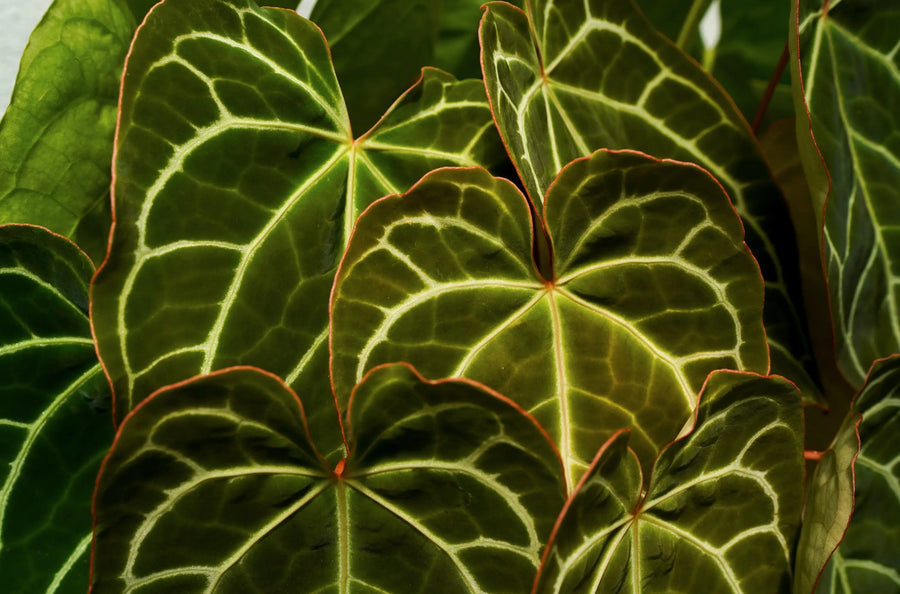
Anthurium plowmanii is a large, broad-leaved Anthurium with a bird’s-nest-style habit and leathery green foliage. It forms a spreading rosette of substantial leaves from a compact centre.
This species is native from Peru to Brazil, Mato Grosso do Sul and Paraguay, where it grows as an epiphyte or lithophyte in seasonally dry tropical biome. Its root zone needs warmth and a chunky substrate that can approach lightly dry at the upper layer between thorough waterings.
The broad leaves of Anthurium plowmanii rise from a compact centre, creating the rounded form often associated with bird’s-nest Anthuriums. The foliage is thick enough to handle brief drying at the upper substrate layer, while the root zone still needs a loose, airy structure that drains well after each watering.
Because the plant carries large leaves on firm petioles, pot stability matters more than tight root confinement. A heavy nursery pot or decorative outer pot can keep the rosette upright, especially as new leaves increase the plant’s spread.
Anthurium plowmanii should be kept away from pets and children. Its tissues contain insoluble calcium oxalate crystals that can cause irritation if chewed or swallowed. Wear gloves if your skin reacts to aroid sap.
Anthurium plowmanii is an accepted Anthurium species described by Thomas B. Croat and published in 1987. It was named for botanist Timothy Plowman. The species combines a broad rosette with epiphytic or lithophytic root behaviour and a seasonally dry tropical range.
Over time, Anthurium plowmanii builds a broad rosette of firm green leaves carried from a compact central crown.
Plant names, growth habits, natural habitats and indoor care guidance are checked against trusted botanical, habitat and horticultural references before publication.View our plant care resources and references.
Sign up for Foliage Factory newsletter for early access to new arrivals and practical care tips that work in real homes.