Light
Very bright / some direct • approx. 20,000–40,000 lux

VAT included · plus
Your new plant has just travelled a long way and needs a calm start in its new home. For step-by-step unboxing and first-week care, check our after-delivery care guide. For deeper tips on how your plant settles in over the next weeks, read our houseplant acclimatization guide.
Secure shipping, carefully packed orders with safe delivery across the EU, UK and Switzerland.
28-day plant guarantee, if a plant arrives damaged or fails soon after delivery, we help you make it right.
Free returns, simple, cost-free returns according to our policy.
For full details, please see:
Please head to our FAQ Page or Contact us.
Quick Care Guide
Light
Very bright / some direct • approx. 20,000–40,000 lux
Watering
Water when ~10–25% dry
Substrate
Moisture-retentive but aerated • Evenly moist • Organic-leaning • Fine-medium
Temperature
Ideal: 18–30 °C • Avoid below: 13 °C
Humidity
Humid 60–80 % +
Growth habit
Upright banana-like herbaceous perennial.
Support
not needed
Growth speed
High
Max size indoors
Max. height: 300 cm • Max. spread: 150 cm
Toxicity & safety
Non-toxic
Origin & habitat
Cultivar of Musa acuminata; species native to tropical and subtropical Asia
Outdoor growing
Outside from 16 °C · sheltered spot
These care values are quick reference points for indoor growing. Use them as a guide, then adjust for pot size, substrate, temperature and how quickly the substrate dries.
For more detail, read the full product description or visit our Plant Care Guides.
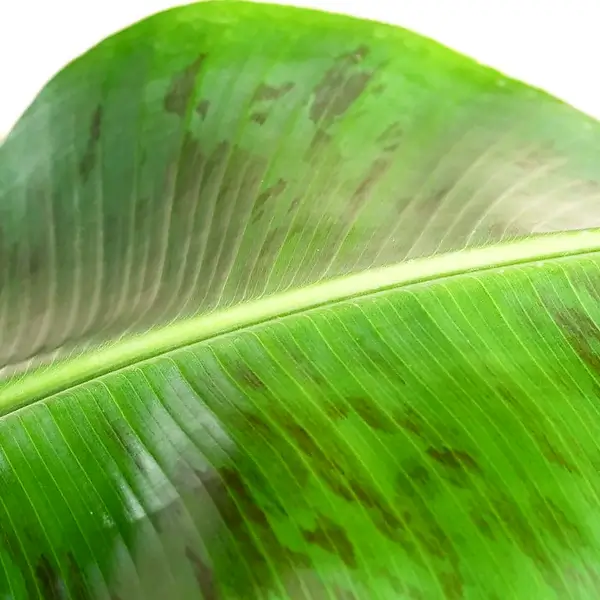
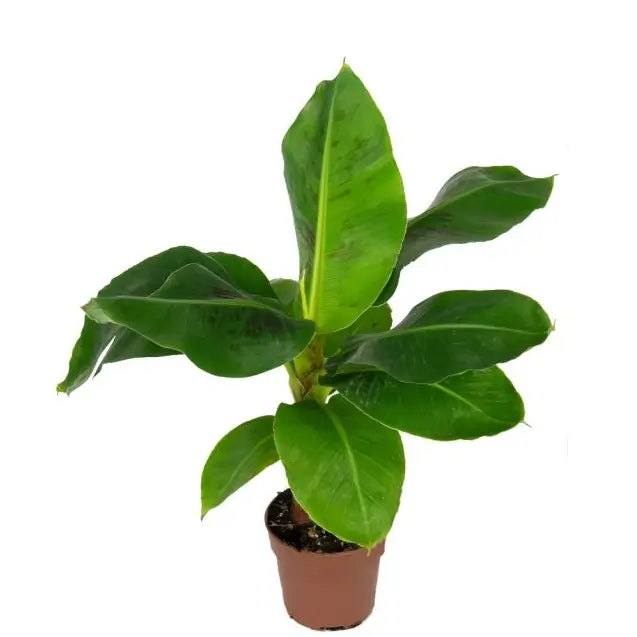
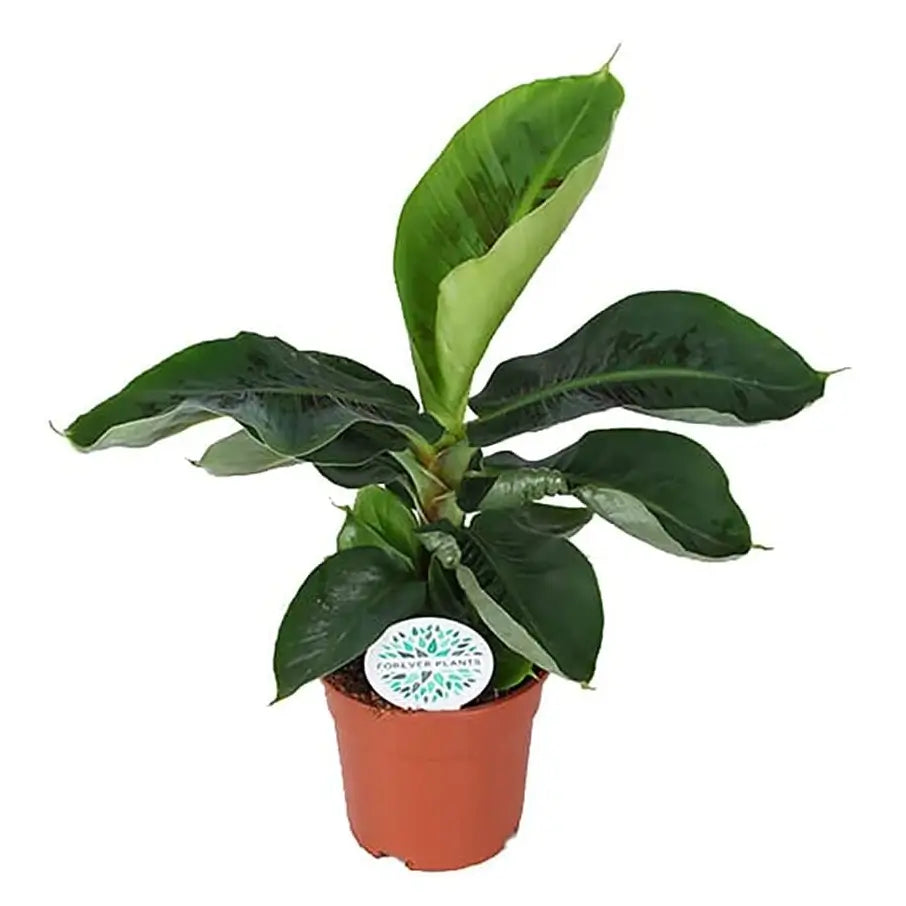
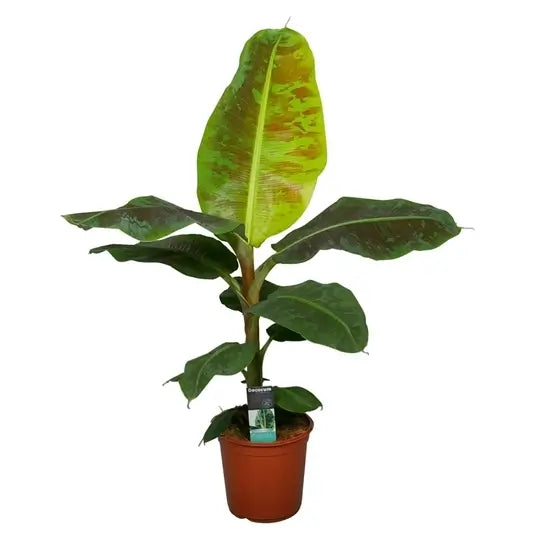
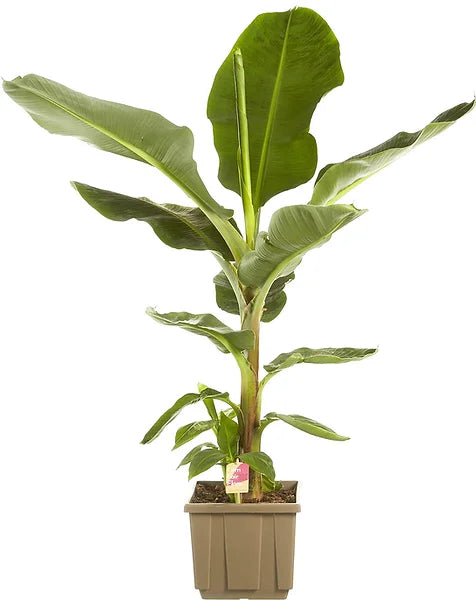
Musa acuminata 'Dwarf Cavendish' is a compact Cavendish banana with broad green leaves, a thick pseudostem, and the potential to flower and produce edible fruit when given enough warmth, light, nutrition, and space. “Dwarf” is relative here. This is smaller than many full-size banana cultivars, but it is still a large, fast-growing herbaceous perennial rather than a small tabletop plant.
The plant forms a pseudostem from overlapping leaf sheaths, while its rhizomatous base can produce pups as it matures. Each new leaf unfurls from the centre and expands into a long, soft blade that can split naturally along the veins. Indoors, Musa acuminata 'Dwarf Cavendish' builds its strongest container growth under bright, warm conditions, with fruiting possible only under strong, sustained cultivation.
Musa acuminata is native to tropical and subtropical Asia and grows primarily in wet tropical conditions. Musa acuminata 'Dwarf Cavendish' belongs to the Cavendish banana group and is listed horticulturally as Musa acuminata 'Dwarf Cavendish' (AAA Group). It is grown as a compact dessert banana for protected cultivation, conservatories, greenhouses, and bright interiors.
In a container, Musa acuminata 'Dwarf Cavendish' uses water and nutrients quickly because its leaves are large and its growth is rapid during warm months. A healthy plant needs a root zone that stays evenly moist but not stagnant. The larger it becomes, the more important pot weight, drainage, and stable placement become, because mature leaves catch air movement and tear easily.
Musa acuminata 'Dwarf Cavendish' can produce flowers and edible fruit, but it needs maturity and sustained warmth. Indoors, fruiting is uncommon unless the plant has a large pot, strong light, generous feeding, and enough time without setbacks. After a pseudostem flowers and fruits, that stem eventually dies back, while the rhizome can continue through pups.
Musa acuminata is considered non-toxic to cats, dogs, and horses. The leaves and stems are fibrous, so chewing large amounts may still cause mild digestive upset. Keep old leaf pieces and trimmed material away from pets that tend to eat plants.
Musa acuminata 'Dwarf Cavendish' belongs to the Musaceae family. Musa acuminata Colla was first published in Memorie della Reale Accademia delle Scienze di Torino 25: 394 in 1820. The species name acuminata means pointed or tapering, while the cultivar name 'Dwarf Cavendish' refers to its smaller Cavendish banana habit. The Cavendish name is associated with William Cavendish, the 6th Duke of Devonshire; at Chatsworth, Joseph Paxton cultivated a banana specimen obtained for the Duke and helped establish the Cavendish banana’s horticultural history.
Plant names, growth habits, natural habitats and indoor care guidance are checked against trusted botanical, habitat and horticultural references before publication.View our plant care resources and references.

Sign up for Foliage Factory newsletter for early access to new arrivals and practical care tips that work in real homes.