Winter Houseplant Care: When Light Slows, Everything Slows
Your home still feels bright. Lamps are on, the thermostat holds steady, and that same sunny window still looks inviting. But for your plants, winter has already changed the rules.
As days shorten and the sun sits lower in the sky, indoor light levels can fall far below their summer strength. What feels bright to you may be much dimmer to a leaf trying to photosynthesise. With fewer photons available, plants use less water, make less sugar, grow more slowly, and move nutrients through their tissues at a calmer pace.
That is why watering habits that worked in August can backfire by December. The same amount of moisture now lingers in the substrate for longer, oxygen levels around the roots drop, and stressed roots become more vulnerable to rot. Leaves may stretch, soften in colour, droop, yellow, or fall. That does not automatically mean your plant is dying. In most cases, it is shifting into a slower winter rhythm.
Start with light, then adjust temperature, humidity, airflow, watering, feeding, semi-hydro setups, pest checks, and cold-season arrivals around that slower winter rhythm.
For detailed indoor light benchmarks and practical ways to measure your space, read Low Light Explained.
Key idea: Winter plant care is not about doing more. It is about matching your routine to slower plant metabolism: less light, slower drying substrate, gentler feeding, steadier temperatures, and better timing.
What looks bright to us in winter can be weak light for houseplants — same window, much lower plant energy.
When winter settles in, houseplants quietly switch gears. Shorter days and weaker sunlight mean less energy reaches their leaves. Photosynthesis slows, sugar production drops, and visible growth follows. Fast summer growth becomes slower, smaller, and more conservative.
That slower pace is not failure. It is how plants match their internal activity to available light. Leaves still absorb light, roots still take up water, and stems still store reserves, but the whole system runs with a smaller energy budget.
Stomata — the tiny pores on leaf surfaces — also behave differently when light is limited. They may stay closed for longer, which reduces water loss but also slows gas exchange and nutrient movement. As transpiration drops, water moves through the plant more slowly. Substrate that dried in a few days during summer may now stay damp for a week or more.
This is where most winter trouble starts. Roots do not only need water; they also need oxygen. When a cool, low-light pot stays wet for too long, the air spaces in the substrate fill with water. Roots slow down, oxygen runs short, and rot organisms get an easier opening.
You may also notice changes above the soil line. Longer internodes, smaller new leaves, softer colour contrast, slower pattern development, or one or two older leaves yellowing can all happen when light drops. Many plants respond to weak light by stretching toward a brighter source or reducing older growth they can no longer support.
Takeaway: Less winter light means slower water use, slower root activity, and a smaller appetite for nutrients. Healthy winter care starts by adjusting your routine to that slower rhythm instead of forcing summer care into darker months.
Light Management — Make Every Photon Count
Light is the first winter variable to fix because it affects almost every other care decision. More usable light means better photosynthesis, stronger roots, quicker drying substrate, steadier leaf growth, and a lower risk of overwatering. Less light means the opposite: slower drying, weaker growth, and a greater need for restraint.
Winter light indoors is often weaker than it looks. A bright room can still be too dim for steady tropical growth, especially once sunlight passes through glass, curtains, shade from neighbouring buildings, or a deep window recess. Before changing watering or fertilizer, look at the light first.
Move Plants Closer to Usable Light
Bring light-hungry tropical plants within 30–50 cm of a bright window where possible, without letting leaves touch cold glass. Even a small move can matter because light intensity drops quickly with distance. A plant sitting 1 m from a window may receive only a fraction of the light available right beside it.
South- and west-facing windows usually give the strongest winter light in much of Europe. East-facing windows can still work well for many aroids, ferns, peperomias, hoyas, and smaller tropicals. North-facing windows often need support from LEDs during the darkest months, especially for plants that are expected to keep growing.
Rotate pots every one to two weeks if growth leans toward the window. This keeps stems more balanced and reduces one-sided stretching. If a plant is already weak, rotate gently rather than constantly changing its position. Stability still matters.
Clean Glass and Leaves
Dust, mineral spots, and dirty glass all reduce light reaching leaf surfaces. In winter, that lost light matters more because the plant is already working with less. Wipe windows and smooth leaves once a month with a soft, damp cloth. Support large leaves from below while cleaning so they do not tear.
For plants with delicate, textured, hairy, or matte leaves, avoid heavy wiping. Use a soft brush or gentle air movement instead. The goal is not to polish leaves until they shine; it is simply to remove the layer of dust that blocks usable light.
Add LEDs the Smart Way
If natural light is weak, a simple daylight-spectrum LED can make winter care much easier. Choose a broad-spectrum white LED in the 4000–6500 K range, place it roughly 25–45 cm above the leaves, and use a timer so foliage plants receive about 12–14 hours of total useful light per day. Adjust distance depending on plant response and lamp strength.
Do not leave grow lights on all night. Plants need a dark period for normal internal rhythms. A regular schedule with 8–10 hours of darkness is better than random light exposure late into the night.
Introduce stronger light gradually. Plants adapted to dim corners can bleach, curl, or stress if moved under strong LEDs overnight. Start with a shorter duration or greater distance, then increase slowly over one to two weeks.
Practical cue: New leaves, compact growth, and substrate that dries at a steady pace usually mean light is supporting active growth. No new growth, long gaps between leaves, or constantly wet soil suggest the plant needs brighter placement, longer LED support, or less water.
Even in winter, tropical plants can keep growing under steady light and warmth. Stability matters more than pushing heat.
Temperature Balance — Steady Beats Warm
Tropical houseplants usually handle normal indoor temperatures well, but they dislike sudden changes. A stable 18–24 °C during the day and nights above 16 °C suits many common tropical plants. Sensitive species, freshly shipped plants, Calathea, Maranta, many Anthurium, and warm-growing aroids often prefer the higher end of that range.
Cold roots are a common winter problem. A room may feel warm at head height while the substrate sits cold on tile, stone, a windowsill, or a draughty floor. Cool, wet roots work slowly and take up less oxygen. That combination makes overwatering damage more likely even if your watering amount has not changed.
Lift pots off cold surfaces with cork mats, wooden stands, plant shelves, or cachepots that create a small insulating air gap. Avoid placing nursery pots directly on stone windowsills during freezing nights. If condensation forms heavily on the glass, leaves should not touch the pane.
Radiators create the opposite problem: hot, dry air that pulls moisture from leaves while the root zone may still be cool. Keep plants away from direct radiator heat, heater vents, fireplace warmth, and strong temperature swings near frequently opened doors.
A small fan can help if air is still, but the airflow should be gentle. The goal is not wind. It is slow air mixing that evens out warm and cool pockets, keeps condensation from sitting on leaves, and discourages mould on damp substrate surfaces.
Cold-night fix: During freezing weather, move plants at least 30 cm from cold windows or close curtains before night temperatures drop. Open curtains again in the morning so plants still receive as much light as possible.
Humidity & Airflow — Moist Air, Not Wet Leaves
Winter heating dries indoor air, and many tropical plants show it quickly. Crispy leaf tips, curled edges, stalled unfurling leaves, and papery new growth often point to low humidity combined with warm, dry airflow.
For many ferns, Calathea, Maranta, and other thin-leaved moisture lovers, aim for around 50–60 % relative humidity. Aroids such as Philodendron, Anthurium, Epipremnum, Monstera, and Syngonium often manage well around 45–55 %, though delicate or newly imported plants may prefer more stable humidity.
A humidifier is the most reliable option because it raises moisture evenly over time. Place it close enough to influence the plant area but not so close that leaves stay wet. Constantly wet leaves in cool winter rooms can encourage fungal spotting, bacterial marks, and damaged tissue.
Plant cabinets, ventilated terrariums, and grouped plants can also create a more stable microclimate. Keep some airflow in any enclosed setup. Stale, saturated air is not the same as healthy humidity.
Occasional misting is not a real humidity strategy. It wets the surface briefly, then evaporates. In cool rooms, repeated wetting can damage sensitive leaves, especially on velvety plants, tightly packed growth, or plants already sitting in low light.
Reading the symptom: If leaf tips brown while the rest of the leaf stays firm and green, humidity, dry airflow, or salt buildup is more likely than a sudden watering crisis. If leaves turn yellow and the pot stays heavy, look at water and light first.
Watering — Slow Down Without Letting Roots Collapse
Watering causes many winter problems because plant water use slows while familiar routines stay the same.
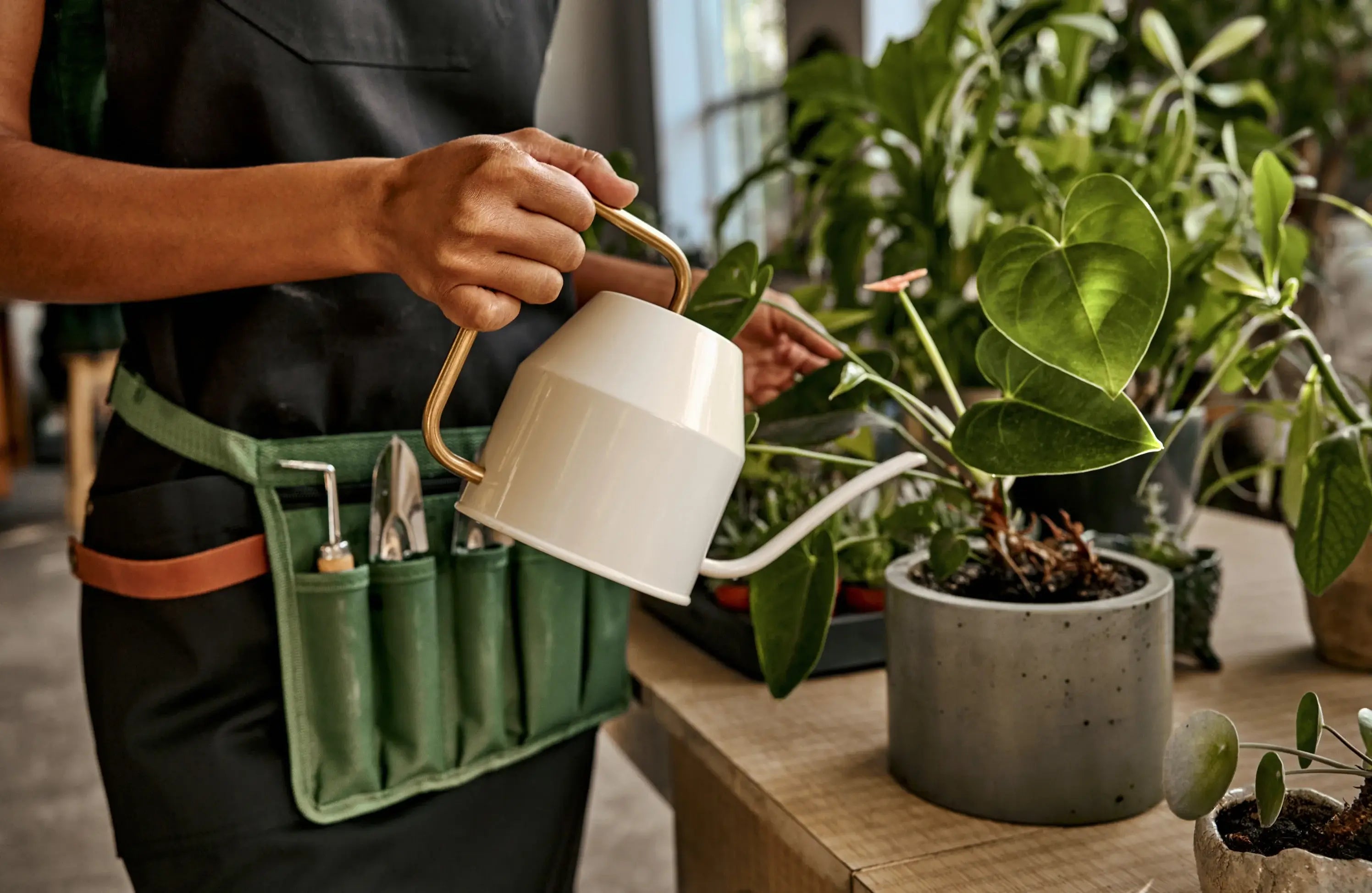
Under weaker light, leaves transpire less and roots absorb less. Substrate can look dry on top while the middle and lower root zone remain damp. A fixed weekly schedule misses that difference. In winter, the plant decides the timing, not the calendar.
Use pot weight as your first check. Lift the pot after watering, then again a few days later. Over time, you’ll feel the difference between heavy, damp substrate and a pot that is ready for water. A simple wooden skewer, moisture probe, or clear nursery pot can also help you check deeper than the surface.
Water when the root zone is approaching dryness for that plant type, not when the top layer alone looks pale. Many tropical plants should not be left bone dry for long, but they also should not sit wet in low light. For aroids, hoyas, peperomias, and many mixed-substrate houseplants, wait until the pot feels noticeably lighter and the upper portion of the mix has dried. For ferns and thin-leaved moisture lovers, keep moisture more even but still airy.
When you water, water thoroughly. Let moisture move through the whole root ball until about 10–20 % drains out, then empty the saucer or cachepot. This prevents dry pockets while also removing excess water from the bottom. Small sips can leave roots unevenly hydrated and encourage salt buildup near the surface.
Use room-temperature water around 20–22 °C. Cold water can chill the root zone, especially in small pots or on cold windowsills. It does not need to be warm; it just should not feel cold to the touch.
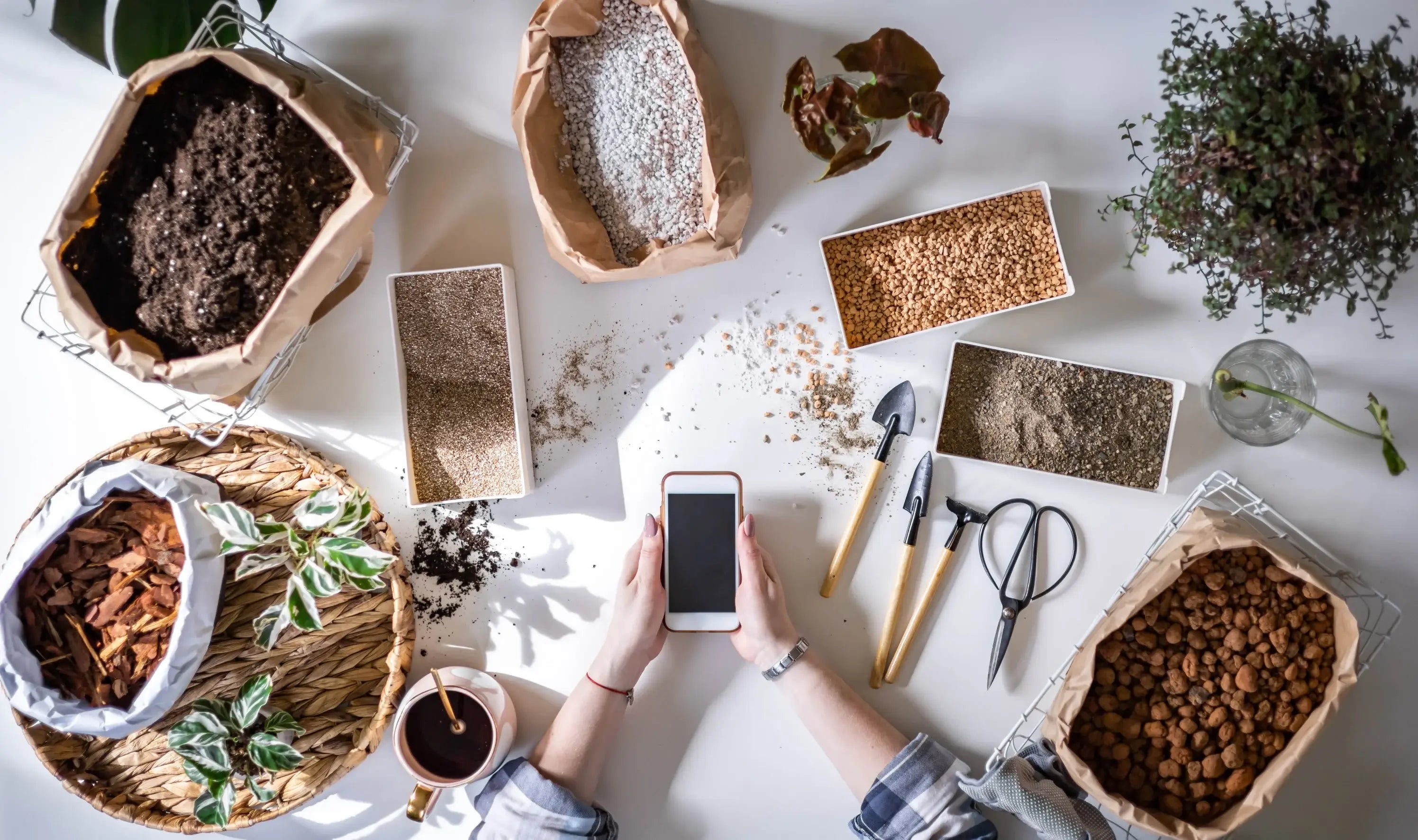
Substrate structure matters more in winter. A dense, fine, peat-heavy mix can stay wet too long. A slightly airier mix with bark, pumice, perlite, lava rock, coco chips, or other mineral and chunky components helps oxygen stay available around roots. Do not repot a stable plant just because winter arrived, but keep substrate structure in mind when you repot later.
If you run LEDs for 12–14 hours a day, plants may remain more active. Extra light can increase transpiration, keep growth moving, and dry substrate faster. In that case, check moisture more often and water normally when the pot is ready. LED-grown plants should not automatically be treated like resting plants.
Winter watering rule: Slow down, but do not abandon the plant. Roots need oxygen, steady moisture, and timing that matches light levels.
In winter, indoor DLI can fall low enough that photosynthesis, water use, and growth all slow sharply.
Feeding — Only If Growth Continues
Fertilizer only helps when plants are actively using nutrients. In low winter light, many houseplants are not building much new tissue, so extra fertilizer stays in the substrate. That can raise salt levels, damage fine root tips, and make water movement harder.
If plants rely only on natural winter light and growth has paused, skip fertilizer until stronger growth returns. This is especially important for plants in dense substrate, cool rooms, or pots that dry slowly.
If plants are clearly growing under strong LED support, light feeding can continue. Use a balanced fertilizer at half strength every 4–6 weeks while new leaves and roots are actively forming. Keep the dose mild rather than trying to push growth through winter.
Semi-hydro and mineral-substrate setups need extra attention because nutrients are always present in the reservoir. Keep total concentration gentle, flush periodically with plain water, and watch leaf tips for salt stress. If you measure EC, winter values should stay conservative; many indoor tropicals do better with mild, steady feeding than strong spikes.
Once a month, flush soil-based pots with plain water if you fertilize regularly and the plant is actively growing. Let excess water drain fully and never leave the pot standing in runoff.
Key line: Fertilizer does not fix low light. It supports growth that light already makes possible.
Semi-hydro and hydroponic setups can be very stable in winter, but they react strongly to cold. Water holds less root-friendly activity when it is cold and stagnant, and roots slow down when reservoir temperature drops. The result can look like overwatering even when the system is technically “correct.”
Keep reservoirs around 18–22 °C where possible. Avoid placing vessels on cold windowsills, stone floors, or directly against cold glass. If the room drops at night, raise containers onto an insulating surface.
Lower fertilizer strength by about 20 % compared with active summer growth unless plants are under strong LEDs and still producing new leaves. Nutrient uptake slows in cooler, dimmer conditions, so a summer-strength reservoir can become too concentrated.
Oxygen matters as much as nutrients. Use an air stone in full hydro systems, refresh the solution regularly, or keep a lower fill line in passive semi-hydro so part of the root system has access to air. Roots sitting constantly in cool, still solution are much more vulnerable than roots in warm, oxygenated water.
If you use LEDs for long photoperiods, expect more evaporation and slightly faster nutrient turnover. Top up with plain water between full changes if the solution level drops quickly, and clean or shade clear containers if algae builds up.
Useful distinction: Warm, oxygen-rich water keeps roots functional. Cold, stagnant water slows them down and makes rot more likely.
Cold window glass, condensation, and wet substrate are a risky winter combination. Keep leaves off the pane and roots away from cold surfaces.
Species Notes — What Is Normal in Winter?
Different plant groups respond to winter in different ways. The examples below describe common behaviour under natural indoor light without supplemental LEDs. If you use grow lights for 12–14 hours per day, many of these plants may stay more active, hold colour better, and dry their substrate faster.
Plant Group
Typical Winter Behaviour
What It Means / How to Care
Alocasia and other storage-heavy aroids
Growth may slow sharply. Older leaves can yellow, collapse, or be shed while the crown or storage organ remains firm.
Many Alocasia rely on stored water and nutrients in thickened stems, rhizomes, corm-like structures, or petioles. Keep warm, bright, and lightly moist, not wet. Do not keep feeding a plant that has paused. Avoid cutting firm living stems too early because they may still hold reserves.
Philodendron, Monstera, Epipremnum, Syngonium
New leaves may come slower, smaller, or farther apart. Vining and climbing growth can stretch toward light.
These aroids usually do not need a dry “dormancy.” They need brighter placement, stable warmth, and a substrate that dries more slowly but still breathes. Keep supports in place, reduce watering frequency, and feed only if new growth continues.
Anthurium
Leaf production slows; flowers may pause; velvety species can show edge stress in dry air.
Keep roots airy and evenly moist, with stable warmth and moderate humidity. Anthurium dislike cold, wet substrate. Avoid heavy feeding in low light, but do not let fine roots dry hard for long periods.
Calathea, Goeppertia, Maranta, Ctenanthe
Leaf movement continues, but patterns may look softer, edges may crisp, and new leaves may unfurl more slowly.
These plants need warm, stable, humid air and gentle light. Keep humidity around 50–60 %, avoid cold draughts, and do not let leaves stay wet. If edges brown while the pot is not dry, look at humidity, airflow, water quality, and salts.
Ferns
Growth slows; fronds may brown at the tips; delicate species can thin out in dry rooms.
Keep moisture more even than for aroids, but avoid stagnant wetness. Fern roots are often fine and shallow, so they dislike both full drought and sour, airless substrate. Humidity and gentle airflow are more useful than frequent misting.
Ficus, including Ficus elastica, Ficus lyrata, and Ficus benjamina
Leaf drop can follow a change in light, temperature, or placement. Growth may pause until conditions stabilise.
Ficus are sensitive to sudden shifts. Keep them above 16 °C, close to bright light, and away from draughts. Do not compensate for leaf drop with extra water. Check the root zone first and keep care steady.
Hoya, Dischidia, Peperomia
Growth slows; leaves usually stay firm; flowering may pause.
These semi-succulent tropicals conserve water well. Let the upper part of the mix dry before watering again, keep bright light, and avoid cold wet roots. Under LEDs, many Hoya can continue slow, steady growth.
Arid succulents and cacti, including Aloe, Haworthia, Echeveria, and many cacti
Growth may almost stop. Leaves can shrink slightly, colour may intensify, and water use drops strongly.
Give the brightest position available, ideally a very sunny window or LED support. Let substrate dry fully between sparse waterings. Avoid feeding until active growth resumes. Cool plus wet is the main risk.
Palms grown indoors
New spear growth slows; older fronds may brown at tips in dry air or after cold stress.
Keep palms in the brightest suitable position, away from radiators and cold glass. Maintain steady moisture without waterlogging. Spider mites can become an issue in dry, stagnant rooms, so inspect fronds regularly.
Reading Winter Signs Correctly
A plant that stops growing but keeps firm stems, firm roots, and stable leaves is resting or slowing down, not dying. Adjust care only when you see real stress: soft stems, blackened tissue, sour-smelling substrate, severe wilting in wet soil, active pests, or roots that collapse when touched.
When days lengthen again, increase watering gradually. Do not switch back to summer care in one week. Wait for new leaves, stronger root activity, quicker drying substrate, and brighter light.
Troubleshooter — Fast Fix Table
Most winter plant problems trace back to one of four things: weak light, cold roots, dry air, or substrate staying wet for too long. Use the table as a first filter before changing everything at once.
Problem
Likely Cause
What to Do First
Yellowing lower leaves
Low light plus substrate staying wet too long
Move closer to brighter light, let the pot dry deeper, and check roots if yellowing spreads quickly
Brown leaf tips
Low humidity, dry heater air, salt buildup, or irregular watering
Raise humidity, improve gentle airflow, flush substrate if fertilized, and check watering consistency
Long gaps between leaves or leggy stems
Low-light stretch response
Move closer to the window, add LED support, or reduce distance between plant and grow light
Sudden leaf drop on Ficus
Change in light, draught, cold shock, or relocation stress
Keep placement stable, avoid cold air, check pot moisture, and do not overwater to “replace” lost leaves
Black, mushy, or translucent leaves
Cold damage, root chill, or wet tissue in low temperatures
Warm the root zone, move away from cold glass, remove collapsed tissue, and reduce watering frequency
Wilting while soil is wet
Oxygen-starved roots or early root rot
Stop watering, increase warmth and airflow, check roots, and repot only if rot is present
Fine webbing or speckled leaves
Spider mites favoured by dry, stagnant air
Inspect undersides, rinse leaves where safe, isolate the plant, increase humidity, and treat promptly
Sticky leaves or small brown bumps
Scale insects or honeydew from sap-feeding pests
Isolate, wipe affected stems and leaves, inspect joints and undersides, and repeat treatment cycles
White mould on substrate surface
Cool, damp, still surface layer
Improve airflow, remove the mouldy top layer, water less often, and check that the pot is not staying wet
New leaves stuck or tearing
Low humidity, inconsistent moisture, or weak root uptake
Best first move: Adjust one variable at a time. Start with light and root-zone moisture, then humidity and airflow. Changing pot, fertilizer, location, and watering all at once makes the plant harder to read.
Logistics & Cold-Season Plant Delivery
Cold shipping and sudden temperature changes can shock even strong plants. Damage is not always visible at the moment of unboxing. Chilled tissue can darken, soften, or collapse over the next several days, especially on thin leaves, new growth, and tender stems.
Unbox immediately after arrival. Bring plants into a warm room around 20–22 °C and remove all packaging carefully.
Remove heat packs right away. They are useful during transit, but direct contact after arrival can overheat or mark leaves.
Let plants stabilise before watering. Wait around 48 hours unless the substrate is extremely dry and the plant is clearly dehydrated.
Do not repot cold, limp, or stressed plants. Repotting adds root disturbance when the plant needs warmth, light, and stability first.
Keep new arrivals bright but protected. Avoid direct radiator heat, cold glass, and strong midday sun immediately after unboxing.
Monitor for delayed symptoms. Cold stress can show as translucent patches, blackened leaf edges, soft petioles, or sudden leaf collapse days later.
The best winter routine depends on whether your plants rely on natural daylight only or receive strong LED support.
Natural Winter Light Only
Care Area
Best Adjustment
Why It Helps
Light
Move plants close to the brightest safe window
Supports photosynthesis without forcing growth
Water
Check pot weight and deeper substrate moisture before watering
Prevents wet roots in low light
Temperature
Keep 18–24 °C by day and above 16 °C at night
Reduces cold-root stress and sudden leaf drop
Humidity
Hold around 45–60 % depending on plant type
Limits crispy edges, stuck leaves, and pest pressure
Feeding
Pause fertilizer unless growth is visible
Avoids salt buildup and burned resting roots
With LED Support
Care Area
Best Adjustment
Why It Helps
Light
Use broad-spectrum LEDs so plants receive around 12–14 h of total useful light, with a true night period
Keeps metabolism steadier through short days
Water
Check more often because substrate may dry faster
Active roots use more water than resting roots
Temperature
Keep roots warm, especially near windows and floors
Light helps most when roots can function too
Humidity
Maintain stable humidity with gentle airflow
Supports new leaves without encouraging fungal issues
Feeding
Feed lightly only during visible growth
Matches nutrients to real plant demand
Weekly Winter Check
Lift each pot before watering; heavy pots usually need more time.
Check leaf undersides for spider mites, thrips, scale, or sticky residue.
Look at the newest growth for stretching, pale colour, stuck leaves, or deformities.
Empty saucers and cachepots after every watering.
Wipe dusty leaves when safe for the plant texture.
Move plants away from cold glass before freezing nights.
Check humidity near plants, not across the room.
Winter Houseplant FAQ
How often should I water houseplants in winter?
Most houseplants need less frequent watering in winter because light is weaker and water use slows. Do not follow a fixed weekly schedule. Check pot weight, deeper substrate moisture, and plant type first. If plants grow under strong LEDs for 12–14 hours a day, they may dry faster and need watering more often than plants relying on natural winter light only. For a full watering method, read The Ultimate Guide to Watering Houseplants.
Should houseplants dry out completely in winter?
Not all of them. Cacti, many succulents, and some semi-succulent plants can dry more deeply between waterings. Ferns, Calathea, Maranta, Anthurium, and many fine-rooted tropicals should not be left bone dry for long. The safer winter goal is airy, well-timed moisture, not constant wetness or extreme drought.
Do houseplants need fertilizer during winter?
Only if they are actively growing. Under low natural winter light, fertilizer often builds up faster than plants can use it. If you use strong LED lighting and see new leaves or roots, feed lightly at half strength every 4–6 weeks. If growth has paused, wait. Fertilizer supports growth; it does not replace light. For nutrient guidance, read The Ultimate Guide to Fertilizing Houseplants.
Can I repot houseplants in winter?
Avoid routine repotting in winter. Plants recover better when light and warmth are stronger. Repot only if the plant has root rot, severe compaction, pests in the substrate, or a potting issue that cannot wait. If a plant arrived cold, limp, or stressed, let it stabilise before disturbing roots. Full instructions are in Repotting Houseplants — A Complete Guide.
How can I increase humidity for tropical plants in winter?
A humidifier gives the most stable result. Plant cabinets, ventilated terrariums, and careful grouping can also help if airflow stays gentle and consistent. Avoid relying on occasional misting. It wets leaves briefly but does not create lasting humidity. For setup ideas, see Mastering Humidity for Healthier Houseplants and To Mist or Not to Mist.
What temperature is best for indoor plants in winter?
Most tropical houseplants do well around 18–24 °C, with nights above 16 °C. Sensitive tropicals often prefer warmer, steadier conditions. Avoid cold windows, cold floors, radiator heat, and draughts. Stable temperatures are more important than pushing plants into constant warmth.
Why are leaves yellowing or falling in winter?
Yellowing and leaf drop often come from low light, sudden temperature changes, or wet substrate around slow roots. Ficus can shed leaves after a shift in light or placement. Aroids may drop older leaves when growth slows. Check light, root moisture, and temperature before adding fertilizer or watering more. For deeper diagnosis, read Why Is My Plant Losing Leaves?.
Is low light harming my plants?
Low light slows growth and water use. It can also cause stretching, smaller leaves, slow unfurling, and weaker colour contrast. Move plants closer to a bright window, clean leaves and glass, or use broad-spectrum LEDs for 12–14 hours daily. Measurable indoor light ranges are explained in Low Light Explained — Myths & Real Light Levels.
What pests are common on houseplants in winter?
Spider mites, thrips, scale, and mealybugs can all become more noticeable indoors during winter. Dry, stagnant air especially favours spider mites. Inspect leaf undersides, petiole joints, new growth, and stems every week. For treatment guides, see Spider Mites on Houseplants and Thrips on Houseplants.
How should I clean leaves in winter?
Wipe smooth leaves with a soft, damp cloth once a month and clean nearby window glass too. Use a soft brush for delicate or textured leaves. Avoid leaf-shine products. The goal is simply to remove dust so the plant receives more usable light. For more on indoor light, read The Fascinating World of Plant Lights.
When will houseplants start growing again after winter?
Many houseplants resume stronger growth as days lengthen and indoor light improves, often from March onward in much of Europe. Increase watering gradually as substrate dries faster and new leaves appear. Do not jump straight into heavy feeding. For the seasonal transition, read Spring Reset — Reboot Your Indoor Jungle After Winter.
Do grow lights mean I can care for plants like it is summer?
Not completely. LEDs can keep growth steadier, but room temperature, humidity, root warmth, pot size, substrate structure, and airflow still matter. Plants under strong LEDs may need more water and light feeding, but they still need a dark period, stable warmth, and careful monitoring.
Conclusion — Winter Isn’t the Enemy
Winter does not kill houseplants by itself. Problems usually start when summer habits continue under winter light. Plants receive less energy, roots work more slowly, substrate dries later, and nutrients move at a quieter pace. Care needs to slow down with them.
Start with light. Move plants closer to safe brightness, clean leaves and windows, and add LEDs where natural light is not enough. Keep temperatures steady rather than simply warmer. Protect roots from cold surfaces, keep humidity comfortable, and use gentle airflow to prevent stagnant dampness.
Water by root-zone moisture, not by habit. Feed only when growth is actually happening. Watch for pests before they spread. Let newly delivered plants recover from cold-season transport before watering heavily or repotting.
A few dropped leaves, slower growth, or softer colour in January is not failure. It is often just seasonal adjustment. When brighter days return, plants with healthy roots, stable stems, and clean leaves are ready to grow again.
Final takeaway: Winter care is not about doing more. It is about doing less, more accurately — more light where possible, less water by default, steadier warmth, cleaner leaves, and patience until growth returns.
Next Steps
For exact brightness ranges and indoor placement tips, read Low Light Explained.
Sugano, S., Ishii, M., & Tanabe, S. (2024). Adaptation of indoor ornamental plants to various lighting levels in growth chambers simulating workplace environments.Scientific Reports, 14, 17424. https://doi.org/10.1038/s41598-024-67877-y
Ghorbel, M., Brini, F., Brestic, M., & Landi, M. (2023). Interplay between low light and hormone-mediated signaling pathways in shade-avoidance regulation in plants.Plant Stress, 9, 100178. https://doi.org/10.1016/j.stress.2023.100178
Chaves, M. M., Pereira, J. S., Maroco, J., Rodrigues, M. L., Ricardo, C. P. P., Osório, M. L., Carvalho, I., Faria, T., & Pinheiro, C. (2002). How Plants Cope with Water Stress in the Field. Photosynthesis and Growth.Annals of Botany, 89(7), 907–916. https://doi.org/10.1093/aob/mcf105
Chaves, M. M., Maroco, J. P., & Pereira, J. S. (2003). Understanding plant responses to drought — from genes to the whole plant.Functional Plant Biology, 30(3), 239–264. https://doi.org/10.1071/FP02076
Aroca, R., Porcel, R., & Ruiz-Lozano, J. M. (2012). Regulation of root water uptake under abiotic stress conditions.Journal of Experimental Botany, 63(1), 43–57. https://doi.org/10.1093/jxb/err266
Li, Y., Hoch, G., & Körner, C. (2024). The sensitivity of root water uptake to cold root temperature follows species-specific upper elevational distribution limits of temperate tree species.Plant, Cell & Environment, 47(7), 2567–2579. https://doi.org/10.1111/pce.14874
Nievola, C. C., Carvalho, C. P., Carvalho, V., & Rodrigues, E. (2017). Rapid responses of plants to temperature changes.Temperature, 4(4), 371–405. https://doi.org/10.1080/23328940.2017.1377812
Morard, P., & Silvestre, J. (1996). Plant injury due to oxygen deficiency in the root environment of soilless culture: A review.Plant and Soil, 184, 243–254. https://doi.org/10.1007/BF00010453
Daniel, K., Sauter, M., & Wankmüller, F. J. P. (2024). How plant roots respond to waterlogging.Journal of Experimental Botany, 75(2), 511–525. https://doi.org/10.1093/jxb/erad319
Folta, K. M., & Childers, K. S. (2008). Light as a Growth Regulator: Controlling Plant Biology with Narrow-bandwidth Solid-state Lighting Systems.HortScience, 43(7), 1957–1964. https://doi.org/10.21273/HORTSCI.43.7.1957
Paradiso, R., & Proietti, S. (2022). Light-Quality Manipulation to Control Plant Growth and Photomorphogenesis in Greenhouse Horticulture: The State of the Art and the Opportunities of Modern LED Systems.Journal of Plant Growth Regulation, 41, 742–780. https://doi.org/10.1007/s00344-021-10337-y
Zheng, L., He, H., & Song, W. (2019). Application of Light-emitting Diodes and the Effect of Light Quality on Horticultural Crops: A Review.HortScience, 54(10), 1656–1661. https://doi.org/10.21273/HORTSCI14109-19
Nelson, J. A., & Bugbee, B. (2014). Economic Analysis of Greenhouse Lighting: Light Emitting Diodes vs. High Intensity Discharge Fixtures.PLOS ONE, 9(6), e99010. https://doi.org/10.1371/journal.pone.0099010
Poorter, H., Bühler, J., van Dusschoten, D., Climent, J., & Postma, J. A. (2012). Pot size matters: a meta-analysis of the effects of rooting volume on plant growth.Functional Plant Biology, 39(11), 839–850. https://doi.org/10.1071/FP12049
Substrates are the hidden factor behind strong roots and predictable indoor growth. This guide breaks down organic vs. inorganic components, compares drainage and moisture traits, and shares DIY re...
I received perfectly heathy and absolutely beautiful plants, even bigger than expected. The delivery within Europe was really fast. I think Foliage Factory has one of the best plant web shops in the internet. It‘s just great to get so much informations about the plants. I will definitely order again :)
Walkerova
★★★★★
Die Pflanzen waren prima verpackt und ein heatpack war im Paket enthalten. Die Lieferzeit hat 2 bis 3 Tagen gedauert, was aus meiner Sicht wirklich gut ist. Alle drei Pflanzen haben die Lieferung gut überstanden. Ich habe mich auf Hoyas spezialisiert und habe schon die nächsten Pflanzen meiner Wunschliste auf der Website gefunden. Daher wird die nächste Bestellung nicht lange auf sich warten lassen.
Marion
★★★★★
Envoie très rapide (2 jours), plantes parfaitement emballées et super offres ! Je suis une habituelle j'ai passé 6 ou 7 commandes et je n'en peut être plus satisfaite du service client et de la qualité et variété des plantes offertes
Iris
★★★★☆
Die Sendung kam leider in keinem guten Zustand bei mir an, kann passieren. Habe mich darauf hin sofort an Foliage Factory gewandt und habe selten einen so guten, schnellen, freundlichen und kulanten Kundendienst erlebt.
Frauke
★★★★★
The plants have arrived in perfect condition, the roots and the foliage so so healthy! I had problem with 1 plant out of 16 and they have responded to my email almost instantly and the issue was resolved straight away. I'm really impressed and satisfied, definitely getting more plants from them again!
Patricija
★★★★☆
Very healthy and well packed plant. Unfortunately there was one plant that ordered couldn’t be delivered as it was out of stock hence 1 star less.
Sam
★★★★★
Everything arrived in good condition and very well packed - it wasn't easy with a fragile plant and a heavy bag of substrate. I recommend it!
Lia
★★★★★
Bester online-Pflanzenhandel den ich kenne (habe davor 4 andere ausprobiert). Eine teure Pflanze wurde beim Transport beschädigt und mir ersetzt. Der Kontakt dabei war auch sehr nett (danke Jan) und hat mir gut geholfen. Die anderen Pflanzen sind in einem sehr guten Zustand, keine Schädlinge, super Bewurzelung. Nur zu empfehlen! :)
C L
★★★★★
Super Service, Gute Auswahl, Preise sind fair. Eine Pflanze kam kaputt an, hab sofort Ersatz bekommen. Danke an den unkomplizierten (und blitzschnellen) Kundenservice!!
Sarah
★★★★★
The plants are carefully packaged and arrive in great conditions (I’m based in Spain) and they’re always there to help in any way they can with your purchase.I have and will always recommend Foliage Factory to every friend I can. I’m not only satisfied with their plants and prices, but their customer service is exceptional.





Leave a comment
This site is protected by hCaptcha and the hCaptcha Privacy Policy and Terms of Service apply.