

To mist or not to mist: what the water does and when it helps
Misting can help with particular jobs, including cleaning foliage and supplying extra water to some air plants. It is an unreliable way to keep a whole room at a chosen humidity. Before making it a daily habit, decide what you expect the water to do. [1, 2, 3]
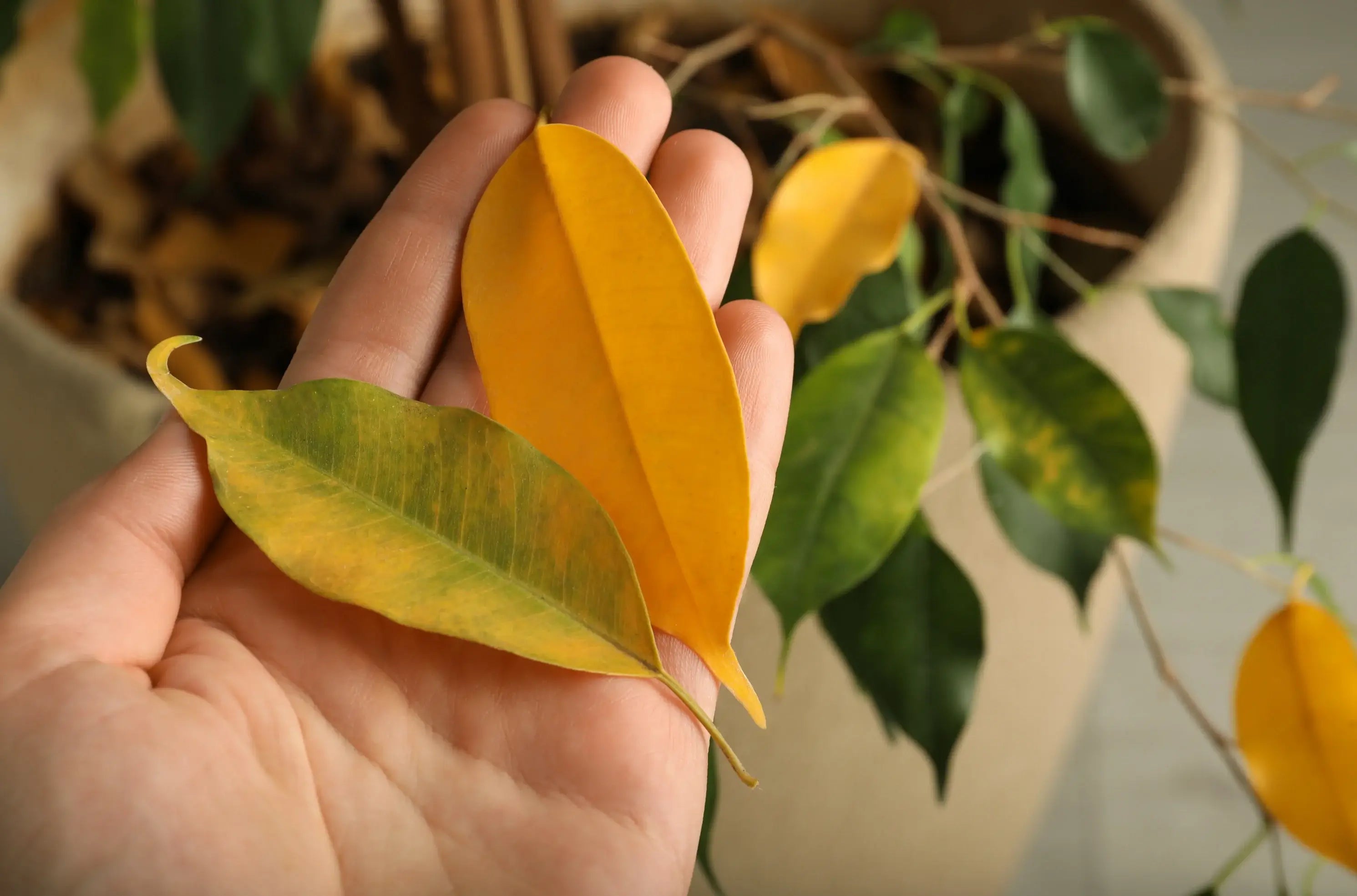
Brown leaf tips, dusty foliage and an air plant needing water may all prompt you to reach for the same bottle. They need different responses. This guide will help you separate the humidity question from watering and leaf care, understand when spraying is useful, and choose a method that addresses the problem you actually have. [2, 3, 4, 5]
Will misting help with dry indoor air?
A spray adds humidity as its droplets evaporate. Until then, the water you can see is liquid sitting on the plant. Some may run off or enter the leaves; the portion that evaporates becomes water vapour in the surrounding air. Wet foliage therefore tells you where the spray landed, but very little about the humidity across the room. [6, 7, 8]
That distinction explains why a spray bottle is difficult to use for room-humidity control. Water vapour spreads beyond the sprayed leaves, and the room exchanges moisture with incoming air and nearby surfaces. Ventilation removes moisture when more vapour leaves than enters. Once the droplets have evaporated, their vapour remains until something removes it; the disappearance of visible water does not itself end the humidity change. Maintaining an increase means replacing the moisture the room loses. [1, 6]

Dry air matters because leaves lose water through transpiration. Tiny adjustable pores called stomata regulate much of that loss and can respond to changing conditions within minutes. At a given temperature, drier air increases the demand for water to evaporate from a leaf, although stomata can narrow and limit the loss. The leaf's own temperature and the air immediately beside it matter too. Measuring near the plant gives you a useful starting point for understanding those conditions. [10, 11, 9]
Measure before changing the humidity
Use a hygrometer that also shows temperature. Its relative-humidity reading, or RH, tells you how close the air is to saturation at that temperature. If the room warms without gaining or losing water vapour, RH falls. A lower reading after the heating comes on can therefore reflect warmer air as well as a change in moisture. [6, 9]
Take readings near the plant, with the sensor out of the spray. Allow the instrument to settle after moving it, following its instructions. Repeat the measurement at different times as heating and ventilation change; a device that saves readings can do this for you. Check its stated accuracy before interpreting small differences—a few percentage points may be within its margin of error. [9]
Compare those readings with guidance for the actual plant and growing method. Also consider where you are growing it. The American Orchid Society gives a 50–80% RH range in its Phalaenopsis cultivation guide. For humidifiers used in homes, the US Environmental Protection Agency advises keeping indoor RH at or below 50%. These recommendations address different settings. A cultivation range should not automatically become a humidifier setting throughout an occupied home. [12, 13]

Choosing a way to raise humidity
If the room needs additional moisture, a humidifier provides a controllable source that you can check with the hygrometer. Evaporative models pass air over wet material; ultrasonic and impeller models release fine droplets. The latter can also disperse minerals and microorganisms from the tank, so use low-mineral water and follow the manufacturer's cleaning instructions. For portable units, the EPA advises unplugging the device before emptying, drying and refilling its tank daily. [13]
Watch the room as well as the display. Condensation on windows or walls, or dampness around the device, is a reason to turn it down or use it less. Excess moisture can support mould on furnishings and building surfaces. A setting that keeps the leaves in humid air can still be excessive for the room. [13, 14]
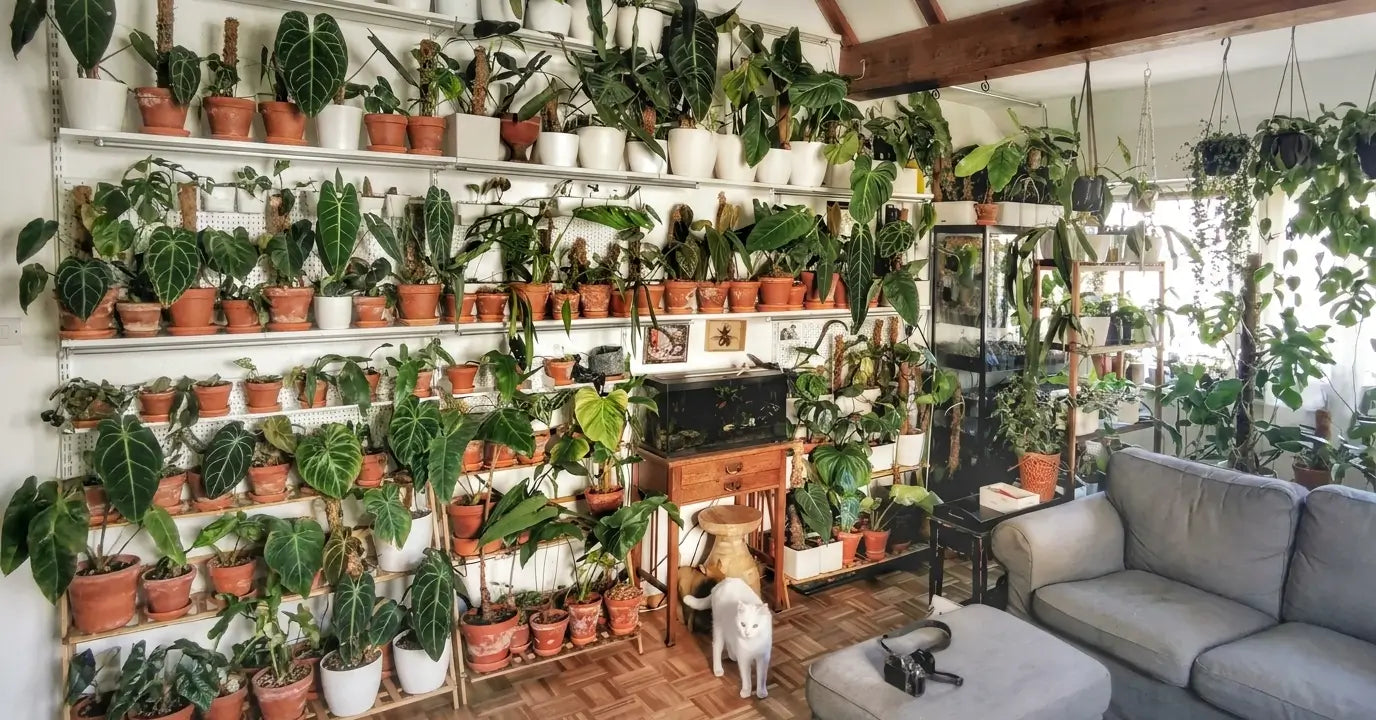
Plants themselves are another source of moisture: water leaves their foliage through transpiration and also evaporates from exposed potting mix. Experiments have measured humidity increases after plants were added to indoor spaces, with results varying between settings. Those experiments do not isolate the effect of moving an unchanged collection closer together. Measure around the foliage before and after regrouping your pots to see what changes where they grow. [7, 15, 16, 1]
A pebble tray also releases vapour as its water evaporates. Its usefulness for humidity depends on the change where the plant grows, so judge it with the hygrometer. Neither a wet tray nor a row of wet leaves tells you how long a chosen RH will last. [6, 7, 9]
The amount of air helps put these methods in perspective. In an ideal 30 m³ room at 22 °C, an increase of ten percentage points in RH takes about 58 g of extra water vapour—the equivalent of roughly 60 mL of liquid water. That assumes complete evaporation, even mixing, unchanged temperature and volume, a final RH below saturation, and no moisture loss to ventilation or surfaces. It is a scale illustration, not an amount to spray onto the plants. An actual room keeps gaining and losing moisture while you humidify it. [17, 18, 1]
A higher RH reading tells you that the air has changed. Whether the plant grows better is a separate question. In a three-month humidity experiment with anthurium, pothos and philodendron, all three gained more total fresh weight and had greater aerial-root fresh weight at very high RH. Fresh weight includes water. Final dry weight—the material remaining after drying—did not differ significantly between the treatments, despite the difference in fresh weight. There was only one chamber at each humidity, so other chamber differences could also have contributed. The plants grew under sustained humidity; the trial did not test daily hand-misting. [19]
For a humidity concern, use the readings to judge whether your method maintains suitable conditions for the plant and the room. A spray can have a separate purpose on the foliage even when room humidity needs no change. Cleaning the leaves is a good example: the aim is to remove what is on the surface. [1, 9, 13, 3]
Using water to clean leaves and remove pests
On large, smooth leaves, wipe dust away with a soft damp cloth or lightly dampened microfibre leaf-cleaning gloves. Foliage suited to rinsing can be washed with lukewarm water at a pressure that avoids damage. For small-leaved houseplants, the New York Botanical Garden also describes occasional misting as a cleaning option. Choose a method that reaches the dust without damaging the leaf surface. [20, 3]
Water temperature deserves particular care with African violets. Rapid cooling injured Saintpaulia ‘Iceberg’ leaves in one experiment; gradual cooling did not produce the same persistent damage. The rate of cooling mattered, which supports paying attention to sudden temperature changes alongside the general advice to rinse suitable foliage with lukewarm water. [21, 20]
Rinsing off spider mites and aphids
Pest removal needs more than a light coating of droplets. First check what is on the plant. Mottling together with fine webbing and mites on leaf undersides can point to spider mites; mottling alone cannot identify them. Look closely underneath the leaves, where eggs also occur, and separate a confirmed or strongly suspected infestation from the rest of the collection. [22, 23]
On foliage that can tolerate it, a strong, directed stream of water can dislodge some spider mites. Reach both the upper and lower leaf surfaces. Keep checking for mites and eggs afterwards: rinsing provides partial control, and an initial reduction does not mean the infestation is resolved. The gentle rinse used for dusting and the stronger stream used for mites serve different purposes. [24, 25, 22]
Exposed aphids can also be dislodged with water. Keep the affected plant separate and check again after rinsing. Access matters: mealybugs can hide where leaves join stems or where leaf bases wrap around them. The RHS guide to indoor sap-feeding pests can help distinguish the insects and their hiding places before you choose a treatment. [23, 25]
For growers using biological control, water application can affect beneficial organisms too. A greenhouse irrigation experiment on Impatiens found fewer spider mites and fewer damaged leaves under repeated overhead irrigation than under drip irrigation. There were also fewer predatory mites, for reasons that remained unresolved. The plants received water this way repeatedly; the comparison does not show what an occasional household rinse would do. [26]

When wetting is part of watering
Cleaning and rinsing remove material from a plant's surface. To contribute to its water supply, some of the water must enter the plant. Air plants use their leaves for this, which is why their watering methods include wetting the foliage. [2, 8, 27]
Watering air plants
In Tillandsia ionantha, specialised leaf structures called trichomes absorb water. For adult Tillandsia, the RHS air-plant guide describes a method based on soaking and allowing the plant to dry between waterings. Extra misting between soaks can help limit dehydration in warm conditions, but supplies too little moisture on its own within this method. The species, growing conditions and how the plant is mounted—attached to a support—all affect its watering needs. [27, 2]
Let water drain after watering. A mounted air plant angled downwards can shed water from its centre; alternatively, gently shake off droplets and allow it to dry. [2]
How a leaf gains and keeps water
Water can also enter leaves in many other plant families. How much gets in varies between plants and depends partly on water potential, a measure of water's tendency to move. Water moves from higher to lower water potential when there is a path it can follow. A droplet can supply a leaf with lower water potential, and the permeability of the leaf surface affects its passage. Droplets show that the surface is wet; they do not measure how much water has entered. [8]
The plant's recent water supply can change that uptake. In tested Crassula species, tiny structures called hydathodes contain water pores and tissue connected with the leaf's veins. Most species took up a tracer—a detectable marker used to follow entry—through these pores when detached leaves came from drought-stressed plants. Material from well-watered plants took up little or none. How readily water spread across the surface did not clearly predict whether uptake occurred. [28]
A wet leaf can also conserve water already inside it. When mist was used to imitate dew on Colocasia esculenta, the leaves maintained higher water potential than leaves kept dry. Measurements of the water's isotope composition suggested a roughly 30% lower transpiration rate, meaning less water lost per unit of time. The findings point to reduced water loss; they do not establish that absorbing the droplets caused the improvement. [29]
Gaining water or conserving it inside a leaf does not necessarily increase photosynthesis, the process by which leaves make sugars. In an experiment with eight kinds of tropical tree, keeping the leaves wet generally reduced photosynthesis, with responses varying among the trees. [30, 8]

Exposed roots and water held between leaves
With an orchid, the water-catching structure may be on the roots. Many exposed orchid roots have velamen, a porous outer covering that takes up liquid. Experiments have recorded solutions entering it within seconds, with uptake speeds varying among species. Those seconds describe wetting the covering; deciding how long to water the whole orchid still requires its own species and growing-method guidance. [31, 32]
With a climbing aroid, an exposed root may lead to water farther away. In its natural setting, Monstera acuminata sends feeding roots down to the soil. In Rhodospatha oblongata, anchor roots and feeder roots have different roles: anchor roots attach to the host without reaching soil, while feeder roots conduct water more readily. An exposed root can be part of the plant's water supply even when it is not taking that water from a spray on its surface. [33, 34]
For an established potted plant, assess the roots' water needs separately from leaf spraying. It remains unclear whether misting helps soften aerial roots or release a new aroid leaf. An unfurling leaf or an exposed root is not, by itself, a cue to spray more. These root studies leave the need for a continuously wet climbing support unresolved. [31, 33, 34]
Some plants hold a water supply above ground, close to the tissue that absorbs it. In Guzmania lingulata, cupped leaf bases form reservoirs, and the bases touching the stored water absorb it. Roots can contribute to water uptake too, as experiments on other tank bromeliads show, although their role varies between species. [35, 36]
Water held between leaves needs particular attention when you water Phalaenopsis. The American Orchid Society advises keeping water from collecting in the crown, the central growing area. Let water drain away from this area after watering. [12, 35]
Why do cuttings need humid conditions?
A leafy cutting introduces a different water-supply problem. It can lose water from its leaves before it has developed a new root system to replace that loss. Soft young shoots can dry rapidly. For species suited to this type of propagation, a humid enclosure or controlled mist system helps protect the cutting while roots form. The rooting medium still needs its own water supply. [37, 38, 39]
For suitable softwood cuttings—taken from soft, flexible shoot tips—the RHS method uses a closed propagator or a plastic bag over the pot. Keep the rooting medium moist and provide good light away from direct, scorching sun. For its bag method, the RHS advises opening the bag for 10 minutes at least twice a week while roots form. [39]
A small enclosure contains much less air than a room. At the same temperature, less water needs to evaporate to raise its RH by the same amount. Limiting air exchange also helps retain moisture when exchange would carry more vapour out than it brings in, with the other conditions unchanged. That is why the air inside can stay humid with a smaller moisture supply. The enclosure does not replace watering the rooting medium. Continue the brief ventilation periods while roots form. [17, 1, 39]
Once the softwood cuttings have rooted, gradually increase ventilation to prepare them for lower humidity. The RHS softwood-cutting guide gives the complete method and the plants it suits. [39]
For semi-ripe cuttings, which have a firmer shoot base and a soft tip, the RHS method has its own sequence. Begin with healthy shoots and clean tools. Ventilate if excess moisture develops, avoid letting the cuttings wilt, and remove dead or diseased material. [40]
Humidity during leaf development can also affect later water loss. In Tradescantia virginiana, leaves grown at high RH closed their stomata less readily during drying than leaves grown at moderate RH. After time in moderate humidity, only leaf regions that were still expanding showed improved closure. This leaf-development experiment helps explain why previous growing conditions matter when a plant moves into drier air. It does not give a universal adjustment period for an established plant leaving a humid cabinet. The rooting stages described here apply to cuttings. [41]
How can you wet foliage without creating problems?
A watering method also has to account for what happens while water remains on the plant. Droplets dry at different rates, water can collect between leaves, and splashes can carry an existing pathogen. [2, 12, 42, 43]
Drying, disease and the plant's condition
How long droplets remain depends on their size, the humidity and the leaf surface. In controlled spray tests, larger droplets and higher RH slowed evaporation. Hairiness alone was not a reliable shortcut: droplets dried faster on the tested hairy Pelargonium tomentosum leaves than on waxy P. stenopetalum leaves. Evaporation can also cool the leaf. These interacting conditions explain why one drying time or one rule for “fuzzy leaves” cannot cover every plant. [42, 44, 9]
Infectious disease adds another requirement: a susceptible plant must encounter a pathogen under suitable conditions. In geranium experiments with Botrytis cinerea, both temperature and the time leaves remained wet affected infection. Warm conditions can favour some infections when foliage stays wet. Water can also carry an existing pathogen between plants, as contaminated overhead irrigation has done in Anthurium production. [45, 46, 43]
Humid conditions can favour grey mould on susceptible tissue. Grey-brown fungal growth on decaying material is a suggestive sign. Where those signs fit, improve ventilation, remove affected dead or dying material and reduce crowding. A brown spot alone is not enough to identify it; the RHS grey-mould guide helps with recognition and care. [47]
Different pathogens respond differently to water. Timed mist treatments have suppressed powdery mildew in controlled strawberry experiments. That result concerns the strawberry pathogen and the tested system; it is not a routine treatment for mildew on houseplants. Identify the problem before deciding whether wetting should be part of its treatment. [48]
Brown tips, drooping or distorted new leaves need a broader look at care. Check the light, roots, potting mix and measured temperature and humidity. Low oxygen around roots can interfere with the water supply to leaves, but wet potting mix or drooping alone does not diagnose it. Recurring unexplained symptoms may also warrant checking the water used for regular watering. The symptom alone cannot tell you that more spraying is the appropriate response. [4, 49, 5]

Can droplets burn leaves in sunlight?
Droplets can focus light, but damage depends on where that light falls. Experiments found no optical sunburn from droplets on the tested hairless Ginkgo and Acer leaves. On the floating fern Salvinia natans, hairs held droplets above the leaf in a position where they could cause sunburn. A mark on a wet leaf alone cannot identify damage caused by droplets focusing sunlight. The surface and the position of the drops matter. [52]
Which water should you use, and can you add anything?
Once you know why you are wetting a plant, water choice becomes a more specific decision. If rinsing repeatedly leaves mineral deposits, low-mineral water can reduce further build-up. Hardness mainly describes dissolved calcium and magnesium; particular water chemistry can leave calcium-carbonate or calcium-sulfate scale as droplets dry. Repeated deposits may remain after another rinse. A white mark alone, however, does not tell you its cause or whether the leaf is damaged. [50, 51, 53]
On a small screen, scroll sideways to read all three columns.
| Water | Effect on mineral residue | Practical point |
|---|---|---|
| Hard tap water | Can leave deposits as it dries; the amount depends on its mineral content. | A hardness reading does not identify every dissolved substance or diagnose leaf injury. |
| Filtered water | Mineral removal depends on the filter. Some filters leave hardness largely unchanged. | Check which substances the filter is rated to reduce. |
| Reverse-osmosis water | A functioning system reduces many dissolved ions, including calcium and magnesium. | Follow its maintenance instructions and check the rated reductions and performance. |
| Distilled water | Many minerals remain behind during distillation, so water distilled from a hard supply usually leaves less residue. | If used for regular root watering, check the combined nutrient supply from the potting mix and fertiliser. |
| Collected rainwater | Often lower in hardness than hard tap water. Composition varies with the roof and collection system. | Keep collection equipment and storage clean, covered and screened as appropriate to the system. |
| Ion-exchange-softened water | Calcium and magnesium are exchanged for sodium or potassium. Dissolved minerals remain. | Check which exchange process is used before making it your regular root-watering supply. |
[50, 51, 53, 54, 55, 56, 57, 58]
For collected rainwater, keep the collection surfaces and storage clean and maintain any filters or equipment that cleans roof runoff. Follow the system's directions for covered storage and screened vents. Rainwater is often lower in hardness than hard tap water, but what runs off the roof and what happens in the tank affect its quality. [57, 58, 50]

Leaving tap water to stand addresses a different question. Free chlorine can decline over time, at a rate that depends on conditions; chloramine persists and ordinary standing removes little of it. Check which disinfectant your supplier uses before assuming a jug left overnight has changed it. The presence of a disinfectant alone is not a reason to treat the water. [59, 60]
When you use that water at the roots
Occasional leaf rinsing and regular pot watering have different implications. If a household softener replaces calcium and magnesium with sodium, consider an unsoftened supply for regular watering. If you change to very low-mineral water for root watering, check the combined nutrient supply from the potting mix and fertiliser: removing minerals from the water also reduces some nutrient inputs. An occasional low-mineral rinse of foliage creates no extra feeding requirement. [54, 61, 53, 62]
For repeated root watering, pH and alkalinity answer different questions. pH describes acidity or basicity. Alkalinity describes how much acid the water can neutralise, which helps determine how repeated watering can shift the potting mix's pH. A high pH around the roots can alter nutrient availability. Assess alkalinity alongside pH when investigating that change; brown tips or a pH-strip result alone cannot tell you whether acidification, flushing or a filter would help. The condition of the roots and potting mix matters too. [51, 63, 5]

Fertilisers, tonics and bottle safety
Can fertiliser go in the spray bottle? Use a product intended for application to leaves, suitable for the plant and intended use, and follow its complete label instructions, including dilution. Adding a feed changes water from a cleaning or watering tool into a formulated treatment. [62, 64]
Foliar feeding can help when a nutrient is not sufficiently available to the plant from the soil. What enters a leaf depends on the nutrient, formulation, leaf surface, humidity and temperature; it may not reach other parts of the plant in the amounts needed there. In magnesium-deficient faba beans, one of the tested spray concentrations increased chlorophyll, the green light-absorbing pigment, in treated leaves. Newly developing leaves showed no chlorophyll improvement. [62, 65, 66]
An unsuitable foliar spray can scorch foliage. Salt concentration is one factor, and ingredients called adjuvants change how the finished spray behaves. Follow the directions for the complete product. With vitamin or “plant tonic” sprays, look for support for the claimed benefit for that product and use: absorption alone does not establish that a well-fed houseplant will benefit. [62, 64]

If you do not know what an old bottle held or whether any residue remains, use a clean bottle kept for plant care. Weedkiller residues and some household cleaning chemicals can injure plants. Keep weedkiller equipment separate from the bottles used for other plant care. [67]
For dry indoor air, use temperature and RH readings to choose and judge a humidity change. For dust or exposed pests, apply water in a way that removes what is on the surface, then check the result. For an air plant, an orchid or a cutting, use the watering or propagation method for that plant, including any drying, drainage or ventilation it requires.
If unexplained brown tips were your original concern, begin with the roots, light and measured growing conditions before adding a daily spray. Misting becomes a useful part of care once you know what you expect it to change. That is a much firmer basis for deciding when to reach for the bottle.
Sources and further reading
Study details and additional examples
Humidity quantities and the room calculation
Relative humidity compares actual water-vapour pressure with saturation vapour pressure at the same temperature. Absolute humidity gives the mass of vapour in a volume of air, commonly in grams per cubic metre. The room example uses saturation data at 22 °C to calculate the extra vapour needed when temperature and volume stay unchanged. Cooling introduces another possible loss: if air reaches its dew point, the temperature at which condensation begins, water vapour can turn back into liquid. [17, 18, 6, 9]
Drying demand close to a leaf
Vapour-pressure deficit (VPD) is the gap between saturation vapour pressure at the air temperature and the actual vapour pressure. It describes the air's drying demand. To estimate the corresponding gap between a leaf and the surrounding air, you also need the leaf's temperature. Calculations commonly treat the air inside a leaf as saturated; this is an approximation. [10, 11]
Water vapour leaving a leaf crosses the boundary layer, the thin region of air beside it. Conditions there can differ from the room average. Leaf shape and airflow affect how readily vapour moves through that layer. A fan can change this local movement while recirculating the room's air. Removing vapour from the room requires exhaust, condensation or another removal mechanism. [11, 1]
The sustained-humidity experiment
Sheeran and Rasmussen followed Anthurium andreanum, Epipremnum aureum and Philodendron scandens for three months. One chamber was maintained at approximately 45% RH and the other at approximately 99% RH. [19]
What the leaf-uptake experiments tested
In European beech, Fagus sylvatica, tracers and imaging showed water entering through leaf trichomes. The specialised trichomes of Tillandsia ionantha also absorb water. [68, 27]
The Crassula experiments followed a tracer entering detached leaves. Uptake through hydathodes occurred in eight of the nine drought-stressed species, including C. ovata. C. perforata was the exception. Little or no tracer entered leaves from well-watered plants. How readily water spread across the surface did not clearly predict whether uptake occurred. [28]
Root roles and bromeliad reservoirs
The feeder roots of Rhodospatha oblongata had higher hydraulic conductivity—water moved through them more readily—than the anchor roots. The anchor roots attached to the host without reaching the soil. [34]
In Aechmea aquilega, Leroy and colleagues measured water uptake through the roots. In Lutheria splendens, leaf trichomes made the larger contribution, although roots also supplied some water. [36]
Humidity during leaf development
The Tradescantia virginiana experiment used growing conditions of 55% and 90% RH. To assess stomatal closure, detached leaves were allowed to dry while chlorophyll-fluorescence images were taken. These images provided an indirect measure of the stomatal response. After plants grown at high humidity spent ten days at moderate humidity, only leaf regions that were still expanding showed improved closure. [41]
What changes in a production system
The Impatiens experiment compared repeated overhead irrigation with drip irrigation. Fewer spider mites and fewer damaged leaves were recorded under overhead irrigation. There were also fewer Phytoseiulus persimilis, the predatory mites used for pest control. The reason for the difference in predator numbers remained unresolved. [26]
The strawberry experiment used timed pulses of mist to suppress Podosphaera aphanis, the fungus that causes strawberry powdery mildew. [48]
A separate propagation experiment used Manchurian lilac cuttings to compare mist applied to the foliage, mist applied only to the cutting bases (submist), and a combination of both. [38]
- Jenny Berger; Emmanuel Essah; Tijana Blanusa (2024). The impact of plants on the humidity of naturally-ventilated office indoor environments. Journal of Building Engineering, 86, 108814.
- Royal Horticultural Society Advice Team (n.d.). Air plants. Accessed 21 September 2026.
- New York Botanical Garden, Mertz Library (n.d.). Houseplants: Tips and Troubleshooting. Accessed 17 September 2026.
- Tournaire-Roux, C., et al. (2003). Cytosolic pH regulates root water transport during anoxic stress through gating of aquaporins. Nature, 425, 393–397.
- J. P. Albano, et al. (2017). Irrigation water acidification to neutralize alkalinity for nursery crop production: Substrate pH, electrical conductivity, nutrient concentrations, and plant nutrition and growth. HortScience, 52(10), 1401–1405.
- US National Weather Service, Louisville office (n.d.). A Discussion of Water Vapor, Humidity, and Dewpoint, and Relationship to Precipitation. Accessed 19 September 2026.
- US Geological Survey, Water Science School (2018). Evapotranspiration and the Water Cycle. Accessed 19 September 2026.
- Z. Carter Berry, et al. (2019). Foliar water uptake: processes, pathways, and integration into plant water budgets. Plant, Cell & Environment, 42, 410–423.
- Bell, S.; National Physical Laboratory (2013). The Beginner’s Guide to Humidity Measurement, Good Practice Guide 124. Good Practice Guide 124. Accessed 17 September 2026.
- Charlotte Grossiord, et al. (2020). Plant responses to rising vapor pressure deficit. New Phytologist, 226(6), 1550–1566.
- Killian Dupont, et al. (2025). Beyond the boundary: a new road to improve photosynthesis via wind. Journal of Experimental Botany, 76(20), 5791–5813.
- American Orchid Society (n.d.). Phalaenopsis Culture Sheet. Accessed 19 September 2026.
- US Environmental Protection Agency (n.d.). Use and Care of Home Humidifiers. Accessed 21 September 2026.
- US Environmental Protection Agency (n.d.). A Brief Guide to Mold, Moisture and Your Home. Accessed 19 September 2026.
- Curtis Gubb, et al. (2018). Can houseplants improve indoor air quality by removing CO₂ and increasing relative humidity?. Air Quality, Atmosphere & Health, 11, 1191–1201.
- Junzhiwei Jiang, et al. (2024). Effects of indoor plants on CO₂ concentration, indoor air temperature and relative humidity in office buildings. PLOS ONE, 19, e0305956.
- National Institute of Standards and Technology (n.d.). Water: Antoine Equation Parameters, NIST Chemistry WebBook. Accessed 19 September 2026.
- National Institute of Standards and Technology (n.d.). Table 1. Saturation (Temperature), NIST water-property tables. Accessed 17 September 2026.
- Laura Sheeran; Amanda Rasmussen (2023). Aerial roots elevate indoor plant health: Physiological and morphological responses of three high-humidity adapted Araceae species to indoor humidity levels. Plant, Cell & Environment, 46(6), 1873–1884. Plant names in the account follow those used in this study.
- Finkle, A.; New York Botanical Garden (2018). I have noticed a lot of dust on my houseplants. What is the best way to clean them?. Accessed 17 September 2026.
- Noriaki Kadohama, et al. (2013). Sudden Collapse of Vacuoles in Saintpaulia sp. Palisade Cells Induced by a Rapid Temperature Decrease. PLOS ONE, 8(2), e57259.
- RHS Advice Team (n.d.). Glasshouse red spider mite. Accessed 19 September 2026.
- RHS Advice Team (n.d.). Indoor plants: sap-feeding insects and mites. Accessed 19 September 2026.
- Missouri Botanical Garden (2024). Spider Mites. Accessed 19 September 2026.
- Finkle, A.; New York Botanical Garden (2021). How do I control pests on my houseplants?. Consulted 18 September 2026 (saved copy).
- George P. Opit, et al. (2006). Overhead and Drip-tube Irrigation Affect Twospotted Spider Mites and their Biological Control by a Predatory Mite on Impatiens. HortScience, 41(3), 691–694.
- Ohrui, T., et al. (2007). Foliar trichome- and aquaporin-aided water uptake in a drought-resistant epiphyte Tillandsia ionantha Planchon. Planta, 227, 47–56.
- Marc Fradera-Soler, et al. (2024). Revisiting an ecophysiological oddity: Hydathode-mediated foliar water uptake in Crassula species from southern Africa. Plant, Cell & Environment, 47, 460–481.
- Cynthia Gerlein-Safdi; Paul P. G. Gauthier; Kelly K. Caylor (2018). Dew-induced transpiration suppression impacts the water and isotope balances of Colocasia leaves. Oecologia, 187, 1041–1051.
- Z. Carter Berry; Gregory R. Goldsmith (2020). Diffuse light and wetting differentially affect tropical tree leaf photosynthesis. New Phytologist, 225, 143–153.
- Frank Hauber; Wilfried Konrad; Anita Roth-Nebelsick (2020). Aerial roots of orchids: the velamen radicum as a porous material for efficient imbibition of water. Applied Physics A, 126, 885.
- Gerhard Zotz; Uwe Winkler (2013). Aerial roots of epiphytic orchids: the velamen radicum and its role in water and nutrient uptake. Oecologia, 171, 733–741.
- Jorge López-Portillo, et al. (2000). Hydraulic architecture of Monstera acuminata: evolutionary consequences of the hemiepiphytic growth form. New Phytologist, 145, 289–299.
- Arinawa Liz Filartiga; Ricardo Vieira; André Mantovani (2018). Aerial root hydraulic conductivity increases with plant size for the aroid vine Rhodospatha oblongata (Araceae). Journal of Plant Hydraulics, 4, e006.
- Gretchen B. North, et al. (2013). Leaf Hydraulic Conductance for a Tank Bromeliad: Axial and Radial Pathways for Moving and Conserving Water. Frontiers in Plant Science, 4, 78.
- Céline Leroy et al. (2019). Water and nutrient uptake capacity of leaf-absorbing trichomes vs. roots in epiphytic tank bromeliads. Environmental and Experimental Botany, 163, 112–123.
- Uwe Druege (2020). Overcoming Physiological Bottlenecks of Leaf Vitality and Root Development in Cuttings: A Systemic Perspective. Frontiers in Plant Science, 11, 907.
- Olivia Sanchez; Stephanie E. Burnett; Bryan J. Peterson (2020). Environment, Photosynthesis, and Adventitious Rooting of Manchurian Lilac Cuttings Propagated in Overhead Mist, Submist, and Combination Systems. HortScience, 55(1), 78–82.
- RHS Advice Team (n.d.). Cuttings: softwood. Accessed 21 September 2026.
- RHS Advice Team (n.d.). Cuttings: semi-ripe. Accessed 21 September 2026.
- Abdolhossein Rezaei Nejad; Uulke van Meeteren (2008). Dynamics of adaptation of stomatal behaviour to moderate or high relative air humidity in Tradescantia virginiana. Journal of Experimental Botany, 59(2), 289–301.
- Y. Yu, et al. (2009). Evaporation and coverage area of pesticide droplets on hairy and waxy leaves. Biosystems Engineering, 104, 324–334.
- Anne M. Alvarez; Peter J. Toves; Tomie S. Vowell (2006). Bacterial Blight of Anthuriums: Hawaii’s Experience with a Global Disease. American Phytopathological Society. Accessed 17 September 2026.
- Y. Yu, et al. (2009). Evaporation and Deposition Coverage Area of Droplets Containing Insecticides and Spray Additives on Hydrophilic, Hydrophobic, and Crabapple Leaf Surfaces. Transactions of the ASABE, 52(1), 39–49.
- C. Sirjusingh; J. C. Sutton (1996). Effects of Wetness Duration and Temperature on Infection of Geranium by Botrytis cinerea. Plant Disease, 80, 160–165.
- Gerard Morales, et al. (2018). Effects of leaf wetness duration and temperature on infection of Prunus by Xanthomonas arboricola pv. pruni. PLOS ONE, 13, e0193813.
- RHS Advice Team (n.d.). Grey mould. Accessed 19 September 2026.
- Belachew Asalf, et al. (2021). Pulsed Water Mists for Suppression of Strawberry Powdery Mildew. Plant Disease, 105(1), 71–77.
- S. Sugano; M. Ishii; S. Tanabe (2024). Adaptation of indoor ornamental plants to various lighting levels in growth chambers simulating workplace environments. Scientific Reports, 14, 17424.
- US Geological Survey, Water Science School (n.d.). Hardness of Water. Accessed 19 September 2026.
- R. S. Ayers; D. W. Westcot (1985). Water Quality for Agriculture — Chapter 5, Miscellaneous Problems. FAO Irrigation and Drainage Paper 29, revision 1, chapter 5. Accessed 19 September 2026.
- Ádám Egri, et al. (2010). Optics of sunlit water drops on leaves: conditions under which sunburn is possible. New Phytologist, 185(4), 979–987.
- US Centers for Disease Control and Prevention (2024). About Home Water Treatment Systems. Accessed 19 September 2026.
- US Environmental Protection Agency, WaterSense (n.d.). Cation Exchange Water Softeners. Accessed 19 September 2026.
- US Centers for Disease Control and Prevention (2024). About Choosing Home Water Filters. Accessed 19 September 2026.
- NSF (n.d.). NSF Standards for Water Treatment Systems. Accessed 19 September 2026.
- Texas Water Development Board (2005). The Texas Manual on Rainwater Harvesting, Third Edition. Third edition. Accessed 19 September 2026.
- C. B. Mendez, et al. (2011). Effect of Roof Material on Water Quality for Rainwater Harvesting Systems — Additional Physical, Chemical, and Microbiological Data. Report for the Texas Water Development Board. Accessed 17 September 2026.
- US Centers for Disease Control and Prevention (2024). About Water Disinfection with Chlorine and Chloramine. Accessed 19 September 2026.
- US Environmental Protection Agency (n.d.). Chloramines in Drinking Water. Accessed 19 September 2026.
- R. S. Ayers; D. W. Westcot (1985). Water Quality for Agriculture — Chapter 4, Toxicity Problems. FAO Irrigation and Drainage Paper 29, revision 1, chapter 4. Accessed 19 September 2026.
- Victoria Fernández; Patrick H. Brown (2013). From plant surface to plant metabolism: the uncertain fate of foliar-applied nutrients. Frontiers in Plant Science, 4, 289.
- US Geological Survey, Water Science School (n.d.). Alkalinity and Water. Accessed 19 September 2026.
- Saulo Augusto Quassi de Castro; Jan Kofod Schjoerring (2024). Foliar nitrogen and phosphorus fertilization. Advances in Agronomy, 187, 109–169.
- B. R. Bondada; J. P. Syvertsen; L. G. Albrigo (2001). Urea Nitrogen Uptake by Citrus Leaves. HortScience, 36, 1061–1065.
- Christina Neuhaus; Christoph-Martin Geilfus; Karl-Hermann Mühling (2014). Increasing root and leaf growth and yield in Mg-deficient faba beans (Vicia faba) by MgSO₄ foliar fertilization. Journal of Plant Nutrition and Soil Science, 177, 741–747.
- Royal Horticultural Society Advice Team (n.d.). Weedkiller damage. Accessed 19 September 2026.
- Schreel, J. D. M., et al. (2020). Identifying the pathways for foliar water uptake in beech (Fagus sylvatica L.): a major role for trichomes. The Plant Journal, 103, 769–780.


Leave a comment