

All About the Dragons: A Complete Guide to Dragon-Named Alocasias
Dragon Alocasias – Species, Cultivars, Hybrids, Care, and Name Mix-ups
Dragon Alocasias are Alocasia species, cultivars, and hybrids with thick sculpted leaves, silver interveinal colour, dark velvety surfaces, or dramatic venation. The name is useful for comparing similar plants, but it does not describe one botanical group.
Most Dragon types trace back to a small group of Southeast Asian species. Some names are used for more than one plant, so compare leaf texture, colour pattern, underside colour, petiole markings, and growth habit before relying on the label.
The main Dragon Alocasia groups
- Baginda cultivar group: Alocasia baginda selections such as ‘Dragon Scale’, ‘Silver Dragon’, and ‘Green Dragon’ (plus variegated forms).
- Jewel-style hybrids: crosses combining A. baginda cultivars with other compact species (examples: ‘Black Dragon’, ‘Dragon Moon’, ‘Dragon Wings’).
- Dragon-named selections outside baginda: plants with Dragon names that come from other species, such as ‘Dragon’s Breath’ from A. heterophylla and ‘Dragon’s Tooth’ from A. longiloba.
- Big “Dragon” hybrids: large, vigorous plants with dramatic petioles and venation, such as ‘Golden Dragon’.
- Name overlaps: the same Dragon name can appear on different plants, as with ‘Pink Dragon’.
Fast ID key: match texture first, then petioles
- Deeply bullate (“armour plates”), thick and matte: usually A. baginda cultivar group (‘Dragon Scale’ / ‘Green Dragon’).
- Bullate leaves with strong silver interveinal colour: usually A. baginda ‘Silver Dragon’ group (including variegated selections).
- Stone-like, heavily rugose, very thick blades: strong A. melo influence (either species or hybrids such as ‘Dragon Moon’).
- Dark velvety surface + crisp pale venation (compact): A. reginula influence (species or hybrids such as ‘Black Dragon’).
- Narrow, falcate/lanceolate leaves with pronounced venation (compact): A. scalprum influence (species or hybrids such as ‘Dragon Wings’).
- Long spear-shaped leaves with a silvery wash (not bullate): A. heterophylla selection (‘Dragon’s Breath’).
- Arrowhead leaves with silver midrib + purple underside (often larger): A. longiloba selection (‘Dragon’s Tooth’).
- Pink petioles: confirm which “Pink Dragon” it is by leaf sheen and underside colour (details in the Pink Dragon section).

Species Origins Behind Dragon Traits
Most Dragon traits come from a small group of Southeast Asian species. Some are compact forest-floor plants with thick leaves; others grow larger and faster. Indoors, that changes care directly: use a loose substrate, avoid cold roots, and give bright filtered light.
Alocasia baginda
|

|
Alocasia melo
|

|
Alocasia reginula
|

|
Alocasia longiloba
|

|
Alocasia heterophylla
|

|
Alocasia scalprum
|

|
Alocasia cucullata
|

|
What the species traits mean indoors
- Jewel textures (baginda / reginula / melo): thick leaves do not protect the plant from root problems in dense, wet mixes.
- Melo influence: heavier, slower leaves and a stronger preference for warmth and bright filtered light.
- Reginula influence: compact dark, velvety leaves, often with faster visible stress when conditions swing.
- Longiloba influence: bigger shape range and faster growth potential when light and root space increase.
Core Baginda Cultivars – Dragon Scale, Silver Dragon & Green Dragon
“Dragon Scale” usually means the Alocasia baginda cultivar group: compact jewel growth, thick bullate texture, and a root system that performs best when moisture and air stay balanced.
Alocasia baginda ‘Dragon Scale’
|

|
Alocasia baginda ‘Silver Dragon’
|

|
Alocasia baginda ‘Green Dragon’
|

|
Note on “Dragon Scale” vs “Green Dragon”
Both names are used for A. baginda selections, and the plants can overlap in appearance. Some clones stay darker green, while others show more muted feathering as leaves mature. Use texture and silver patterning for ID rather than expecting the names to separate every plant perfectly.
Variegated Dragons – What changes (and what doesn’t)
Variegated baginda cultivars exist because mutations happened and were then propagated. Some appear through tissue culture, some as one-off sports. Pale sections contain less chlorophyll, so these plants usually grow more slowly and react badly to repeated stress.
Alocasia ‘Dragon Scale’ Albo Variegata
|

|
Alocasia ‘Dragon Scale Mint’
|

|
Alocasia ‘Silver Dragon’ Aurea Variegata
|

|
Before buying a variegated Dragon
- Expect variation: pattern shifts leaf to leaf; identical repeats are not typical.
- Plan for slower growth: fewer leaves per year compared with green forms is normal.
- Avoid avoidable stress: cold roots, soggy substrate, repeated repotting, and abrupt dry-down all slow recovery.
Jewel-Style Dragon Hybrids
Some Dragon names refer to hybrids. Their parents often show clearly in the plant: melo adds thicker, more rugged leaves; reginula adds a darker velvet surface; scalprum adds narrower blades and sharper venation.
For the compact, stone-textured side of that group, Alocasia melo, Maharani and Dragon Moon are easier to separate when texture comes before the trade name.
Alocasia ‘Black Dragon’
|

|
Alocasia ‘Dragon Moon’
|

|
Alocasia ‘Dragon Wings’
|

|
Other Dragon Names & Name Overlaps
Alocasia ‘Pink Dragon’ – one name, two plants
|

|
Alocasia ‘Aurora’
- Background: horticultural plant; in cultivation it is treated as either an undescribed species or a possible natural hybrid.
- Breeding note: later used as a parent in the Safari Series.
- Typical leaf traits: matte green blades; undersides often stay green or only darken mildly; petioles can be bright pink with less streaking
- Growth habit: more open and taller than Morocco in many setups
Alocasia ‘Morocco’
- Parentage: ‘Aurora’ × ‘Polly’.
- Typical leaf traits: glossy dark green blades with narrow silver shadowing; glossy dark burgundy undersides; petioles light pink with green/brown streaking
- Growth habit: compact and symmetrical; often produces basal shoots from the base.
Quick ID tip
- Glossy blade + burgundy underside + streaked pale pink petioles: Morocco.
- More matte blade + greener underside + brighter pink petioles with less streaking: Aurora when sold as Pink Dragon.
Alocasia heterophylla ‘Dragon’s Breath’
|

|
Alocasia longiloba ‘Dragon’s Tooth’
|

|
Alocasia ‘Dragon Tail’
Common name mix-up
|

|
Alocasia ‘Golden Dragon’
|

|
Dragon Alocasias – Quick Comparison
| Name | Type / Parentage | Leaf traits | Growth habit | Care notes |
|---|---|---|---|---|
| Dragon Scale | A. baginda cultivar | Deep green, pronounced bullation, matte surface | Compact jewel | Use a structured mix and let the top layer dry slightly before rewatering |
| Silver Dragon | A. baginda cultivar | Silver interveins, dark veins, bullate surface | Compact jewel | Keep bright and warm; avoid cold, waterlogged roots |
| Green Dragon | A. baginda cultivar | Green surface with pale feathering | Compact jewel | Give the same careful watering as Dragon Scale |
| Dragon Scale Albo / Mint | Variegated A. baginda selections; pattern varies by plant | White or mint marbling over bullate leaves | Compact jewel, slower | Avoid abrupt dry-down, repotting stress, and cold exposure |
| Silver Dragon Aurea | Variegated A. baginda selection | Golden marbling over a silver base | Compact jewel, very slow | Keep bright, warm, and evenly moist without soaking the mix |
| Black Dragon | Silver Dragon × A. reginula ‘Black Velvet’ hybrid | Very dark, velvety surface over bullate structure | Compact jewel, slow | Cold, soggy substrate damages roots quickly |
| Dragon Moon | A. melo × Silver Dragon hybrid | Stone-like texture with silver patterning | Compact-to-medium, slow | Use a coarse substrate; do not keep it constantly wet |
| Dragon Wings | Dragon Scale × A. scalprum hybrid | Narrow blades, strong venation, partial bullation | Compact-to-medium | Keep the mix open and avoid stale moisture around the roots |
| Pink Dragon (Aurora) | Horticultural plant; parentage not clearly fixed | Matte blade, greener underside, pink petiole | More open habit | Avoid cold drafts and erratic watering |
| Pink Dragon (Morocco) | Aurora × Polly hybrid | Glossy blade, burgundy underside, streaked pink petiole | Compact, basal shoots | Compact growth still needs drainage and warmth |
| Dragon’s Breath | A. heterophylla cultivar | Spear-shaped leaves with a silver wash | Medium, upright | Keep warm and avoid cold, wet substrate |
| Dragon’s Tooth | A. longiloba selection name | Arrowhead blade, silver midrib, purple underside | Larger, faster potential | Give more light and root space than compact jewel types |
| Dragon Tail | Often confused with A. cucullata ‘Crinkles’ | Curling or contorted leaves | Varies | Compare leaf shape, curl, and surface before buying |
| Golden Dragon | Large hybrid often linked to A. sarian × “New Guinea Gold” | Large blades, striped petioles, strong veins | Large-form | Needs room, bright light, and a pot that dries predictably |

Tissue Culture, Mutations, and Variegated Forms
Tissue culture (micropropagation) helped make Dragon plants easier to find because it can produce many similar young plants from one selected plant. During that process, occasional off-types can appear. Some become variegated or differently shaped selections if the trait repeats well enough in production.
What tissue culture changes for buyers
- Availability: once a plant enters production, price and supply can change quickly.
- Off-types happen: a batch can produce occasional plants with different colour, shape, or variegation because variation can arise during in vitro regeneration.
- Similar plants can be mixed up: compare the plant’s leaves and petioles, not only the name on the label.
Why variegated Dragons can change leaf to leaf
- Variegated pattern can shift: some variegated plants are chimeric mosaics in the growing tip; pale sectors can expand or shrink as the plant grows.
- Care can’t create variegation: genetics sets the potential; brighter filtered light mainly helps the plant support low-chlorophyll tissue.
For a deep dive into variegation mechanisms, chimeras, and what “reversion” really means, see: coloured-variegation guide.
Care Essentials for Dragon Alocasias
Dragon Alocasias do best with strong filtered light, warm conditions, and a substrate that holds moisture without turning stagnant. Numbers help as starting points, but the real lever is how the pot dries and takes in air again between waterings.
1. Light – bright, filtered, and consistent
- Target: bright, indirect light near a window with filtering or under quality grow lights (many plants perform well around ~8,000–15,000 lux at leaf level).
- Avoid: harsh midday sun on leaves; deep shade that stretches petioles and reduces new leaf quality.
- Variegated forms: keep brighter than green forms so the plant can support low-chlorophyll sectors (without chasing “more variegation”).
2. Watering – controlled, not scheduled
- Rule: water when the top ~15–20% of pot depth is dry, then water thoroughly so excess drains freely.
- Never: let pots sit in drainage water; avoid mixes that stay cold and wet for long stretches.
- Hybrid nuance: ‘Black Dragon’ often responds best to slightly longer dry-down than pure baginda cultivars; ‘Dragon Moon’ tolerates brief dryness but still fails in extremes.
3. Temperature + airflow – warm roots, moving air
- Optimal: 20–28 °C.
- Cold stress risk: persistent exposure below ~16 °C slows metabolism and raises rot risk.
- Airflow: gentle, consistent air movement reduces fungal spotting risk and improves drying behavior.
4. Humidity – ventilated, not stagnant
- Common sweet spot: many jewel Dragons hold cleaner leaves in mid-to-high indoor humidity, but dense wet substrate is still the bigger rot risk.
- Best tools: a room humidifier or a well-ventilated cabinet/vitrine (with a small fan).
5. Substrate – open, aerated, moisture-balanced
- Goal: moisture retention without compaction; quick air return after watering.
-
Example mix:
- fine orchid bark + perlite (structure and air)
- coco coir or quality peat-free base (moderate moisture)
- small mineral fraction (pumice, lava, or similar) for stability
- Alternative systems: inert or mineral substrates can work well with regular feeding and occasional flushing.
6. Fertilizing – moderate feeding
- Approach: balanced liquid feed at a conservative dilution, adjusted to actual growth pace.
- Variegated forms: keep feeding moderate; fast forcing increases stress in low-chlorophyll tissue.
7. Water quality + salts – the hidden cause of “brown edges”
- What it looks like: crisp margins, dull growth, white crust on the medium surface or pot rim, and uneven water uptake.
- Why it happens: minerals from hard water + soluble fertilizer salts accumulate as water evaporates and plants transpire.
- Fix: occasional leaching (top-watering until plenty drains out), plus avoiding constant bottom-watering without periodic flushes.
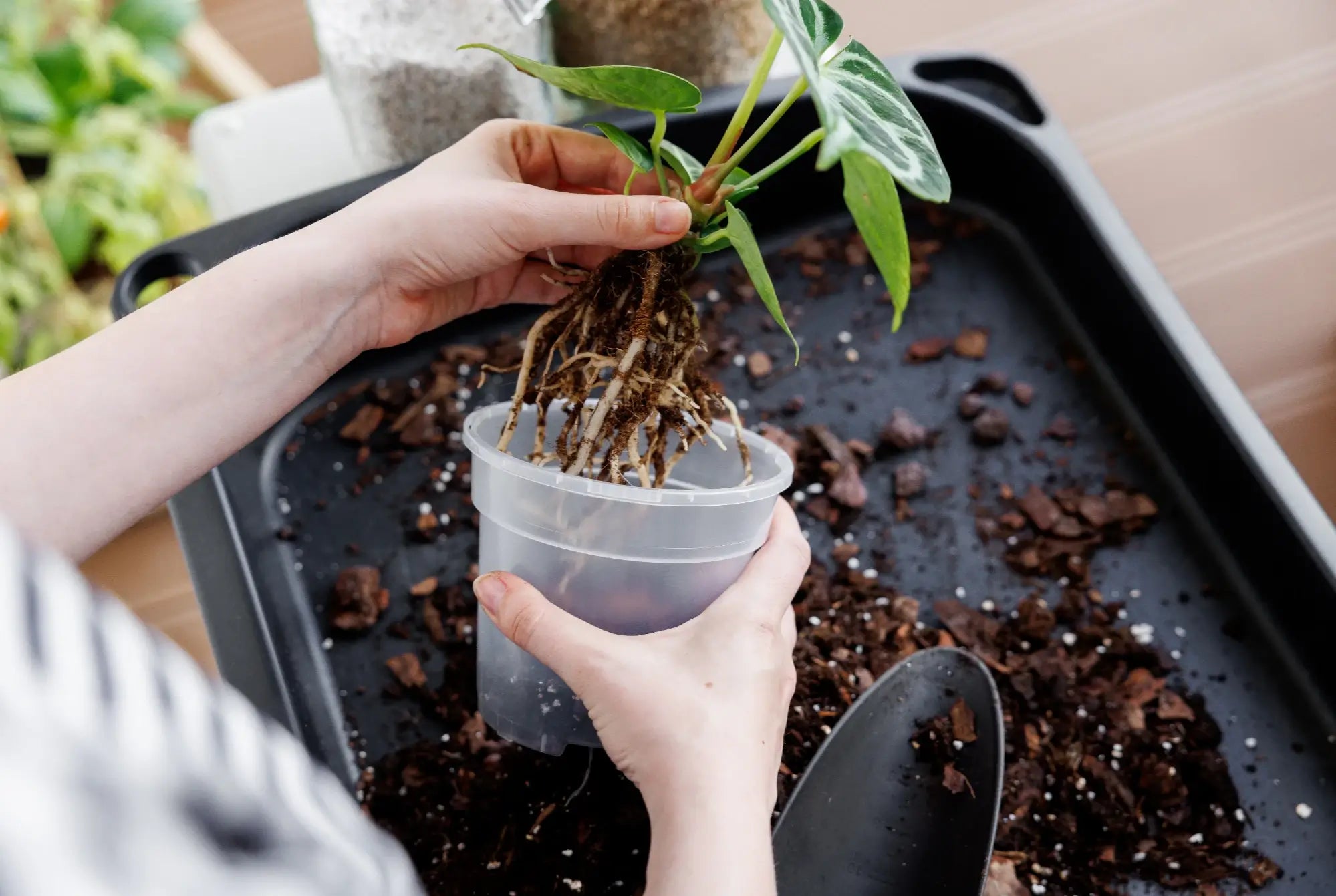
8. Repotting – minimal upsizing, maximum structure
- Repot when the mix collapses or the root ball becomes overly crowded.
- Upsize modestly to avoid large zones staying wet for too long.
9. A “no-cabinet” success path
- Warmth: keep plants away from cold window glass at night.
- Pot + mix: choose a pot size that dries predictably; keep structure high (air pockets matter).
- Light: push brightness up before pushing water or fertilizer.
- Air movement: a small fan in the room can make a bigger difference than chasing perfect humidity numbers.
10. Pests – realistic, repeatable control
- Common pests: spider mites, thrips, mealybugs.
- Baseline routine: check undersides weekly; isolate new arrivals; rinse foliage when pests are spotted.
- Treatment approach: use repeatable contact treatments labelled for ornamentals (and repeat on schedule); combine with environmental correction (airflow, light, watering rhythm).
11. Toxicity
Dragon Alocasias contain calcium oxalate crystals. Ingestion can irritate mouth and throat; sap can irritate skin. Keep away from pets and children and use gloves if sap sensitivity is an issue.

Propagation Techniques for Dragon Alocasias
Why propagation can be slow
- Compact growth: many jewel types do not divide cleanly.
- Corm timing: corms appear when plants are established; not every plant produces them quickly.
- Root fragility: disturbance increases rot risk if the medium stays wet.
Most reliable method: corm propagation
Corms are the most consistent option because they detach naturally near the base.
Where to find corms
- in the substrate near the rhizome base
- often discovered during repotting
How to sprout corms
- Collect: remove corms gently; avoid tearing the parent’s roots.
- Clean: rinse off old substrate; remove any soft tissue.
- Sprout setup: place in lightly moist sphagnum (or another airy sprouting medium) in a ventilated container.
- Conditions: warm (around 24–28 °C), high humidity, bright but indirect light.
- Timing: sprouting commonly takes weeks; slow corms are normal in jewel types.
- Transition: move into a structured mix once roots are established and a shoot is stable.
Aftercare: the step that prevents most losses
- Keep the medium open: do not “seal” a sprouted corm into dense, wet media.
- Reduce humidity gradually: once a leaf is functioning, acclimate over days rather than dropping humidity in one step.
- Water rhythm: keep evenly moist early on, but still avoid stagnant wetness.
Rhizome division – only for mature plants
- Attempt only with multiple clear growth points.
- Expect slow recovery; warmth and an open mix matter more than “extra water”.
What doesn’t work
- Leaf cuttings: no node, no plant.
- Petiole cuttings: regeneration from petiole segments is not reliable for Dragon Alocasias.
Dragon Alocasia Troubleshooting – Symptoms, Causes, Fixes
| Symptom | Likely causes | Fix |
|---|---|---|
| Brown leaf edges |
|
|
| Yellowing lower leaves |
|
|
| Silver fading greener |
|
|
| Sudden leaf collapse |
|
|
| Brown spots on leaf surface |
|
|
Why silver colour changes with light
- Structural reflectance: “silver” effects in many leaves come from surface and tissue structure that scatters light. Under lower light, green pigmentation can become more visually dominant and soften the silver effect.
- Variegation: pattern is genetic; brighter light mainly supports the plant’s energy budget so variegated sectors can persist.

Dragon Alocasia FAQs
1) Why is Silver Dragon turning greener?
Most often, light is too weak for strong silver expression, or the leaf is still hardening off. Increase filtered brightness and evaluate mature leaves rather than new emergence.
2) Do Dragon Alocasias need a winter rest?
Indoors, growth slows mainly when light and temperature drop. If warmth and light remain sufficient, growth can continue. Avoid intentional “dry rest” routines; adjust watering to actual dry-down speed instead.
3) Why are leaves curling inward?
Common drivers are uneven dry-down, low humidity swings, or temperature instability. Check pot dry-down first, then confirm warmth and airflow are steady.
4) How often should watering happen?
No fixed schedule fits. Water when the top ~15–20% of pot depth is dry, then water thoroughly and let excess drain.
5) Why are new leaves smaller?
- Light deficit: most common driver.
- Root restriction or collapse: roots cannot supply enough water/nutrients.
- Salt stress: buildup can reduce uptake and stall growth.
6) Are Dragon Alocasias pet-safe?
No. Alocasias contain calcium oxalate crystals that irritate mouth and throat if ingested, and sap can irritate skin.
7) What’s actually “rare” right now?
Variegated selections and newly released hybrids tend to be scarce early on. Availability can change quickly once a plant enters large-scale production, but no specific release is guaranteed.
8) Can semi-hydroponic systems work?
Yes, when nutrient concentration and flushing are managed consistently. Inert substrates remove “soil rot” variables, but oxygen balance and salt control still matter.
Final takeaways
Dragon Alocasia covers several plant types. Compact baginda cultivars such as ‘Dragon Scale’, ‘Silver Dragon’, and ‘Green Dragon’ have thick, bullate leaves. Hybrids such as ‘Black Dragon’, ‘Dragon Moon’, and ‘Dragon Wings’ combine baginda traits with darker, more rugged, or narrower leaves. ‘Dragon’s Breath’, ‘Dragon’s Tooth’, and ‘Golden Dragon’ are separate Alocasia lines with different size, texture, and care needs.
Match care to leaf type and growth habit. Compact jewel types need bright filtered light, warmth, structured substrate, and careful watering. Larger longiloba-style or Golden Dragon plants need more space and stronger light. Flush salts occasionally, check for pests regularly, and avoid leaving the substrate wet for days.
Shop Dragon Alocasias and related types
Browse our Alocasia collection for Dragon Scale types, Silver Dragon forms, compact hybrids, and larger Alocasia plants suited to bright indoor spaces.
➜ Shop Alocasias
Sources and Further Reading
Taxonomy, cultivar background, and horticultural references for the species, hybrids, and tissue-culture notes in this article:
International Aroid Society. Aroideana Vol. 7 No. 3 (1984): cultivated Alocasia – culture and taxonomy. https://www.aroid.org/aroideana/aroideana-v7n3
Kurniawan, A., & Boyce, P. C. (2011). Studies on the Alocasia Schott (Araceae-Colocasieae) of Borneo II: Alocasia baginda, a New Species from Eastern Kalimantan, Indonesian Borneo. Acta Phytotaxonomica et Geobotanica 61(3): 123–126. https://www.jstage.jst.go.jp/article/apg/61/3/61_KJ00007062768/_article/-char/en
Plants of the World Online (Kew). Alocasia baginda. https://powo.science.kew.org/taxon/urn:lsid:ipni.org:names:60456116-2
Plants of the World Online (Kew). Alocasia melo. https://powo.science.kew.org/taxon/urn:lsid:ipni.org:names:995487-1
Plants of the World Online (Kew). Alocasia reginula. https://powo.science.kew.org/taxon/urn:lsid:ipni.org:names:1006568-1
Plants of the World Online (Kew). Alocasia longiloba. https://powo.science.kew.org/taxon/urn:lsid:ipni.org:names:84195-1
Plants of the World Online (Kew). Alocasia heterophylla. https://powo.science.kew.org/taxon/urn:lsid:ipni.org:names:84179-1
Plants of the World Online (Kew). Alocasia scalprum. https://powo.science.kew.org/taxon/urn:lsid:ipni.org:names:1010791-1
Plants of the World Online (Kew). Alocasia cucullata. https://powo.science.kew.org/taxon/urn:lsid:ipni.org:names:84151-1
Aroidpedia. Alocasia baginda and documented cultivars/hybrids: ‘Dragon Scale’, ‘Silver Dragon’, ‘Green Dragon’, ‘Black Dragon’, ‘Dragon Moon’, ‘Dragon Wings’, ‘Aurora’, ‘Morocco’, Alocasia heterophylla ‘Dragon’s Breath’, Alocasia cucullata ‘Crinkles’. https://www.aroidpedia.com/alocasia
US Plant Patent. Alocasia ‘ALO3’ (Morocco). https://patents.google.com/patent/USPP25803P2/en
Tazmin, N. et al. (2024). In vitro propagation of Alocasia baginda ‘Silver Dragon’ through direct and indirect organogenesis. https://www.banglajol.info/index.php/PTCB/article/view/74343
Chen, J. et al. (2003/2019 upload). Somaclonal variation and cultivar development of ornamental aroids (chapter context). https://www.researchgate.net/publication/313728109_Somaclonal_variation_as_a_source_for_cultivar_development_of_ornamental_aroids
Philippine Alocasia Project. Species profiles for Philippine endemics (including heterophylla and scalprum). https://sites.google.com/view/philippinealocasias/
Smithsonian National Museum of Natural History. Botany collections search (specimen context). https://collections.nmnh.si.edu/search/botany/
University of Maryland Extension. Mineral and Fertilizer Salt Deposits on Indoor Plants. https://extension.umd.edu/resource/mineral-and-fertilizer-salt-deposits-indoor-plants
University of Nebraska–Lincoln Extension (Lancaster County). Success With Houseplants – Fertilization (leaching salts). https://lancaster.unl.edu/success-houseplants-fertilization/
University of Missouri Extension. Caring for Houseplants (bottom watering and salt buildup). https://extension.missouri.edu/publications/g6510


Leave a comment