Spider Mites on Houseplants — Exact Steps to Stop Them for Good
White speckles, dull leaves, maybe a faint shimmer of web — then you notice the “dust” moves. That’s a spider mite colony, not lint. These tiny mites thrive in warm, dry indoor air and can turn healthy leaves pale and brittle fast. It’s tempting to reach for a “stronger” spray, but spider mites rarely lose to strength. They lose to coverage and timing.
The truth: you can clear spider mites safely once you work with their life cycle. Rinse to knock numbers down, coat the leaves with a contact treatment, then repeat on schedule until hatching stops.
You’ll stop spider mites with rinse + insecticidal soap or horticultural oil, repeated every 3–5 days for two weeks, while you reduce the hot-dry, still-air setup that speeds them up.
At-a-Glance: How to Get Rid of Spider Mites Fast
Confirm: Do the white-paper tap test — hold a sheet under a leaf, tap it, and watch for tiny moving specks. If they crawl, it’s spider mites.
Routine: Rinse leaf undersides → spray insecticidal soap or horticultural oil (follow label; often 1–2%) → repeat every 3–5 days for two weeks.
Best conditions: Aim for 18–26 °C, around 45–60 % humidity, and gentle airflow to slow population growth and reduce flare-ups.
Prevent spread: Isolate affected plants and test any pots nearby.
Long-term fix: Keep humidity steady, clean large leaves weekly, and quarantine all new plants for 14 days with one or two tap tests.
📌 Quick formula to remember:
rinse, coat, repeat — every few days until two clean tap tests in a row show no movement.
Two-spotted spider mite (Tetranychus urticae) — the tiny arachnid behind many indoor infestations. Knowing what you’re looking at helps you act early.
Contents:
How to Spot Spider Mites Early — Before the Webbing Appears
By the time you see fine webbing, a colony is already established. The key is to catch them in the “dust” stage — when they’re scattered, feeding, and much easier to remove.
➜ What to Look For
Tiny pale dots on the upper leaf surface. These merge into dull or silvery patches as the infestation grows.
Leaves lose their natural shine and can feel slightly grainy.
New growth stays smaller; edges may curl or look tired.
Under bright light, affected areas can sparkle with uneven pale speckles.
📌 Note on Colour:
Spider mites aren’t reliably “red.” Many indoor infestations look yellowish-green to translucent, and the classic dark “two spots” may be hard to see without a lens. In cooler seasons, some adults can turn orange-red — which is where “red spider mite” comes from.
➜ Quick Confirmation
Tap Test: Hold white paper under a leaf and tap sharply. Slow-moving, dust-sized dots can indicate mites.
Hand Lens Check: With a 10–20× magnifier, you may see the common “two-spotted” pattern on many mites — a useful clue for Tetranychus urticae.
➜ Don’t Confuse These With Other Problems
Thrips: Silvery streaks and black specks — damage often runs in lines, and adults look slender rather than dot-like.
Scale Insects: Hard bumps on stems. No movement, no webbing.
Nutrient Deficiency: Broader, more uniform yellowing, no fine stippling pattern.
Dust: Doesn’t move when tapped.
➜ Where They Hide First
Undersides of leaves (sheltered and easy to miss).
Leaf joints and petiole bases (warm, protected creases).
Pot rims, shelf edges, and tight corners near the plant.
Plants close to heaters, radiators, or very warm grow-light zones.
💡 Note on Leaf Damage
Pale stippling forms when mites pierce leaf cells and suck out the contents. Those emptied cells lose chlorophyll, so the leaf turns speckled and dull from above. By the time webbing appears, feeding has already removed a lot of working leaf tissue — which is why early action saves the most leaf area.
First move in any mite outbreak — isolate the plant before the colony spreads. Separation saves the rest of your collection.
90-Second Action Plan — What to Do Right Now
Step 1 – Isolate
Move the affected plant away from the rest of your collection. Mites spread through contact between touching leaves, pots, shelves, tools, and hands. Keep it separate until you’ve done two clean tap tests in a row with no visible movement.
Step 2 – Rinse Thoroughly
Take the plant to a sink or shower and rinse the undersides of leaves and stems with a strong, steady stream until water runs off. This knocks down a large share of mobile mites and breaks up early colonies — but it doesn’t replace follow-up treatments, because eggs and hidden pockets can survive.
Let the plant drain fully before spraying. 👉 Expect some older leaves to continue declining — judge progress by clean new growth and clean tap tests, not by old damage.
Step 3 – Soap or Oil Treatment
Use an insecticidal soap or a horticultural oil labeled for spider mites and for indoor/ornamental use.
Follow label directions (many products sit around 1–2 % when diluted).
Spray both sides of every leaf until they glisten.
Dry in shade — heat and strong sun can scorch wet, freshly treated leaves.
💡Tip:
Soft or delicate leaves often do better with insecticidal soap.
Thick or leathery leaves often tolerate horticultural oil better.
Skip dish detergents and “DIY essential oil sprays” — they’re inconsistent and much more likely to burn foliage.
Patch-test one leaf first, then wait 24 hours before treating the whole plant.
Step 4 – Repeat on Schedule
Spider mites develop fast in warmth, so timing matters more than “stronger” products. Set a reminder and repeat the rinse + spray routine every 3–5 days for two weeks.
Stop only after two clean tap tests in a row, then do one extra round to catch late hatchlings.
Step 5 – Check Neighbours
Test nearby pots with the white-paper tap test — even if they look healthy.
If you see movement, treat those plants on the same schedule.
If they’re clear, recheck once after your next treatment to be sure.
Step 6 – Clean Surroundings
Wipe pot rims, window ledges, and shelves with mild soapy water.
Remove fallen or trimmed leaves — don’t keep them nearby.
Let everything dry fully before returning plants to their spots.
Spider mites reproduce fast in warm conditions — the reason timing and repeated treatments matter more than “spray strength.”
Why One-Shot Sprays Fail — Understanding How Spider Mites Multiply
You spray, feel relieved, and a week later the pale dots return. It isn’t bad luck — it’s biology. Spider mites are built for fast turnover, and many sprays have little to no residual effect once dry.
Fast Life Cycle
Temperature drives everything. In cooler conditions, development slows. In warm conditions, it accelerates sharply — and that’s when indoor outbreaks feel like they appear overnight.
💡Life Cycle Note
A full spider mite life cycle has five stages: egg, larva, protonymph, deutonymph, and adult. In warm conditions, egg-to-adult development can be about a week; cooler temperatures slow it. The takeaway is simple: your treatment interval has to stay shorter than their development speed.
Eggs + No Residual
Eggs are protected and many sprays don’t affect them well, especially after the spray dries. That’s why a single treatment can look successful, then rebound a few days later when the next wave hatches. Repeating every few days isn’t “overkill” — it’s how you intercept each hatch before it becomes egg-laying adults.
Coverage Is the Make-or-Break
Spider mites cluster on leaf undersides, along midribs, and in tight creases. If leaf undersides aren’t fully coated, survivors rebuild quickly. Think “paint coverage,” not “light mist.”
Webbing Is Shelter
Webbing isn’t just a symptom — it’s protection. Heavy webbing can reduce contact and hide mites in folds and leaf joints. In advanced outbreaks, wiping webs first (then rinsing and spraying from below) noticeably improves results.
Evolving Resistance
Tetranychus urticae is also famous for developing pesticide resistance quickly. Reusing the same active ingredient over and over selects for survivors. Mechanical control plus contact products (soap/oil) stay effective largely because they rely on direct contact, not a single biochemical target.
📌 Key Takeaway
Spider mites don’t “come back” because you didn’t spray hard enough. They come back when timing or coverage leaves a breeding pocket behind. The fix is the same every time: rinse, coat, repeat on schedule until hatching stops.
Predatory mites such as Neoseiulus californicus hunt spider mites in leaf crevices and can support long-term control in indoor collections.
How to Stop Spider Mites Indoors — The Proven Step-by-Step Control Plan
Once you understand their timing, spider mites become manageable. This plan mirrors the logic used in professional plant care and IPM, scaled for home collections: mechanical knockdown + contact treatment + repeat timing.
1. Start With a Rinse
Spray or shower the undersides of every leaf until water runs off. For dense foliage, angle the nozzle upward to reach hidden spots. If the plant can’t be moved, wipe leaf undersides with a damp microfiber cloth instead — the goal is still physical removal.
2. Apply Contact Treatment
Use an insecticidal soap or horticultural oil labeled for spider mites.
Soap: contact action; best for many soft, delicate leaves.
Oil: contact smothering action; often preferred for thicker, tougher leaves. Avoid spraying under strong light or above 28 °C.
Do not mix soap + oil in the same bottle unless the label explicitly says you can.
If you use neem-based products, treat them as a rotation tool rather than a stand-alone “cure.” Azadirachtin can reduce feeding and reproduction, but results depend on formulation and coverage.
3. Keep the Rhythm
Repeat your rinse + spray routine every 3–5 days for two weeks. The point is to intercept hatchlings before they become egg-laying adults.
4. Optional Biological Backup
Predatory mites are a strong option, especially for large collections or recurring outbreaks.
Phytoseiulus persimilis: fast, curative predator that feeds on spider mites aggressively, but won’t persist without prey.
Neoseiulus californicus: steadier, more tolerant predator used preventively; it can also survive on other food sources when prey is low.
Important: soaps and oils can kill predators on contact. If you plan to use predatory mites, stop spraying, rinse off visible residues where possible, let foliage dry, then release predators. After release, avoid contact sprays unless you’re willing to pause biological control and reintroduce predators later.
5. Balance the Room
Warm, dry, still air makes outbreaks easier. Aim for 18–26 °C and moderate humidity (around 45–60%) with gentle airflow from a small fan on low. Don’t rely on brief leaf misting as a humidity fix — stability at room level is what changes the odds. Keep plants out of hot, stagnant corners when possible.
Also: avoid drought-stressing plants, but don’t keep soil constantly wet. Stick to the plant’s normal watering rhythm in an airy mix so roots stay oxygenated.
6. Confirm Success
After two clean tap tests in a row, do one more treatment cycle. Then keep weekly tap tests for a few weeks so any late survivors get caught early.
📌Think of this as timing, not panic. Each cycle cuts their numbers until there’s nothing left to breed.
💡 Why This Routine Works
Knocks numbers down fast — rinsing physically removes mites and disrupts colonies.
Forces full coverage — soap/oil only work when leaf undersides are coated.
Outpaces hatching — repeated timing is what prevents rebounds.
Improves conditions — so flare-ups are less likely to start again.
Predator sachets release mites gradually, which can help keep pressure down in large or densely planted setups.
Spider Mite Products and Methods — What Works and What Doesn’t
Garden centres sell plenty of “instant spider mite killers,” but indoor success comes down to the same basics: coverage, timing, and repetition. If a method doesn’t physically remove mites or kill by direct contact, it usually disappoints indoors.
✓ Treatments Proven to Work
These options consistently reduce spider mites on houseplants when used with full coverage and repeated timing.
Insecticidal Soap
How it works: Contact action that disrupts the mite’s outer surface; it must hit the pest directly.
How to use: Follow label directions; spray both sides of every leaf until fully coated. Repeat every few days on schedule.
Best for: Many thin or delicate leaves.
Tip: If residue builds up or leaves look dull, a gentle plain-water rinse the next day can help on some plants (only if your plant tolerates rinsing).
Horticultural Oil
How it works: Smothers by contact. Coverage matters; avoid heat and strong light right after spraying.
How to use: Follow label dilution and timing; apply in shade or cool light, never above 28 °C.
Best for: Thick-cuticle plants such as Ficus, Hoya, and many succulents (always patch-test first).
Tip: Oils can be phytotoxic on some plants — patch test and avoid spraying stressed plants.
Plain Water Rinsing
How it works: Dislodges mites physically — no resistance possible.
How to use: Rinse under moderate pressure, especially on leaf undersides. Support leaves with your hand so you don’t tear them.
Best for: Plants that tolerate rinsing and overhead water.
Bonus: Safe to combine with all other methods.
Predatory Mites (Biological Control)
How it works: Predators hunt mites in creases and undersides that sprays often miss.
How to use: Release into sheltered leaf areas or use sachets. Follow supplier instructions for rates and placement.
Conditions: Warm (roughly 18–28 °C) and not overly dry; avoid contact sprays once predators are released.
How it works: Some products based on entomopathogenic fungi (such as Beauveria bassiana or Metarhizium anisopliae) can infect and reduce mite populations over time.
How to use: Follow manufacturer instructions precisely; performance depends on coverage and suitable conditions.
Best for: People building a rotation plan or trying to reduce reliance on repeated soap/oil rounds.
Reality check: These options are typically slower than soap/oil knockdown — they’re supportive, not “instant.”
🚫 Skip These — Ineffective or Counterproductive Treatments
Product or Treatment
Why It Fails or Backfires
Systemic insecticides
Most systemics sold for houseplants target insects, not mites, so results are often poor. Effective miticides exist, but product choice and legality vary by country — always follow local regulations and label directions.
Strength varies wildly and leaf burn is common — especially under lights or warmth.
Neem/azadirachtin as the only treatment
It can reduce feeding and reproduction, but it’s inconsistent as a solo solution. Use it in rotation with proper coverage and timing, not as a one-product fix.
Alcohol wipes
Evaporate too fast to matter on colonies. Only useful for very small, isolated spots — and easy to scorch sensitive leaves.
💡 If it doesn’t rinse off, coat fully, or hunt actively — it usually won’t solve spider mites indoors.
⚠️ Quick Safety Rules
Patch test one leaf first and wait 24 hours.
Never spray under full sun or near artificial heat.
Ventilate after treatment, and keep pets, kids, and food away until leaves are fully dry.
Don’t mix products unless the label explicitly says you can.
Follow label storage and disposal guidance; don’t pour concentrates into sinks or drains.
If you’re using predatory mites, avoid soaps and oils — they can kill predators on contact.
Heavy webbing means the colony is mature — but outbreaks still collapse when coverage and timing stay consistent.
Why Spider Mites Keep Coming Back — Troubleshooting the Usual Gaps
You rinse, spray, breathe a sigh of relief… and two weeks later the speckles return. It’s usually one small gap in the routine. Close the gap, and the rebound stops.
Where Do Spider Mites Come From?
Most outbreaks begin with a single infested plant — often one picked up from a garden centre, online seller, or supermarket shelf. Pre-potted herbs and flowering gifts are common sources, especially when they’ve been grown warm and dry with limited airflow.
They’re easy to miss early. Small starter colonies hide on leaf undersides and in folds where you don’t naturally look. That’s why quarantine works: it gives you time to catch the first mites before they spread.
🛑 Quarantine every new plant — even if it looks healthy — for 10–14 days. Run one or two tap tests during that time.
When to Prune Hard — or Let a Plant Go
If a plant is heavily webbed across multiple leaves, declining fast, or rebounding repeatedly, the most practical move can be removing the worst growth (or, in extreme cases, removing the plant from your collection). Pruning heavily damaged leaves makes coverage easier and reduces shelter for mites. If an outbreak is truly severe, isolating and disposing of the most infested parts can protect the rest of your plants and stop the cycle in one step.
📌 Host Susceptibility Note
Some plants show spider mite damage sooner than others. Thin, soft leaves often reveal stippling quickly, while thick, tough leaves can hide early feeding longer. Don’t assume “no symptoms” means “no mites” — use a tap test and check undersides.
These are the most common rebound triggers — and how to fix them:
1. Missed Undersides or Hidden Creases
Most mites live beneath leaves or deep in petiole folds. If even one pocket survives, the colony restarts. Fix: Spray from below. Use a mirror or phone camera to check angles you can’t see.
2. Timing Gaps
Warm conditions shorten development speed. Waiting a full week between treatments can let a new generation mature unseen.
Fix: Repeat on schedule (every 3–5 days) until you get two clean tap tests in a row, then do one extra round.
3. Stopping Too Early
When webbing fades, adults may be down — but hatchlings can appear days later.
Fix: Always do one extra full cycle after the last clean tap test.
4. Re-infestation From Untreated Neighbours
One untreated plant within reach can restart everything.
Fix: Test and treat by “zones” (nearby shelves / same room cluster), not just the obvious problem plant.
5. Environment Still Favouring Them
Warm, dry, still air accelerates breeding — the perfect indoor climate for spider mites.
Fix: Moderate humidity, gentle airflow, and avoiding hot corners won’t “kill” mites — but it makes outbreaks much harder to sustain.
6. Over-Mixing or Over-Concentrating
Heavier oil or soap layers raise plant stress but don’t guarantee better control.
Fix: Follow label rates, focus on coverage, and keep your interval tight.
7. Skipped Follow-Up Checks
Because development speed depends on temperature, late survivors can show up after you feel “done.”
Fix: Keep weekly tap tests for a few weeks after treatment. If you spot movement again, one quick cycle usually stops it early.
➜ What to Expect After Recovery
Some old leaves may still drop — that’s normal stress and old damage showing through. What you want to see is no new stippling, clean leaf undersides, and clean new growth as the plant continues to grow.
Spider mites feed and lay eggs under leaves. Regular underside checks are the simplest long-term prevention habit.
Your 5-Minute Weekly Routine to Keep Spider Mites Away
Once your plants recover, staying ahead of spider mites doesn’t take much — just a small weekly habit loop that keeps colonies from getting established.
Step
Action
Purpose / Why It Matters
1. Inspect Undersides
Shine a flashlight under one or two random leaves each week.
Early detection — mites hide underneath leaves where you don’t naturally look.
2. Do the Tap Test
Hold a sheet of white paper under a leaf, tap it, and check for moving dots.
Confirms presence; early action prevents webbing-stage outbreaks.
3. Keep the Climate Balanced
Aim for 18–26 °C and moderate humidity. Use a small fan for gentle airflow.
Warm + dry + still air favours mites; airflow and steadier humidity help reduce flare-ups.
4. Wipe and Clean
Dust large leaves weekly with a damp cloth; remove debris from shelves and soil surface.
Cleaner surfaces make it easier to spot early colonies and reduce “hidden” build-up.
5. Avoid Drought Stress
Don’t let plants sit bone-dry for long stretches; water according to each plant’s normal rhythm in an airy substrate.
Stressed plants often show damage faster, and dry air + dry plants makes outbreaks easier to sustain.
6. Quarantine and Observe
Isolate new plants for 14 days and do a tap test before adding them to your setup.
Stops hidden infestations from entering your collection.
💡 Why It Works
Regular checking catches mites before they web.
Clean leaves and airflow reduce the “safe corners” mites love.
Moderate humidity makes warm, dry flare-ups less likely (but doesn’t replace treatment if mites are present).
Stable care reduces plant stress so damage doesn’t escalate as quickly.
📌Five minutes a week keeps spider mites from gaining ground again — no panic sprays, no repeating battles.
For Large Plant Collections — Scaling Up Spider Mite Prevention
If your collection fills multiple shelves or rooms, prevention has to be realistic. Not every plant can go to the shower, and not every leaf can be inspected daily. The goal becomes simple: catch outbreaks early, keep airflow moving, and treat by zones.
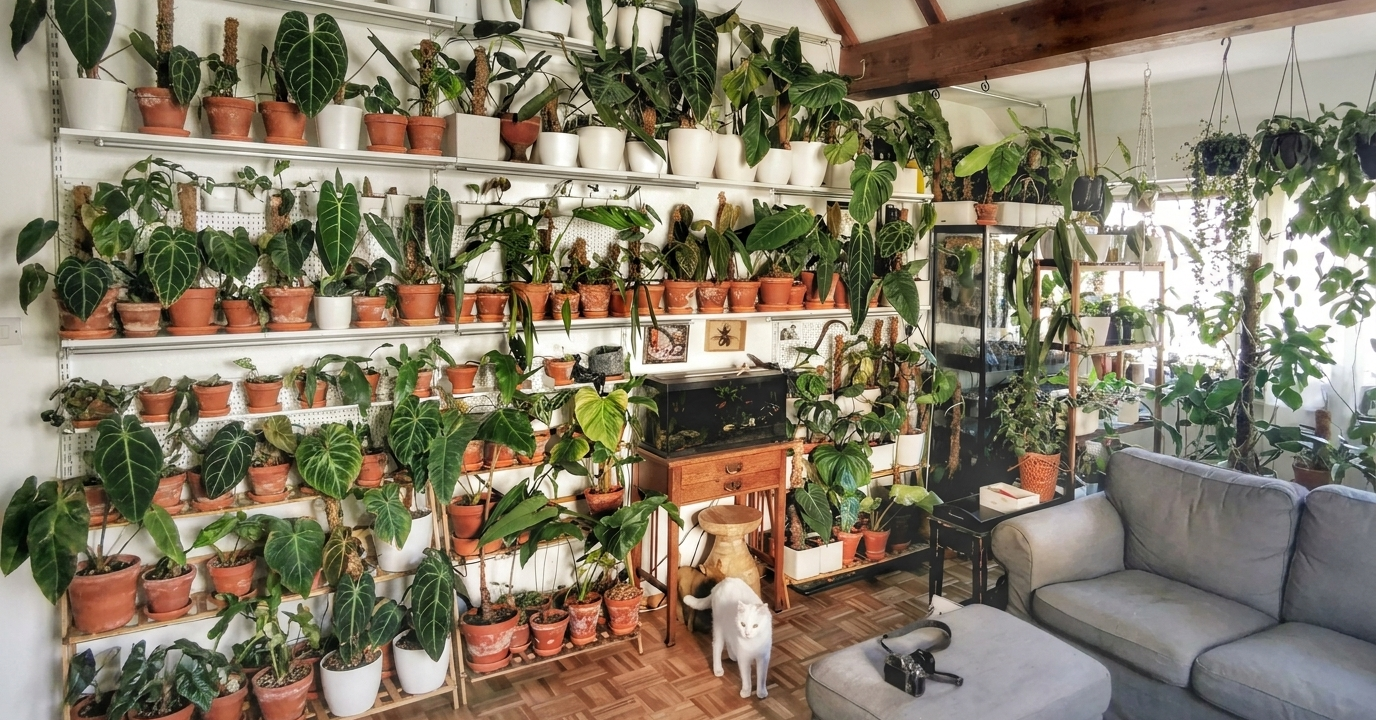
Spider mites spread fastest in dense, dry setups with still air and limited visibility — exactly what crowded plant shelves can become. Here’s how to stay in control without turning plant care into a second job:
Strategy
How to Apply It
Why It Works
Create Inspection Zones
Divide your setup by shelf, room, or plant cluster. Check one zone per day instead of everything at once.
Keeps prevention doable and makes sure every plant gets eyes on it weekly.
Use “Sentinel Plants”
Keep one easy-to-check plant (large, pale leaves) in each zone as an early warning plant.
If mites show up on a sentinel, you can treat that zone before it spreads.
Maintain Air Circulation
Run small fans on low across dense shelves or corners. Avoid constant direct drafts on delicate plants.
Reduces stagnant pockets and makes colony build-up harder.
Spot-Treat Instead of Rinse
For heavy or fixed plants, wipe leaf undersides with a damp microfiber cloth, then spray in place with a labeled soap/oil product.
Physical removal still works — the key is repeating on schedule.
Rotate Biological Control
Use Neoseiulus californicus preventively in zones that flare up; use Phytoseiulus persimilis for visible outbreaks.
Prevention plus fast curative response reduces the need to spray entire shelves.
Batch Cleaning Days
Once a week, wipe or rinse the warmest areas (top shelves, crowded corners) and remove debris.
Reduces dust build-up and makes early symptoms easier to notice.
Track and Tag
Use notes, tags, or a simple list to mark treated zones and next treatment dates.
Prevents missed intervals — the most common reason large collections rebound.
💡 Tip:
In large collections, success comes from keeping intervals tight and treating in clusters. One untreated pocket can rebuild surprisingly fast in warm, dry conditions.
That faint dusting of webbing is an early warning — mites multiply long before full leaf damage appears.
Spider Mite FAQs — Straight Answers to Common Questions
How long does a spider mite life cycle take indoors?
It depends on temperature. In warm conditions, egg-to-adult development can be about a week; cooler temperatures slow it. That’s why “one spray and wait a week” often fails — the next generation is already arriving.
Do eggs survive sprays?
Often, yes — especially with soaps and any spray that dries quickly. Oils can suppress eggs better than many soaps, but no spray replaces timing. Repeating on schedule is what prevents hatchlings from becoming egg-laying adults.
Can spider mites live in soil?
Not the common species. Tetranychus urticae prefers leaves, not roots. Soil mites you might see are usually harmless decomposers.
Are there white spider mites?
Spider mites can look pale or translucent, especially in early infestations and without magnification. The “tiny white specks” moving under leaves are often spider mites that simply don’t show strong colour yet — which is why the tap test and a hand lens make identification much easier.
What humidity helps control them?
Spider mites thrive in warm, dry conditions. Moderate humidity (often around 45–60% indoors) and gentle airflow can make flare-ups less likely, but humidity alone won’t clear an active infestation — you still need coverage and timing.
Are predatory mites effective indoors?
Yes, if conditions are suitable and you avoid killing them with contact sprays. Phytoseiulus persimilis is a strong curative predator for active outbreaks. Neoseiulus californicus is often used preventively and can help reduce recurring flare-ups.
Is neem/azadirachtin enough on its own?
Usually not. Azadirachtin can reduce feeding and reproduction, but results vary by formulation and coverage. If you use it, treat it as part of a rotation plan — not as the only tool.
Why do spider mites keep coming back on my plant?
Most rebounds trace back to three things:
Missed undersides or hidden creases.
Too much time between treatments.
Warm, dry, still air making conditions easy for them.
How long until my plant looks normal again?
You should see damage stop spreading within 1–2 weeks if your timing is tight. Cosmetic recovery depends on the plant: old stippling won’t “turn green” again, but clean new growth and stable conditions are the real signs you’re back in control.
Once you learn the signs and timing, spider mites become manageable — not a crisis.
A steady rinse remains one of the most reliable spider-mite controls — low risk, low drama, high impact when repeated on schedule.
Final Wrap-Up — Stay in Rhythm, Not in Panic
Spider mites look intimidating, but once you understand their timing, they’re controllable. Outbreaks keep going because cycles overlap — eggs hatch, hatchlings mature, and new eggs appear — until you interrupt that loop consistently.
Three-Step Control Loop
Rinse thoroughly. Use a strong, steady stream on leaf undersides and stems to knock mites down fast.
Spray soap or oil (label rate). Coat both sides of every leaf evenly, then dry in shade.
Repeat every few days. Keep intervals tight enough to outpace hatching until two clean tap tests in a row — then do one extra cycle.
= Simple timing, real control.
No gimmicks. No “stronger spray” arms race. Just coverage, timing, and follow-through.
And one final truth that keeps expectations sane: you can clear spider mites from a plant — but new plants can reintroduce them. Quarantine, weekly checks, and treating by zones are what keep outbreaks small.
Keep Building Your Pest-Free Setup
More science-backed guides on pests, humidity, and balanced plant care:
Al-Zahrani, J. K., Al-Abdalall, A. H., Osman, M. A., et al. (2023). Entomopathogenic fungi and their biological control of Tetranychus urticae: Two-spotted spider mites. Journal of King Saud University – Science, 35, 102910. https://doi.org/10.1016/j.jksus.2023.102910
Grbić, M., Van Leeuwen, T., Clark, R. M., et al. (2011). The genome of Tetranychus urticae reveals herbivorous pest adaptations. Nature, 479, 487–492. https://doi.org/10.1038/nature10640
Martínez-Villar, E., Sáenz-De-Cabezón, F. J., Moreno-Grijalba, F., Marco, V., & Pérez-Moreno, I. (2005). Effects of azadirachtin on the two-spotted spider mite, Tetranychus urticae (Acari: Tetranychidae). Experimental and Applied Acarology, 35, 215–222. https://doi.org/10.1007/s10493-004-5082-6
Migeon, A., & Dorkeld, F. (2006–present). Spider Mites Web: a comprehensive database for the Tetranychidae. INRAE Montpellier. Retrieved April 2026, from https://www1.montpellier.inrae.fr/CBGP/spmweb/
Chinese money plant (Pilea peperomioides) didn’t become famous through marketing — it spread through cuttings and friendship. Get the origin story plus care, propagation from pups, and styling tips.
Self-watering pots can make plant care steadier—if the setup is right. Learn how wick and reservoir systems work, which houseplants suit them, what mineral substrates to use, how to fertilize safel...
Die Pflanzen waren prima verpackt und ein heatpack war im Paket enthalten. Die Lieferzeit hat 2 bis 3 Tagen gedauert, was aus meiner Sicht wirklich gut ist. Alle drei Pflanzen haben die Lieferung gut überstanden. Ich habe mich auf Hoyas spezialisiert und habe schon die nächsten Pflanzen meiner Wunschliste auf der Website gefunden. Daher wird die nächste Bestellung nicht lange auf sich warten lassen.
Marion
★★★★★
I received perfectly heathy and absolutely beautiful plants, even bigger than expected. The delivery within Europe was really fast. I think Foliage Factory has one of the best plant web shops in the internet. It‘s just great to get so much informations about the plants. I will definitely order again :)
Walkerova
★★★★★
Envoie très rapide (2 jours), plantes parfaitement emballées et super offres ! Je suis une habituelle j'ai passé 6 ou 7 commandes et je n'en peut être plus satisfaite du service client et de la qualité et variété des plantes offertes
Iris
★★★★☆
Die Sendung kam leider in keinem guten Zustand bei mir an, kann passieren. Habe mich darauf hin sofort an Foliage Factory gewandt und habe selten einen so guten, schnellen, freundlichen und kulanten Kundendienst erlebt.
Frauke
★★★★★
The plants have arrived in perfect condition, the roots and the foliage so so healthy! I had problem with 1 plant out of 16 and they have responded to my email almost instantly and the issue was resolved straight away. I'm really impressed and satisfied, definitely getting more plants from them again!
Patricija
★★★★☆
Very healthy and well packed plant. Unfortunately there was one plant that ordered couldn’t be delivered as it was out of stock hence 1 star less.
Sam
★★★★★
Everything arrived in good condition and very well packed - it wasn't easy with a fragile plant and a heavy bag of substrate. I recommend it!
Lia
★★★★★
Bester online-Pflanzenhandel den ich kenne (habe davor 4 andere ausprobiert). Eine teure Pflanze wurde beim Transport beschädigt und mir ersetzt. Der Kontakt dabei war auch sehr nett (danke Jan) und hat mir gut geholfen. Die anderen Pflanzen sind in einem sehr guten Zustand, keine Schädlinge, super Bewurzelung. Nur zu empfehlen! :)
C L
★★★★★
Super Service, Gute Auswahl, Preise sind fair. Eine Pflanze kam kaputt an, hab sofort Ersatz bekommen. Danke an den unkomplizierten (und blitzschnellen) Kundenservice!!
Sarah
★★★★★
The plants are carefully packaged and arrive in great conditions (I’m based in Spain) and they’re always there to help in any way they can with your purchase.I have and will always recommend Foliage Factory to every friend I can. I’m not only satisfied with their plants and prices, but their customer service is exceptional.
José
Get 10% off your next plant order
Sign up for Foliage Factory newsletter for early access to new arrivals and practical care tips that work in real homes.







Leave a comment
This site is protected by hCaptcha and the hCaptcha Privacy Policy and Terms of Service apply.