

The Tale of Philodendron corsinianum: A Botanical Legacy and Cultivation Marvel
Philodendron × corsinianum is best understood as a historical cultivated hybrid, not as a wild species with a single native range to “recreate” indoors. That distinction matters in practice. What keeps Philodendron × corsinianum growing well in a pot is straightforward: bright filtered light, steady warmth, a root zone with real air in it, and a watering rhythm that lets the mix move from fully moist to partly dry without staying soggy.
Once those pieces are in place, Philodendron × corsinianum is much easier to manage than its reputation suggests. It’s a slow climber, but it’s predictable when light and root conditions stay consistent.

History, identity, and naming
Philodendron × corsinianum was raised in Florence before 1888 in the public gardens of Le Cascine. Ferdinando Ragioneri is closely associated with its creation, and Angiolo Pucci is part of the same historical record. The plant had already attracted attention by the time it appeared at the Ghent exposition in 1887, and the name was published in 1888. It was named after Prince Corsini, then mayor of Florence, and later spread further in cultivation through Makoy in Liège.
The horticultural history is clear. The exact parentage is less straightforward, because different historic records use different names and conventions. Modern registry notes commonly list Philodendron pinnatifidum as the seed parent and Philodendron verrucosum as the pollen parent, while older notes may reference parentage using earlier names that don’t map neatly onto today’s labels. Treat parentage as part of the cultivated backstory, not as a care blueprint.
That also affects how this plant should be presented today. The published name still exists, but it is not best treated as a neatly placed wild species with a mapped native range. In cultivation, labels may show Philodendron ‘Corsinianum’, Philodendron × corsinianum, or a version without the multiplication sign. In practice, these names point back to the same cultivated plant and its long horticultural history.
How to recognise Philodendron × corsinianum
This plant is usually described as a slow climber with a scrambling habit and relatively short internodes. It does not behave like a compact self-heading philodendron. Given support, it grows with more purpose; without it, the stem often sprawls and the plant can look looser and less defined.
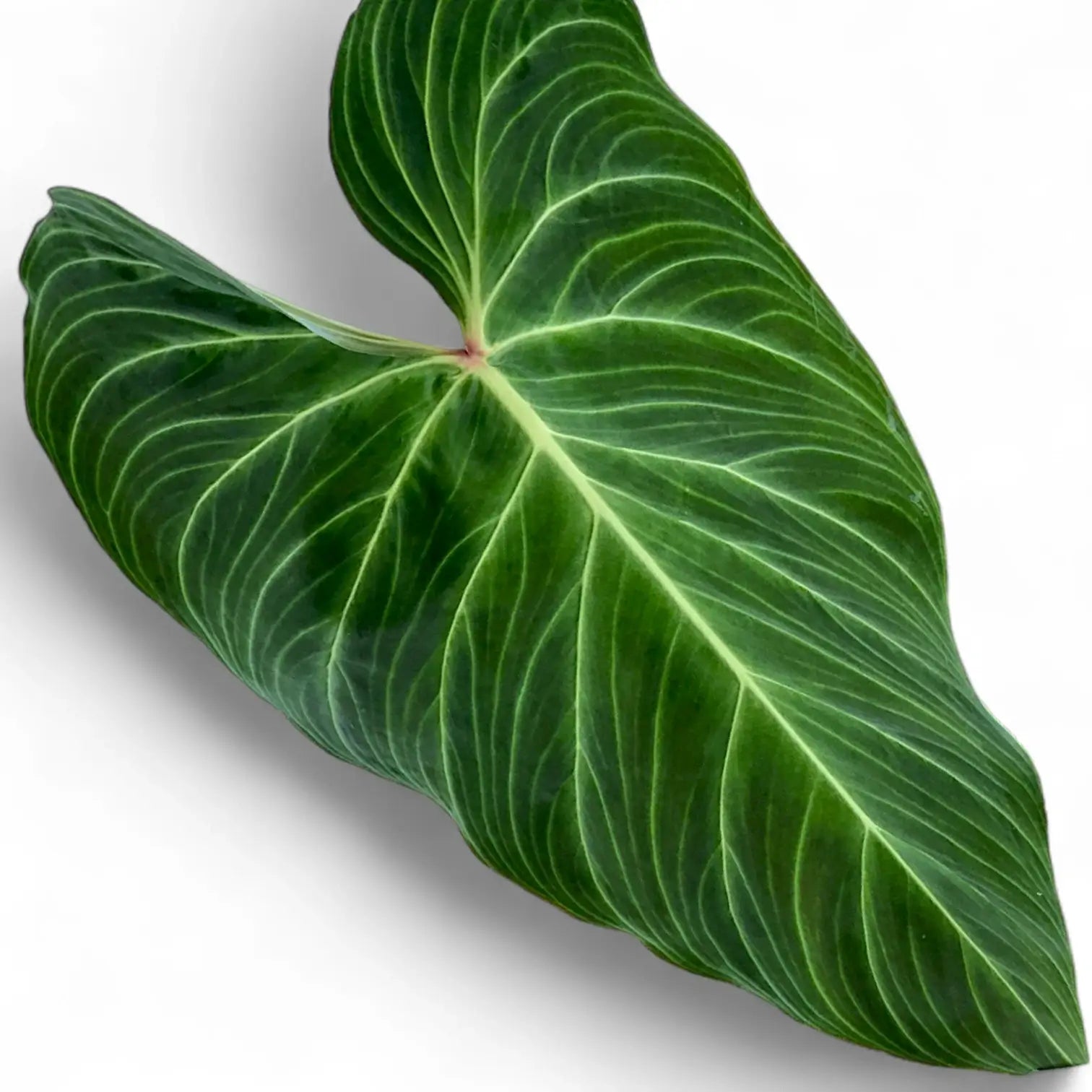
The leaves are broad, cordate to cordate-ovate, and can become substantial over time. Older descriptions place the blade width at roughly 28 to 46 cm, with a softly lobed or scalloped outline rather than a perfectly smooth edge. The upper surface is deep green, while younger leaves often show reddish-purple tones beneath, especially between the veins. That underside colour usually softens as the leaf matures.
- Growth style: slow climber with a scrambling habit; looks best with support.
- Internodes: typically short compared to many fast vine-type philodendrons.
- Leaf shape: broad heart-shaped to cordate-ovate, often with a gently scalloped edge.
- Leaf underside: younger leaves may show reddish-purple tones between green veins, fading with age.
- Cataphyll remnants: old sheath tissue can dry down into fibrous strands at the nodes on established stems.
Flowering is possible on mature, well-established plants, but it should not be treated as a routine indoor outcome. Historical descriptions mention a richly coloured spathe with red to crimson tones and a pale spadix, but most growers will know Philodendron × corsinianum primarily for its foliage and growth habit rather than for repeat blooming indoors.

What its background can and cannot tell you
There is no single wild habitat to recreate, because Philodendron × corsinianum is a cultivated hybrid rather than a species with one clear native distribution.
What Philodendron × corsinianum does show clearly is a growth pattern familiar from climbing philodendrons: it prefers warmth, strong filtered light, and a breathable root zone. It also responds well to support. Those cues are more useful indoors than trying to assign one “natural habitat” to a plant that has lived in cultivation for well over a century.
Humidity still has a role, but it needs to be kept in proportion. Higher humidity can help new leaves open more cleanly and may reduce cosmetic edge damage, especially during active growth. It does not compensate for weak light, dense substrate, or roots that stay wet and airless for too long. Indoors, light quality and root conditions usually drive the outcome more than chasing extreme humidity targets.
Growing Philodendron × corsinianum indoors
Bright, usable light
Give Philodendron × corsinianum bright filtered light for much of the day. Close to a bright window is usually better than a position further inside the room where growth slows to a crawl. If you want a more practical target, think in terms of strong indirect light at leaf level rather than vague labels like “medium light.” A little soft direct sun at the start or end of the day can be fine once the plant is acclimated, but prolonged harsh sun through hot glass can damage the leaves.
In low light, the stem stretches, leaf size stalls, and the potting mix dries too slowly. That last part matters just as much as slower growth: when light is too low, the root zone stays wet longer and problems pile up faster.
Water thoroughly, then let air return to the mix
Do not water by calendar. Watering needs to follow the drying speed of the pot, which depends on light, temperature, root mass, pot size, and the structure of the mix. A good pattern is to water thoroughly, let excess water drain away, and then wait until the upper third to half of the mix has dried before watering again. In a finer mix, you may need to let the drying phase go a little further. In a chunkier, faster-draining mix, the interval will often be shorter.
The point is not to keep the plant dry for long stretches or constantly moist at all times. The point is to create a cycle in which roots get both water and oxygen. When the mix stays wet and heavy for too long, root function drops, leaves begin to yellow, and new growth slows. That pattern is often mistaken for thirst or nutrient deficiency when the real issue is lack of air in the root zone.
A structured mix matters more than gimmicks
Philodendron × corsinianum does better in a loose, airy substrate than in dense universal potting compost. A workable mix usually combines a moisture-retentive base with coarse material that keeps air pockets open around the roots. Bark, pumice, perlite, coarse coco husk, or similar materials can all help. The exact recipe matters less than the result: the mix should wet through properly, drain freely, and not collapse into a compact mass after repeated watering.
Use a container with drainage holes and skip stones or pebbles at the bottom. A drainage layer does not correct a heavy substrate, and it does not improve root oxygen where the roots actually grow. If the root zone above it is too dense, the problem remains.
Repot when the substrate has broken down, the plant dries unusually slowly, or the roots have clearly filled the container. A modest size increase is usually safer than moving a slow-growing climber into a much larger pot full of wet mix.
Warmth first, humidity second
Stable warmth matters year-round. Aim for roughly 18 to 27°C and avoid long periods of cold, especially when the mix is still damp. Once temperatures drop too far, root activity slows and water sits around the roots for longer, which makes decline easier even when the plant is not visibly wilted.
Humidity is useful, but it does not need to turn into a constant project. Around 50 to 60% is usually workable indoors, and somewhat higher levels can help new foliage develop more cleanly. If the air is persistently very dry, a humidifier is more effective than small passive methods. Routine misting is not a reliable way to change ambient humidity around the plant in a meaningful way.
Support, feeding, and propagation
Philodendron × corsinianum responds well to support. A board, coir pole, moss pole, or trellis can improve posture and often helps the plant make broader, more confident leaves over time. A support that allows aerial roots to attach is usually more useful than letting the stem trail loosely without direction.
Feeding should stay moderate. In active growth, small regular doses of balanced fertiliser are easier to manage than occasional heavy feeding. Overdoing it can leave salts in the substrate, which then shows up as brown edges, root stress, or irregular growth. Flushing the pot thoroughly from time to time helps keep the mix from becoming overly concentrated.
Propagation is possible from stem sections with viable nodes, but it should not be oversold as a quick way to build a big specimen. Philodendron × corsinianum is not a fast philodendron, and small plants benefit more from being allowed to establish than from being cut up too early.
Safety and handling
Like many members of Araceae, Philodendron × corsinianum contains sap with irritating compounds (including calcium oxalate crystals). Keep it away from pets and small children, avoid getting sap in eyes or mouth, and wash hands after pruning or taking cuttings.
Common indoor problems
- Yellowing leaves and a pot that stays heavy: usually points to a mix that stays wet too long for the available light and temperature.
- Smaller new leaves and longer gaps between nodes: most often a light issue, sometimes made worse by lack of support.
- Brown edges or rough new growth: often linked to uneven watering, salt build-up, dry air during leaf expansion, or roots that are no longer functioning well.
- Leaf damage after cold exposure: low temperatures can leave dull patches, soft damage, or a general stall in growth, especially when the mix is also staying wet.
- Sticky droplets on stems or leaf bases: can be nectar from extrafloral nectaries, not automatically pests; check closely for insects before treating.
- Pests: thrips, spider mites, and mealybugs are all possible indoors. Check new growth, petiole bases, and leaf undersides regularly, isolate new arrivals, and repeat treatment properly rather than assuming one quick spray will solve the problem.
If the pot stays heavy for days and yellowing continues, pause watering, move Philodendron × corsinianum into brighter light, and make sure the container drains freely. If the mix smells sour, feels swampy, or the plant stays stalled despite better light and warmth, unpot and check roots: trim any soft or hollow sections, then repot into a fresh, structured mix that re-wets evenly and drains fast.
What to expect over time
Philodendron × corsinianum is a slow historical climbing hybrid that responds best to stable conditions rather than constant intervention. Bright filtered light, steady warmth, support, and a breathable substrate do more for it than extreme humidity routines or keeping the mix continually wet.
Once the root zone stays airy and the stem has something to climb, Philodendron × corsinianum becomes easier to read: leaf size improves, growth steadies, and care decisions become much more predictable.
References & further reading
- International Aroid Society – Aroid Cultivar Registry: Philodendron ‘Corsinianum’
- International Aroid Society (aroid.org) – Cultivar Registry
- Kew Science – Plants of the World Online: Philodendron × corsinianum
- Naturalis Repository – CATE Araceae overview paper (Blumea 54: 13–15)
- Aroidpedia – Aroid cultivars (terms and naming context)
- Aroidpedia – Pest management guide


Leave a comment