

Why So Many Houseplants Don’t Belong in Soil — Epiphytes Explained
If your orchids collapse, Monstera stalls, or Hoya sulks no matter how “careful” you are — the problem often isn’t effort. It’s the root environment.
Not because soil is inherently wrong, but because most bagged indoor potting mixes become fine, water-retentive, and oxygen-poor when wet. Many popular houseplants are adapted to the opposite: airy debris pockets, bark crevices, canopy humus, and wet–dry cycles where roots get soaked briefly, then breathe again.
Important scope check (so you don’t apply orchid logic to everything):
- These principles apply to true epiphytes (many orchids, Tillandsia, Platycerium), lithophytes (rock growers), and root-climbing canopy plants (many Monstera, Philodendron, Syngonium, plus many hoyas).
- These principles generally don’t apply to most terrestrial houseplants that naturally root in mineral soil and do fine in a structured potting mix that still holds some moisture.
Epiphytes are plants that grow on other plants for support (without parasitizing the host). Plants that grow on rock are lithophytes. Plenty of “epiphyte-style” houseplants can shift between modes depending on habitat. Either way, the core indoor question is simple: are roots getting structure + oxygen?
Epiphytes are also far from rare. Globally, they make up roughly about one in ten vascular plant species, and in many tropical forests they represent a striking share of local plant richness — a lifestyle successful enough to shape entire canopies.
So why do orchids rot in ordinary mixes while hoyas stay stubbornly vegetative? Why do climbing aroids throw aerial roots everywhere? The answers are in how these plants actually live: roots built for oxygen, nutrients arriving in tiny doses, water arriving in bursts, and growth guided by vertical structure.

Quick-Care Principles for Epiphyte-Style Houseplants (TL;DR)
True epiphytes and epiphyte-style climbers don’t all want the same watering method, but they often fail the same way: wet + airless roots. Keep the root zone structured and breathable, then match watering to the plant’s growth form.
| Principle | What It Means | Indoor Application |
|---|---|---|
| Structure, not compost | Air spaces and stable structure matter more than “richness” | Chunky bark + mineral components; avoid fine, peat-heavy mixes for epiphyte-style plants |
| Wet–dry rhythm | Brief saturation, then rapid re-oxygenation | Water thoroughly, drain completely, then let the medium move toward airy-drying before re-watering |
| Match watering to lifeform | Mounted epiphytes and potted climbers don’t drink the same way | Mounted orchids/Tillandsia: soak + fast dry; potted aroids/hoyas: deep watering through the mix, never constant dampness |
| Light drives everything | Strong growth needs enough energy | Bright, indirect light for most; adjust by genus (some orchids/bromeliads take brighter, some ferns need gentler) |
| Vertical structure matters | Many climbers mature by ascending | Use poles, cork, trellises, or mounts; guide roots into appropriate supports |
| Feed lightly, don’t salt-burn | Canopy nutrition arrives in tiny pulses; salts accumulate fast in bark/semi-hydro | Use low-dose fertilizer regularly during active growth; flush occasionally; avoid heavy “hits” |
| Airflow is prevention | Stagnant wetness is rot fuel | Slotted pots, baskets, breathable media, and gentle air movement keep roots functional |
| Read the roots | Roots show needs earlier than leaves | Orchid velamen: silver → green with hydration; climbing aroid aerial roots: often searching for grip or usable moisture pockets |
| Source responsibly | Many canopy lineages include range-restricted species | Choose nursery-propagated orchids, bromeliads, and aroids; avoid wild-harvested moss/lichens |
Before you repot: a quick root-zone reality check
- Mix stays wet for days: pot feels heavy and cold long after watering.
- Fine, collapsed texture: medium turns into a paste instead of staying chunky.
- “Thirsty” look with wet soil: leaves droop while the pot is still damp (often oxygen starvation, not drought).
- Sour smell / constant fungus gnats: organic, stagnant conditions are dominating the pot.
- Roots slough when touched: outer tissue slides off, leaving stringy cores.
If two or more apply, “watering less” rarely fixes it. The fix is usually more structure and faster re-oxygenation.

What Are Epiphytes? Definition, Examples, and Why It Matters Indoors
Epiphytes grow on other plants for physical support without extracting nutrients from the host. They gather water and nutrients from rain, mist, and debris that collects around their roots.
That matters indoors because many favorites are either true epiphytes or canopy-adapted climbers with epiphyte-style roots: Phalaenopsis orchids, Tillandsia, Platycerium (staghorn ferns), many bromeliads, many hoyas, and many climbing aroids (Araceae).
A useful companion term is lithophyte: plants that grow on rock. Some houseplants can be epiphytic in one habitat and lithophytic in another. The indoor takeaway stays the same: avoid fine, airless root zones that stay wet.
Types of Epiphytes Explained — True, Hemi, Facultative, and Accidental
“Epiphyte” isn’t one lifestyle. It’s a spectrum. Some species spend their whole lives off the ground. Some connect to soil later. Many climbers (especially in Araceae) behave like canopy-rooters even when they originate on the forest floor.
Fast ID: which group is your plant?
- True epiphyte: lives on plants; needs fast-drying airflow (many orchids, Tillandsia, Platycerium).
- Root-climbing canopy plant: climbs and roots into debris pockets on surfaces; usually still benefits from a grounded root zone indoors (many Monstera, Philodendron, Syngonium).
- Facultative epiphyte: can grow on trees or in pots if the mix stays airy (many hoyas, Dischidia, some bromeliads and ferns).
- Accidental epiphyte: usually terrestrial, occasionally establishes on trees when conditions are unusually favorable.
One caution for aroid terminology
Terms like “hemiepiphyte” are used inconsistently for climbing aroids. Some sources apply hemiepiphyte labels broadly; others prefer terms like root-climber or nomadic vine. The care takeaway is unchanged: give roots structure, oxygen, and a climb.
How Epiphytes Survive Without Soil (and What That Means for Your Houseplants)
Canopy life means no stable groundwater and uneven nutrition. Epiphytes survive by turning short pulses of rain and debris into usable resources — and by keeping roots oxygenated.
“No Soil” Doesn’t Mean “No Organic Matter”
Epiphytes rarely sit on bare bark forever. Roots trap bark flakes, dust, leaf bits, insect frass, and moss, building canopy humus. It’s “soil-like” in chemistry, but different in structure: fluffy, airy, fast-draining, and constantly re-oxygenated.
Indoors: the goal isn’t to eliminate organic material. It’s to avoid fine, wet, oxygen-poor conditions that smother roots.
Velamen and Root Skins — Why Many Epiphyte Roots Need Air
Many orchids have velamen radicum, a multi-layered outer root tissue that absorbs water quickly, buffers drying, and protects inner tissues. It’s why orchid roots can go silver when dry and turn green when hydrated.
Some aroids (especially Anthurium) also show velamen-like multi-layered root tissues. Not every aroid aerial root behaves like an orchid root, but the shared direction is clear: porous environments and rapid re-oxygenation matter.
Indoors: dense media stays wet and limits oxygen diffusion. In that condition, roots don’t “drink better” — they lose function.
Aroid Adventitious Roots — Attachment vs Resource Capture (why supports change growth)
Climbing aroids can produce adventitious roots from nodes that do different jobs depending on species, age, and conditions. Some primarily attach and stabilize the climb. Others can exploit moist debris pockets and act like extra resource collectors when they find a breathable surface.
Indoors: a support can be more than a “stick to climb.” A breathable pole or cork board can become a usable rooting surface. That’s when many climbers stop behaving like thin vines and start building thicker stems and larger leaves.
Water Capture — Tanks, Trichomes, Shields
- Tank bromeliads: rosettes hold water and debris, creating tiny wetlands.
- Tillandsia trichomes: specialized leaf hairs absorb water and dissolved nutrients directly.
- Staghorn fern shield fronds: trap leaf litter and water against the mount, protecting roots and building “canopy compost.”
Indoors: match the mechanism. Tanks need fresh water and occasional flushing. Tillandsia needs soak-and-dry cycles plus airflow. Staghorn shields stay intact even when they brown — they’re protective architecture.
Water Storage — Built-in Buffers
- Pseudobulbs in many orchids store water and carbohydrates.
- Succulent leaves/stems in hoyas and epiphytic cacti buffer drought.
- Thick cuticles reduce water loss after stomata close.
Indoors: storage traits don’t mean “keep it dry forever.” They mean the plant can handle pulses and short dry spells — as long as roots still get oxygen.
Nutrients Without Soil — Small Inputs, Efficient Capture
- Litter capture: debris breaks down in place and feeds roots in canopy pockets.
- Microbial processing: microbes convert trapped material into usable nutrients.
- Mycorrhiza: orchids depend on fungal partners to germinate and establish.
Indoors: low-dose feeding works best when paired with periodic flushing. Bark, moss, and semi-hydro can accumulate fertilizer salts quickly.
Epiphytes in Forest Ecosystems — and What It Means for Indoor Plant Care
Epiphytes build canopy habitat: water-holding mats, litter traps, microbial communities, and shelter for countless invertebrates. In cloud forests, epiphyte mats and canopy humus can store substantial water and influence local moisture dynamics — not because they replace the forest floor, but because they add a suspended layer of storage and cycling.
Indoors: the useful translation isn’t “make everything wetter.” It’s: build a root zone that can be watered thoroughly while still re-oxygenating quickly.
Threats to Epiphytes in the Wild (and How Growers Can Help)
Epiphytes can be tough, but they’re exposed. They can’t tap groundwater, and they can’t relocate if the canopy dries. Habitat loss, microclimate shifts, and unsustainable harvest hit some epiphyte-rich lineages especially hard.
- Choose nursery-propagated orchids, bromeliads, and aroids.
- Avoid wild-collected mosses and untraceable “forest” materials.
- Support growers using seed-grown or tissue-culture methods where appropriate.

Epiphyte Care Indoors — Substrates, Watering, Light, and Feeding Guide
Epiphyte-style care is a set of principles applied differently depending on whether the plant is a true epiphyte, a root-climbing canopy plant, or a flexible facultative epiphyte.
1) Substrate – Replace “fine” with “structured”
- Goal: a medium that holds its shape and keeps air pockets, even after watering.
- Works well: bark chunks, coarse fibers, perlite/pumice, and other mineral components that resist collapse.
- Watch for: mixes that start chunky but break down into wet sludge within weeks.
For many epiphyte-style plants, “rich” is less important than stable structure.
2) Pot choice and sizing – a hidden make-or-break factor
- Right size: snug enough that the medium dries and re-oxygenates predictably.
- Too large: wet center stays airless long after the surface looks dry.
- Breathable options: slotted orchid pots, mesh pots, baskets, or nursery pots with additional aeration.
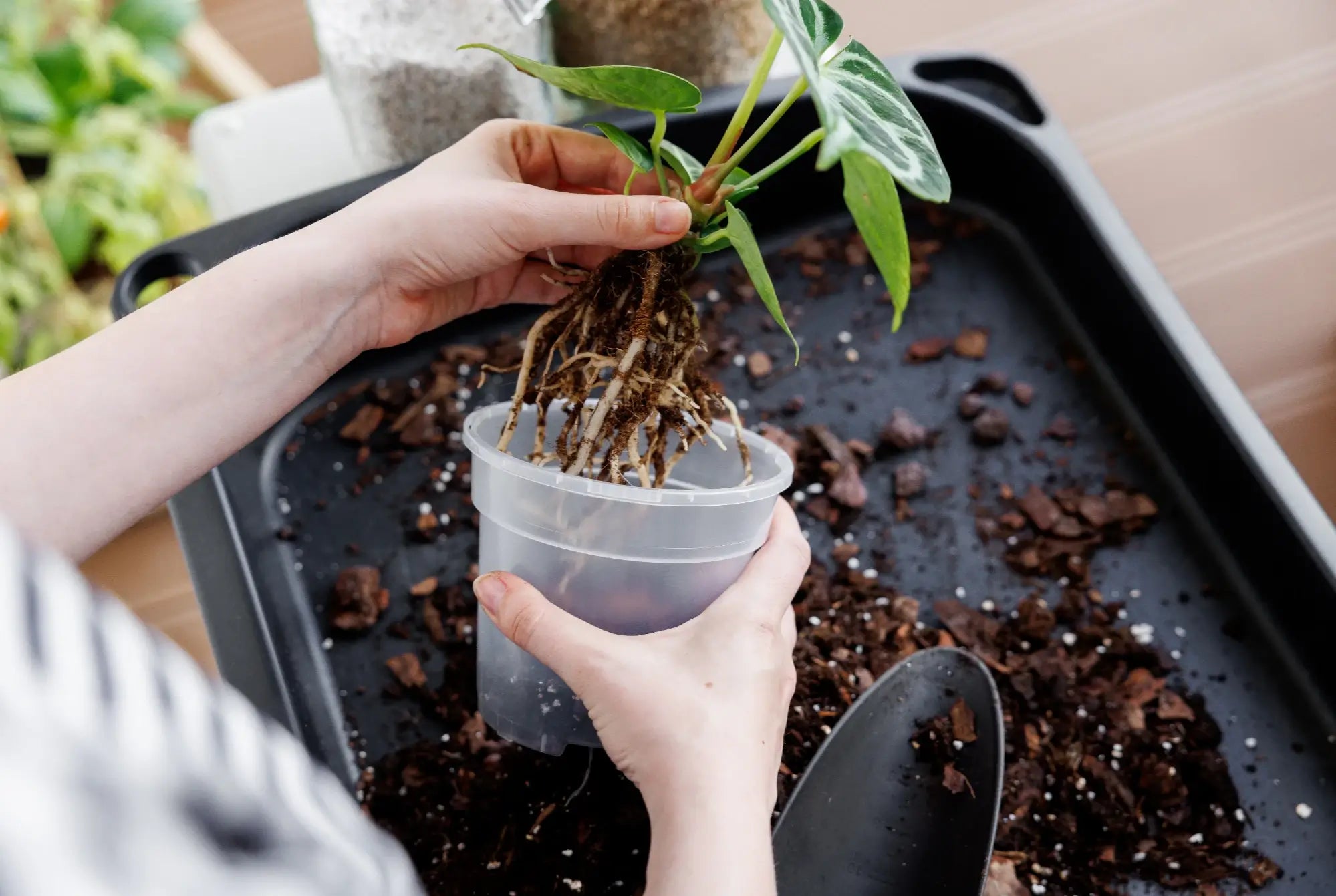
3) Transition without shock (especially if roots are already struggling)
- Unpot and rinse gently so you can actually see root condition.
- Remove only what’s truly dead (mushy, hollow, sloughing). Keep firm roots even if they’re stained.
- Downsize if needed so the new mix doesn’t stay wet for days.
- Repot into structured medium and settle it lightly (don’t compact).
- Aftercare: bright light (not scorch), stable warmth, and a wet–dry rhythm that allows re-oxygenation.
4) Watering – “pulse” doesn’t mean “random”
- Mounted epiphytes: soak thoroughly, then dry fast with airflow.
- Potted climbers and hoyas: water through the medium, drain fully, then wait until the root zone is airy again.
- Avoid: keeping the pot constantly damp to “make up for humidity.” That’s a common route to chronic root dysfunction.
5) Light – dappled, not dim
Many canopy plants grow in broken light, not deep shade. Weak light is a frequent reason for stretching, small leaves, and non-blooming even when roots are healthy.
If you want a practical definition of bright, indirect light, that guide breaks it down without guesswork. For choosing spots by window orientation, see Understanding Window Orientations and Plant Selection.
6) Feeding and water quality – keep salts under control
- Low dose, consistent: safer than occasional heavy feeding.
- Flush occasionally: bark/semi-hydro can accumulate salts quickly.
- Hard water note: mineral-heavy water can leave deposits over time, especially in bark and on exposed roots.
🔗 For deeper dives on setup and mechanics: substrate guide, the watering guide, From Soil to Semi-Hydro.
🔗 For Araceae growth forms and support logic: aroid overview.
Common Epiphyte Care Mistakes (and How to Fix Them)
| Problem | Likely Cause | Fix |
|---|---|---|
| Roots rotting | Fine, dense media + prolonged wetness + poor re-oxygenation | Repot into structured bark/mineral mix; improve pot aeration; water thoroughly then let the medium return to airy |
| Aerial roots sprawling | Searching for grip and usable moisture pockets | Add a stable support; guide roots into breathable material (cork, airy pole, bark pockets) |
| Stalled growth / small leaves | Weak light, no support for climbers, chronic root stress | Increase light safely; add support; rebuild root-zone structure |
| Yellowing / curling leaves | Root dysfunction from chronic wetness, salt buildup, or sharp dry air swings | Check roots; flush salts; stabilize conditions; avoid constant damp pots |
| Orchids won’t bloom | Too little light, weak roots, missing temperature cues (varies by genus) | Strengthen roots in airy bark; increase light; for Phalaenopsis, a cooler night period often helps trigger spikes |
| Hoyas not flowering | Not enough light, chronic wetness, immaturity, or peduncles removed | Brighter light + airy mix + drying rhythm; keep peduncles; keep conditions steady once buds form |
| Tank bromeliads rotting | Stagnant water in cool, still conditions; substrate staying wet | Flush and refresh the tank; keep warm with airflow; keep the root zone airy rather than wet |
| Semi-hydro decline | Salt accumulation, stale reservoir, roots not adapted yet | Use low-dose fertilizer, flush regularly, refresh reservoir, transition gradually |
| Wrong-care mismatch | Treating a terrestrial plant like an epiphyte (or vice versa) | Identify growth form first; not every “tropical” plant benefits from bark-heavy mixes |
Epiphytes Indoors — Why Support, Mounts, and Airy Mixes Matter
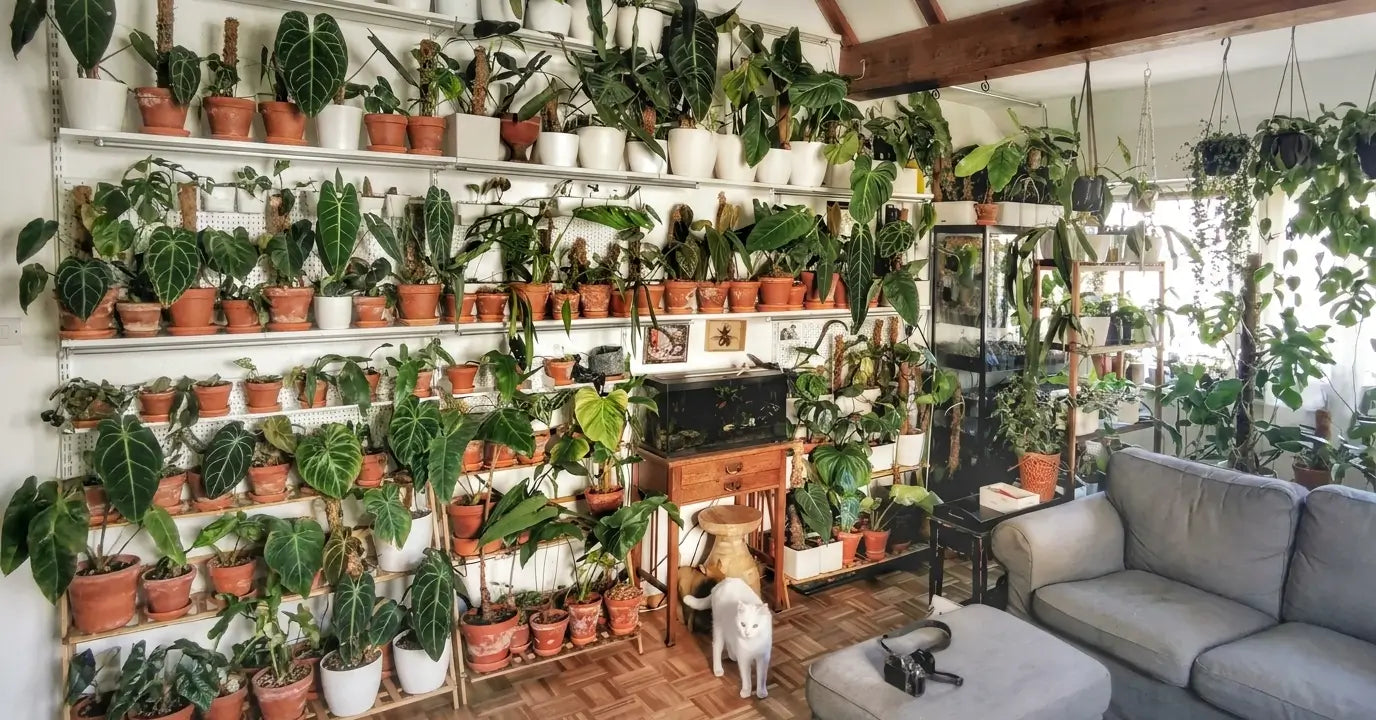
Epiphytes turn vertical space into habitat. Indoors, the same biology shows up as healthier roots, stronger growth form, and fewer “mystery” problems when roots are given breathable structure and a functional climb.
- Climbing aroids often mature through climbing and rooting into surfaces.
- Orchids function best when roots can re-oxygenate rapidly after watering.
- Mounted ferns and epiphytic cacti often stabilize once the root zone can breathe and dry predictably.
Why Your Choices Matter
Epiphyte-rich lineages include many range-restricted species. Not every epiphyte is endangered, but habitat loss and microclimate change can hit some groups hard. Choosing nursery-grown plants and avoiding wild-harvest materials reduces pressure on vulnerable habitats.
Epiphyte FAQs — Roots, Growth, Fertilizer, and Mounting
Why are orchid roots silvery or white?
Velamen looks silver when dry and turns green when hydrated. It’s designed for rapid uptake and airflow.
Why do aerial roots wander on climbing aroids?
They’re searching for a surface that offers grip and moisture pockets. A stable support plus a breathable rooting surface usually changes the whole growth pattern.
Do epiphyte-style plants need fertilizer?
Yes, but low-dose feeding is safer than heavy dosing. Bark and semi-hydro can accumulate salts quickly, so occasional flushing matters.
Why does Phalaenopsis refuse to bloom?
- Light: most “no bloom” cases are simply not enough light for spike formation.
- Root health: stressed roots can’t support flowering effort.
- Temperature cue: a modest cooler-night period often helps trigger spikes in season.
Why does Hoya grow but never flower?
- Light: flowering usually needs stronger light than “survival bright.”
- Maturity: many plants won’t bloom until they’ve built enough mass.
- Peduncles: keep them; repeated blooms come from existing spurs in many species.
- Stability: frequent moves and constant wetness can keep growth vegetative.
Can epiphytes be grown without pots?
Many can. Mounting orchids, Platycerium, Dischidia, and some hoyas often works very well when soak-and-dry cycles and airflow are reliable. Root-climbing aroids usually still benefit from a grounded root zone indoors, even when supported on poles or boards.

Conclusion — The Real Problem Isn’t “Soil,” It’s Suffocation
Many popular houseplants don’t fail because they “hate soil minerals.” They fail because fine, wet media becomes oxygen-poor. Epiphytes and epiphyte-style climbers are built for structure, airflow, and water in pulses, plus enough light to pay for growth.
The fix is better physics: chunkier structure, better aeration, a wet–dry rhythm, and the right kind of support. Once roots can breathe, the rest of the plant starts making sense.
What to do at home:
- Give roots structure + oxygen: bark-heavy mixes, baskets, slotted pots, breathable poles/boards.
- Water in a wet–dry rhythm: thorough wetting, full drainage, then re-oxygenation.
- Feed low-dose and consistently, and flush occasionally to prevent salt buildup.
- Choose nursery-propagated plants and avoid wild-harvest materials.
Glossary of Key Terms
Accidental epiphyte – A plant that normally grows in soil but occasionally establishes on other plants under favorable conditions.
Aerial roots – Roots produced above the substrate; they can anchor, explore, or capture resources depending on species and conditions.
Aroids – Members of Araceae (e.g., Monstera, Philodendron, Anthurium). Growth forms range from terrestrial to canopy-rooting climbers.
Canopy humus – Organic debris that accumulates in canopy forks and mats, forming a fluffy, highly aerated substrate.
Epiphyte – A non-parasitic plant that grows on other plants for support, harvesting moisture and nutrients from rain, mist, and debris.
Facultative epiphyte – A plant that can grow epiphytically or terrestrially when oxygen and structure are present.
Hemiepiphyte – A plant with an epiphytic phase during its life cycle; usage varies, especially for climbing aroids.
Lithophyte – A plant that grows on rock, often in crevices filled with airy organic debris.
Mycorrhizal partnership – A symbiosis between fungi and roots; essential for orchid seed germination.
Pseudobulb – A swollen orchid stem that stores water and carbohydrates.
Shield fronds – Sterile, protective staghorn fern fronds that trap debris and protect roots.
Trichomes – Specialized leaf hairs (notably in Tillandsia) that absorb water and dissolved nutrients.
Velamen radicum – Multi-layered outer root tissue in many orchids (and in some aroids), aiding rapid water uptake and buffering drying.
References and Further Reading
- Bader, M. Y., & Zotz, G. (2009). Epiphytic plants in a changing world: Global change effects on vascular and non-vascular epiphytes. In U. Lüttge, W. Beyschlag, & B. Büdel (Eds.), Progress in botany (Vol. 70, pp. 147-170). Springer. https://doi.org/10.1007/978-3-540-68421-3_7
- Bartels, S. F., & Chen, H. Y. H. (2012). Mechanisms regulating epiphytic plant diversity. Critical Reviews in Plant Sciences, 31(5), 391–400. https://doi.org/10.1080/07352689.2012.680349
- Benzing, D. H. (1990). Vascular epiphytes: General biology and related biota. Cambridge University Press. https://doi.org/10.1017/CBO9780511525438
- Benzing, D. H. (2000). Bromeliaceae: Profile of an adaptive radiation. Cambridge University Press. https://doi.org/10.1017/CBO9780511565175
- Costa, D. S., Zotz, G., Hemp, A., & Kleyer, M. (2018). Trait patterns of epiphytes compared to other plant life-forms along a tropical elevation gradient. Functional Ecology, 32(8), 2073–2084. https://doi.org/10.1111/1365-2435.13121
- Dycus, A. M., & Knudson, L. (1957). The role of the velamen of the aerial roots of orchids. Botanical Gazette, 119(2), 78–87. https://doi.org/10.1086/335966
- Einzmann, H. J. R., Andrade, J. L., & Zotz, G. (2023). CAM plants: Their importance in epiphyte communities and prospects with global change. Annals of Botany, 132(4), 685–698. https://doi.org/10.1093/aob/mcac158
- Faria, R. T., Stegani, V., Bertoncelli, D., Alves, G. A. C., & Assis, A. M. (2018). Substrates for the cultivation of epiphytic orchids. Semina: Ciências Agrárias, 39(6), 2851–2866. https://doi.org/10.5433/1679-0359.2018v39n6p2851
- Ferreira, R. O., Borges, R. A. X., & Mayo, S. J. (2020). Anatomy of the adventitious roots of Philodendron (Araceae) and its importance for the systematics of the genus. Australian Systematic Botany, 33, 207–219. https://www.publish.csiro.au/sb/SB18038
- Helbsing, S., Riederer, M., & Zotz, G. (2000). Cuticles of vascular epiphytes: Efficient barriers for water loss after stomatal closure? Annals of Botany, 86(4), 765–769. https://doi.org/10.1006/anbo.2000.1239
- Hew, C. S., & Yong, J. W. H. (2004). The physiology of tropical orchids in relation to the industry (2nd ed.). World Scientific. http://dx.doi.org/10.1142/9789812819871_0004
- Hoeber, V., & Zotz, G. (2021). Not so stressful after all: Epiphytic individuals of accidental epiphytes experience more favourable abiotic conditions than terrestrial conspecifics. Forest Ecology and Management, 479, 118529. https://doi.org/10.1016/j.foreco.2020.118529
- Hoeber, V., & Zotz, G. (2022). Accidental epiphytes: Ecological insights and evolutionary implications. Ecological Monographs, 92(4), e1527. https://doi.org/10.1002/ecm.1527
- Inselsbacher, E., Cambui, C. A., Richter, A., Stange, C. F., Mercier, H., & Wanek, W. (2007). Microbial activities and foliar uptake of nitrogen in the epiphytic bromeliad Vriesea gigantea. New Phytologist, 175(2), 311–320. https://doi.org/10.1111/j.1469-8137.2007.02098.x
- Krömer, T., & Batke, S. P. (2025). Epiphytic Plants: Perspective on Their Diversity, Distribution, Systematics and Conservation in the Changing Environment. Plants, 14(15), 2265. https://doi.org/10.3390/plants14152265
- Nieder, J., Prosperi, J., & Michaloud, G. (2001). Epiphytes and their contribution to canopy diversity. Plant Ecology, 153(1), 51–63. https://doi.org/10.1023/A:1017517119305
- Svahnström, V. J., Nic Lughadha, E., Forest, F., Leão, T. C. C., et al. (2025). Geographic range size and rarity of epiphytic flowering plants. Nature Plants. https://doi.org/10.1038/s41477-025-02022-9
- Watkins, J. E., & Cardelus, C. (2012). Ferns in an angiosperm world: Cretaceous radiation into the epiphytic niche and diversification on the forest floor. International Journal of Plant Sciences, 173(6), 695–710. https://doi.org/10.1086/665974
- Yang, S.-J., Sun, M., Yang, Q.-Y., Ma, R.-Y., Zhang, J.-L., & Zhang, S.-B. (2016). Two strategies by epiphytic orchids for maintaining water balance: Thick cuticles in leaves and water storage in pseudobulbs. AoB Plants, 8, plw046. https://doi.org/10.1093/aobpla/plw046
- Zimmerman, J. K. (1990). Role of pseudobulbs in growth and flowering of Catasetum viridiflavum (Orchidaceae). American Journal of Botany, 77(4), 533–542. https://doi.org/10.1002/j.1537-2197.1990.tb13585.x
- Zotz, G. (2005). Vascular epiphytes in the temperate zones – A review. Plant Ecology, 176(2), 173–183. https://doi.org/10.1007/s11258-004-0066-5
- Zotz, G. (2013). The systematic distribution of vascular epiphytes – a critical update. Botanical Journal of the Linnean Society, 171(3), 453–481. https://doi.org/10.1111/boj.12010
- Zotz, G. (2013). “Hemiepiphyte”: A confusing term and its history. Annals of Botany, 111(6), 1015–1020. https://doi.org/10.1093/aob/mct085
- Zotz, G., Weigelt, P., Kessler, M., Kreft, H., & Taylor, A. (2021). EpiList 1.0: a global checklist of vascular epiphytes. Ecology. https://doi.org/10.1002/ecy.3326
- Zotz, G., & Hietz, P. (2001). The physiological ecology of vascular epiphytes: Current knowledge, open questions. Journal of Experimental Botany, 52(364), 2067–2078. https://doi.org/10.1093/jexbot/52.364.2067
- Zotz, G., & Winkler, U. (2013). Aerial roots of epiphytic orchids: The velamen radicum and its role in water and nutrient uptake. Oecologia, 171(3), 733–741. https://doi.org/10.1007/s00442-012-2575-6
- International Aroid Society (Aroideana journal). https://www.aroid.org/aroideana/
- CATE Araceae. https://cate-araceae.myspecies.info/
- Aroidpedia. https://www.aroidpedia.com/


Leave a comment