

Why Is My Plant Drooping? Dry Wilt vs Wet Wilt
Drooping does not automatically mean “water me.” It means the leaves are not being held up properly by internal water pressure.
That can happen in two opposite ways. The substrate around the roots may be too dry, so the plant cannot replace the water its leaves are losing. Or the pot may be wet, but the roots may be too oxygen-stressed, damaged, cold or rotten to move water upward properly.
Dry wilt and wet wilt can look almost identical above the pot. The root area gives you the answer.
Before watering, fertilising, repotting or moving the plant across the room, check what is happening below the surface.

Fast drooping diagnosis
Plant drooping + dry, light pot
Likely direction: dry wilt
➜ First check: moisture deeper in the pot, not only on the surface
✓ Do now: water thoroughly, let excess drain, then reassess
Plant drooping after watering
Likely direction: dry pockets, root damage, heat stress or light stress
➜ First check: whether water actually reached the centre of the pot
✓ Do now: check moisture distribution before watering again
Plant drooping + wet, heavy pot
Likely direction: wet wilt or root oxygen stress
➜ First check: pot weight, smell, root colour and substrate density
✓ Do now: stop watering; inspect the roots if decline continues
Plant drooping + yellow lower leaves
Likely direction: root stress, old-leaf decline or water imbalance
➜ First check: wet/dry status before feeding
✓ Do now: check the roots before fertilising
Plant drooping after delivery
Likely direction: transport and acclimation stress
➜ First check: timing, older leaves, stem firmness and moisture in the pot
✓ Do now: settle the plant in steady conditions; avoid rushed repotting
Plant drooping after repotting
Likely direction: root disturbance, poor root contact, unstable support or moisture mismatch
➜ First check: pot size, substrate fit, moisture around the roots and physical stability
✓ Do now: keep conditions steady, lightly moist and not soaked
Plant drooping near hot or cold glass
Likely direction: water loss and uptake are out of balance
➜ First check: leaf temperature, cold roots and pot moisture
✓ Do now: move the plant to steadier conditions
Plant drooping + stippling, webbing or silvering
Likely direction: pest pressure
➜ First check: leaf undersides, new leaves, sticky residue, black specks or webbing
✓ Do now: isolate the plant and inspect closely
Plant drooping while substrate stays wet for days
Likely direction: low light, dense substrate, oversized pot or weak roots
➜ First check: drying speed and root health
✓ Do now: improve aeration around the roots and adjust light if needed
💡Leaf droop is different from stem collapse. Limp leaves can recover if the roots, stems and growing points are still firm. Soft stems, a blackened crown, mushy petioles or a collapsing base are more urgent signs of tissue damage, cold damage or rot.
First check: is the root area dry or wet?
Do not diagnose from the top layer alone. The surface can look dry while the centre of the pot is still wet. It can also look recently watered while the inner root ball is still dry because water ran down the sides.

Check several clues together:
- Pot weight: dry pots usually feel much lighter than wet pots of the same size.
- Moisture below the surface: check deeper than the top layer before adding water.
- Drainage holes: look for standing moisture, a stale smell or visible root condition.
- Clear nursery pot: useful for reading condensation, drying pattern and root colour without constant unpotting.
- Water movement: fast runoff can mean water is passing around the root ball instead of soaking through it.
- Drying speed: substrate that stays wet for days points to low water use, poor aeration, too much pot volume or root decline.
- Cachepot: check the outer pot too. Water trapped under the nursery pot can keep the lower root area wet while the surface looks normal.
💡 For a simple physical check, a wooden probe such as The Soil Checker is useful because it reads deeper moisture better than a quick surface touch.

📌 Quick rule:
Dry around the roots = water may be needed.
Wet around the roots = more water is usually wrong.
Unclear moisture status = check again before acting.
Roots do not simply sit in water and drink. Water has to move through functioning root tissue and into the plant. Root water transport depends on root structure, hydraulic properties and living root function, not just on whether the pot contains moisture.
Dry wilt: when drooping really means the plant needs water
Dry wilt is straightforward. The substrate around the roots has dried enough that the plant cannot replace the water lost from its leaves. Leaves soften, petioles lose firmness, and the plant may suddenly look smaller, tired or folded downward.
Dry wilt is likely when:
- the pot feels light
- the substrate is dry below the surface
- leaves are soft but not mushy
- leaf edges feel dry or slightly crisp
- the plant improves after thorough watering
- the plant has been in bright warmth, active growth or fast-drying substrate
- water runs through the pot quickly without soaking the root ball evenly

Wilting is linked to loss of turgor pressure inside plant cells. Turgor loss point is widely used in plant-water-stress research because it marks when leaf tissue can no longer stay pressurised in the same way.
🔗 For a deeper watering framework, use our houseplant watering guide.
If the plant perks up after watering
If the plant perks up after watering, dry wilt was probably involved. Some plants stand back up within a few hours; others take longer. Older leaves may stay creased, tired or partly damaged if the plant wilted hard.
✗ Avoid letting the plant collapse repeatedly before watering. Repeated hard wilt weakens leaves, damages fine roots and makes the plant less resilient.
If water runs through but the plant stays limp
The root ball may have become hard to rewet. Peat-rich and some organic substrates can become hydrophobic after drying too far, so water channels down the sides while the centre stays dry. Research on peat-based substrates shows that drying can reduce rewetting ability.
In that case, water slowly. Add water, pause, let the substrate absorb it, then water again. For suitable pots, a short bottom soak can help rehydrate the centre more evenly. Once the root ball is moist again, let excess drain fully.
✗ Do not leave the plant sitting in water for hours. For risks and proper use cases, see our bottom watering guide.
Wet wilt: why overwatered plants can look thirsty
Wet wilt is more misleading. The leaves look thirsty, but the pot is already wet.
When substrate remains saturated, air spaces around the roots fill with water. Roots need oxygen for normal function. Waterlogged conditions can reduce root oxygen supply and affect growth, nutrient uptake, hydraulic function and photosynthesis.
That is why a plant can droop in wet substrate. Water is present, but the roots are not working well enough to move it.
Wet wilt is likely when:
- the pot feels heavy
- the substrate stays wet for several days
- leaves are limp but watering does not help
- lower leaves yellow while the mix stays wet
- stems soften near the base
- the pot smells sour, stale or rotten
- roots look brown, grey, hollow, slimy or mushy
- the substrate is dense, compacted or broken down
- the pot is much larger than the root system
- the plant is in low light and using little water
🚩 Red flag:
Drooping + wet substrate + yellow lower leaves + sour smell = check the roots.

Low light matters because plant growth and water use often slow when usable light is limited. Indoors, this can make the substrate dry more slowly and leave stressed roots with less energy for recovery.
🔗 For more on this part of the problem, read our drainage and aeration guide, substrate guide and root rot guide.
When to inspect roots
Inspect the roots if the plant droops while the substrate stays wet, the pot remains heavy for days, lower leaves yellow quickly, the base softens, the substrate smells sour, or visible roots are brown, grey, hollow or mushy.
➜ If the roots are mostly firm and healthy, improving the conditions may be enough: brighter indirect light, stable warmth, better drainage, better aeration and less frequent watering.
➜ If the roots are mushy, hollow or rotten, dead tissue needs removing and the plant may need a more suitable, airier substrate.
Why your plant is drooping after watering
A plant drooping after watering usually means one of three things.
1. The root ball did not actually rehydrate
Water may have run through dry channels. The surface looks wet, but the centre of the pot is still dry. This is common after severe drying.
2. The roots are damaged
If the roots were already oxygen-stressed, cold-damaged or rotting, watering will not restore uptake. Water is there, but there may not be enough functional root tissue left to move it properly.
3. The leaves are losing water faster than the roots can replace it
Hot glass, direct sun, strong grow lights too close, draughts, dry moving air or cold roots can put water loss and water uptake out of balance.
Do not water again automatically. Check whether the substrate core is dry, evenly moist, overly wet, cold, compacted or affected by root damage.
Drooping after delivery
Drooping after delivery is common and not always serious. The plant has been boxed in darkness, moved through changing temperatures and handled outside normal growing conditions.
Shipping can temporarily affect a plant because it spends time boxed, dark and exposed to changing temperatures. Older leaves may droop, yellow or shed after delivery, especially if the plant was already carrying older growth. That does not mean every post-delivery droop is harmless. Whole-plant collapse, mushy stems, a blackened base or rotten roots are not normal settling-in.

Usually less worrying
- one older lower leaf hanging or yellowing
- temporary limpness after unpacking
- slightly lowered leaves in the first day or two
- firm stems, crown or growing point
- new growth that is still intact
❗More worrying
- mushy stems
- a blackened base
- a rotten smell
- the whole plant collapsing while the substrate is wet
- roots that are visibly brown, hollow or slimy
- cold-damaged, translucent tissue
After delivery, give the plant bright indirect light, normal room warmth, no direct hot sun, no cold sill, and water only when the pot actually calls for it.
💡 Do not repot immediately unless the roots are clearly failing or the substrate is staying wet in a risky way. For settling-in care, read our houseplant acclimation guide.
Usually less urgent:
One older lower leaf drooping after delivery while stems and new growth stay firm.
Drooping after repotting
Repotting disturbs roots. Fine roots can break, root hairs are disrupted, and contact between the roots and the substrate changes. The plant may droop because uptake is temporarily reduced while the roots settle again.
Common causes include:
- root disturbance
- air pockets around the roots
- heavy trimming or teasing of the root ball
- the old root ball and new substrate drying at different speeds
- a sudden shift from a fine mix to a coarse mix, or from a coarse mix to a dense mix
- a pot that is too large for the root system
- new substrate staying wet around reduced roots
- soaking the plant heavily after repotting
- loose support, an unstable root ball or top-heavy stems
➜ After repotting, root recovery may happen before the leaves visibly improve.
➜ For larger climbing plants, check the support too. A loose pole, unstable root ball or top-heavy stem can look like drooping even when water status is not the main issue.
➜ Keep moisture steady, not soggy. Keep light bright but gentle. Do not keep repotting again because the leaves still look tired.
➜ If the mix is wet and the plant keeps declining, treat it as root stress rather than normal repotting sulk. For pot size, substrate choice and safer timing, use our repotting guide.
Drooping from heat, cold or strong light
Drooping can happen when leaf water loss is faster than root uptake. The pot does not have to be bone dry for this to happen.
Watch for:
- midday droop near bright glass
- leaves touching hot windows
- direct sun through glass
- grow lights too close
- cold windowsills
- cold floors
- warm leaves above cold roots
- draughts from doors or windows
- dry moving air from fans, heaters or ventilation

Cold roots are easy to miss. Research on cold root temperature found that low root temperatures reduced water transport rate, stem water potential and stomatal conductance.
In indoor terms: roots may slow down while leaves still lose water. Adding water to already cool, wet substrate makes the problem worse.
Dry moving air can increase leaf water loss, especially when the roots are cold, dry or already damaged.
Move the plant away from hot glass, cold glass, cold surfaces or harsh direct light. Then reassess moisture before changing watering.
🔗 For placement and artificial light setup, use our bright indirect light guide and grow light guide.
Drooping with yellow leaves
Drooping plus yellowing usually needs a moisture and root check first.
One yellowing older lower leaf can be old-leaf decline, especially after delivery, repotting or a stress event. Several yellowing leaves plus drooping, especially with a wet pot, point more strongly toward root trouble. For a fuller pattern diagnosis, use our guide to yellow leaves on houseplants.
✗Do not fertilise first. Fertiliser is not emergency care for a plant with failing roots.
Check:
- is the substrate dry or wet?
- does the pot stay wet too long?
- are the roots firm or soft?
- is the pot oversized?
- is the plant in too little light for the current watering rhythm?
Yellowing needs its own pattern diagnosis: which leaves, where on the plant, how fast, and with what root condition.
Drooping with pests
Pests can make plants look weak, limp or slow, especially when feeding damage reduces leaf function or damages new growth.
Drooping alone is not enough to diagnose pests. Drooping plus visible damage is different.
Check for:
- fine webbing
- pale stippling
- silvered or scraped-looking patches
- black specks from thrips
- sticky residue
- cottony clusters
- distorted new leaves
- weak growth points
- leaves that fail before they harden
💡 Thrips feeding can cause stippling, silvering, scarring and discoloration. Spider mites feed by piercing cells and removing contents, which can leave pale stippling and weakened tissue.
📌 Inspect leaf undersides, petioles, cataphylls, new leaves and tight growth points. Isolate suspect plants before treatment. Use our thrips guide, spider mite guide or beneficial insects guide once you know what pest you are dealing with. A contact product such as Insect Heroes Plant Soap only belongs here when pest signs are actually present.
Should you water a drooping plant immediately?
Only when the area around the roots is actually dry. A light pot, dry deeper substrate and soft but not mushy leaves point toward dry wilt. A wet, heavy pot points in the opposite direction: stop watering and check the roots, oxygen and drying speed instead.
💡 Adding water without checking the pot first can make a stressed plant worse.
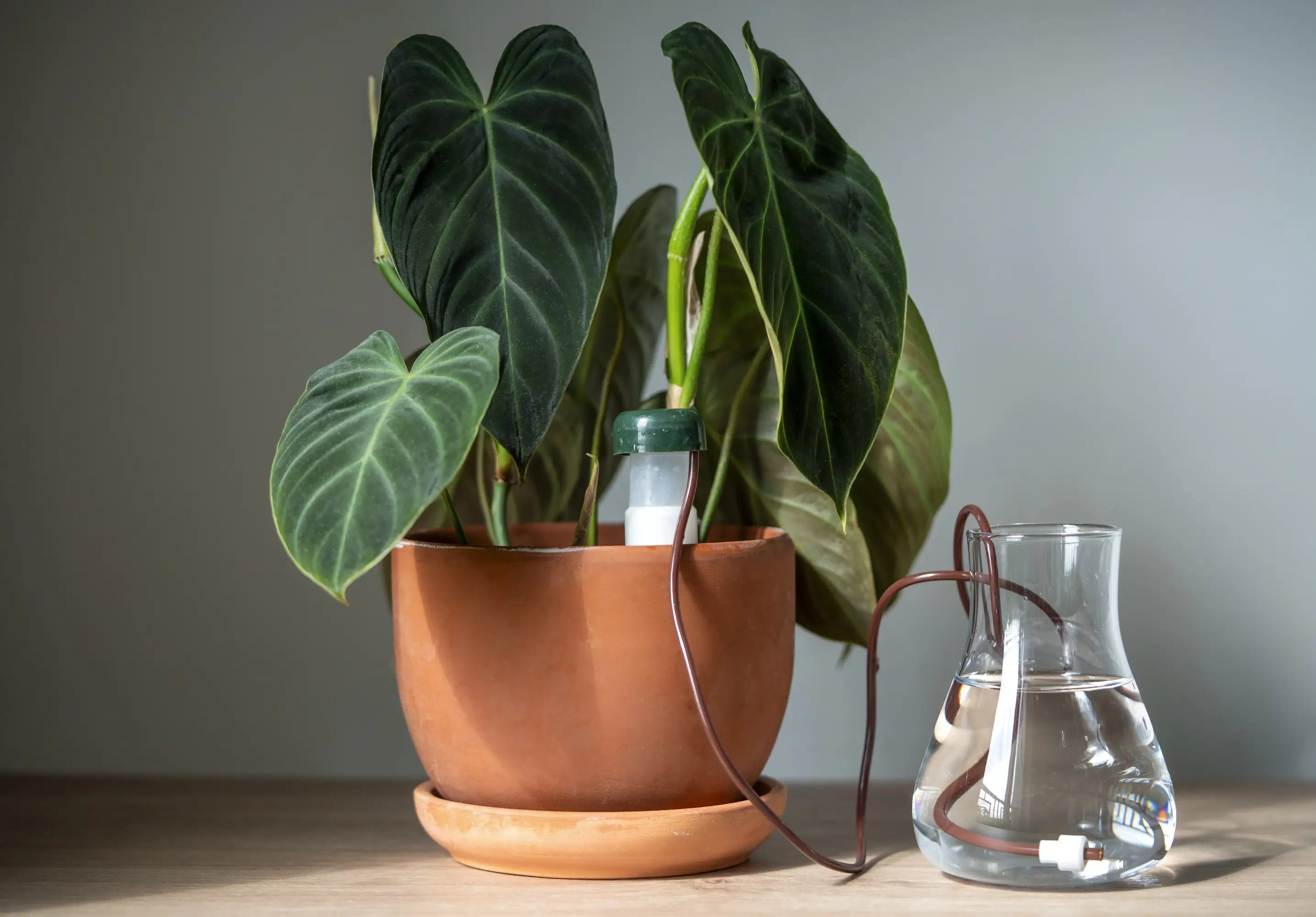
Self-watering pots: useful, but not a rescue tool
Self-watering pots can work well for some plants, but only when the roots are healthy, the substrate is suitable and the light is strong enough for steady water use.
They are not a fix for:
- rotting roots
- dense soil
- cold windowsills
- very low light
- plants already collapsing in wet substrate
- succulents or dry-adapted plants in moisture-retentive mixes
If the plant is drooping while the pot is wet, moving it into a self-watering setup usually makes diagnosis harder and root stress worse. Use our self-watering pots guide before switching systems.
How to help a drooping plant recover
Dry wilt
✓ What helps: water thoroughly, let excess drain, keep conditions steady
✗ Avoid: tiny sips, repeated collapse before watering
Hydrophobic root ball
✓ What helps: rehydrate slowly; use a short bottom soak only when suitable
✗ Avoid: assuming fast runoff means the centre is wet
Wet wilt
✓ What helps: stop watering, empty the cachepot, improve light and air around the roots
✗ Avoid: more water, fertiliser, stagnant wet mix
Root rot suspicion
✓ What helps: inspect the roots, remove dead tissue, move into suitable airy substrate
✗ Avoid: waiting while the plant collapses in wet substrate
Delivery stress
✓ What helps: stable light, warmth and careful watering
✗ Avoid: immediate repotting, fertilising, daily moving
Repotting stress
✓ What helps: even moisture, no further disturbance, steady conditions
✗ Avoid: repotting again quickly, soaking to “help”
Heat or light stress
✓ What helps: reduce harsh exposure, move from hot glass or direct sun
✗ Avoid: dark recovery corner, repeated location changes
Cold-root stress
✓ What helps: move from a cold sill or floor, keep the roots warmer
✗ Avoid: extra watering while the roots are cold
Pest stress
✓ What helps: isolate, inspect, treat based on the pest found
✗ Avoid: treating blindly without checking signs
💡 Plants recover fastest when the cause is corrected and conditions stop changing. Fix the most likely issue first, then give the plant time to respond before making another change.
How long does recovery take?
Dry wilt may improve within hours if the roots are functional and leaf tissue has not been damaged. Severe dehydration can leave older leaves creased, yellowed or partly collapsed even after watering.
Wet wilt, repotting stress, cold-root stress and root loss recover more slowly because the plant has to rebuild root function first. Judge progress by firm stems, stable new growth, healthy roots and a pot that dries at a normal pace, not by one older leaf.
What not to do
✗ Do not water again if the substrate is already wet.
✗ Do not fertilise a collapsing plant.
✗ Do not repot every drooping plant immediately.
✗ Do not move the plant repeatedly in the same week.
✗ Do not assume humidity is the main issue.
✗ Do not diagnose from a dry surface alone.
✗ Do not leave the plant standing in water inside the cachepot.
✗ Do not ignore substrate that stays wet for days.
✗ Do not move a root-stressed plant into a self-watering pot as a rescue.
✗ Do not remove every drooping leaf before checking whether the stems, roots and new growth are still viable.
Drooping is stressful to see, but overcorrecting often causes more damage than the original problem. Plants with root stress need oxygen, stability and accurate diagnosis.
Plant-specific drooping notes
Alocasia
Alocasia can change leaf angle noticeably, and older leaves may decline after stress or while new growth develops. Drooping can come from drought, cold exposure, delivery stress or root damage. A wet pot plus drooping is the main red flag, especially if lower leaves yellow at the same time. If the crown, corm or rhizome tissue feels soft instead of firm, treat it as urgent rot risk rather than normal leaf adjustment.
Spathiphyllum
Spathiphyllum often shows dramatic dry wilt and may stand back up after thorough watering. That does not make repeated collapse harmless. Repeated hard wilt can weaken older leaves and leave them creased or yellowed. If Spathiphyllum droops while the substrate is wet, check the roots rather than adding more water.
Philodendron and Monstera
Large leaves can droop when the roots are dry, cold, disturbed after repotting or sitting in dense wet substrate. After repotting, leaves may hang because the roots have lost contact or anchoring. In low light, the substrate may stay wet longer, slowing recovery and increasing root stress.
Anthurium
Anthurium roots need oxygen around them. Dense, stagnant mix is a warning sign, especially when leaves droop and the substrate stays wet. Airy, structured substrate is usually safer than fine soil that holds water tightly around the roots. Limp leaves with firm roots are less concerning than limp leaves with sour substrate and soft, dark roots.
Hoya
Soft or wrinkled Hoya leaves can mean drought, but they can also mean root loss. Repeated watering without checking the roots can make decline worse. If Hoya is limp and the substrate is wet, inspect root health before watering again. Healthy Hoya roots are usually firm; dead roots often slip, hollow out or detach easily.
Prayer plants
Prayer plants move their leaves naturally through daily light cycles, so timing matters. Evening lift or folding is not the same as stress collapse. Limp leaves during the day, crispy edges, pests, wet substrate or repeated failure to recover all need closer checks. Nyctinastic leaf movement is driven by pulvinus-related turgor changes, so normal movement and stress droop should not be confused.
Succulents
Soft, drooping succulent leaves with wet substrate are a rot warning, not a watering cue. Many succulents tolerate dry periods better than stagnant wet roots. If the leaves are soft and the pot is wet, stop watering and check root health.
FAQ
Should I water a drooping plant?
Only if the area around the roots is actually dry. If the substrate is wet, watering again can make root stress worse. Check pot weight, deeper moisture, drainage holes and drying speed before acting.
Why is my houseplant drooping even after watering?
The root ball may still be dry inside, especially if water ran through channels. Roots may also be damaged, so water is present but not moving into the plant properly. Heat, strong light, dry moving air or cold roots can also keep leaves limp after watering.
Can overwatering make plants droop?
Yes. Overwatering can keep substrate saturated, reducing oxygen around the roots. Oxygen-stressed or damaged roots cannot absorb and transport water properly, so leaves may droop even though the pot is wet.
Why is my plant drooping while soil is still wet?
Likely causes include root oxygen stress, root damage, dense substrate, an oversized pot, low light or cold roots. Do not water again. Check whether the roots are firm and healthy or brown, hollow, soft or slimy.
Why is my plant drooping after repotting?
Repotting disturbs fine roots and changes contact between the roots and the substrate. The plant may droop while roots re-establish. Larger climbing plants may also sag if the support, pole or root ball is unstable. Keep moisture stable, avoid soaking, and do not repot again unless the substrate or root health is clearly wrong.
Why is my plant drooping after delivery?
Transport means darkness, movement and temperature changes. Temporary drooping can happen after unpacking, especially in older leaves. Keep the plant steady and check moisture before watering. Whole-plant collapse, mushy stems or rotten roots are not normal delivery stress.
Will drooping leaves stand back up?
Sometimes. Leaves often recover from dry wilt if the tissue has not been damaged. Leaves affected by root rot, cold damage, severe dehydration or pest damage may not return fully. Judge recovery by firm stems, stable new growth and root health, not by one old leaf.
Should I cut off drooping leaves?
Not immediately. If a leaf is still green and attached firmly, it may recover or still support the plant. Remove leaves that are yellow, mushy, rotten, fully collapsed or heavily pest-damaged.
Why does my plant droop during the day and recover later?
Daytime droop often means water loss temporarily exceeds uptake. Heat, direct sun, hot glass, strong grow lights, dry moving air or cold roots can cause this. If the plant recovers in the evening and the roots are healthy, adjust exposure before changing watering.
Can normal leaf movement look like drooping?
Yes. Some plants naturally change leaf angle through the day. Prayer plants are the clearest example. Compare the same plant at the same time of day before treating normal movement as stress.
Can pests make houseplants droop?
Yes, especially when pests damage new growth or reduce leaf function. Look for stippling, webbing, silvering, sticky residue, black specks, cottony clusters or distorted new leaves. Treat based on the pest found, not drooping alone.
Sources and further reading
-
Bartlett, M.K., Scoffoni, C. & Sack, L. “The determinants of leaf turgor loss point and prediction of drought tolerance of species and biomes: a global meta-analysis.” Supports turgor loss, wilting and plant water-stress physiology.
https://pubmed.ncbi.nlm.nih.gov/22435987/ -
Boursiac, Y., Protto, V., Rishmawi, L. & Maurel, C. “Experimental and conceptual approaches to root water transport.” Background on root water movement and why functioning root tissue matters.
https://link.springer.com/article/10.1007/s11104-022-05427-z -
Manghwar, H. et al. “Waterlogging stress in plants: Unraveling the mechanisms and impacts on growth, development, and productivity.” Supports wet-substrate, oxygen-deficient-root and impaired-function discussion.
https://www.sciencedirect.com/science/article/pii/S0098847224001825 -
León, J., Castillo, M.C. & Gayubas, B. “The hypoxia–reoxygenation stress in plants.” Supports cautious recovery advice after root-zone oxygen stress.
https://pmc.ncbi.nlm.nih.gov/articles/PMC8355755/ -
Ferrante, A. et al. “Post-production physiology and handling of ornamental potted plants.” Useful for storage, shipping and post-production quality changes in potted ornamentals.
https://www.sciencedirect.com/science/article/abs/pii/S0925521414002506 -
Macnish, A.J., Leonard, R.T. & Nell, T.A. “Sensitivity of Potted Foliage Plant Genotypes to Ethylene and 1-Methylcyclopropene.” Supports narrow discussion of ethylene sensitivity, display life, leaf senescence and abscission in traded potted foliage plants.
https://journals.ashs.org/view/journals/hortsci/46/8/article-p1127.xml -
Durand, S., Jackson, B.E., Fonteno, W.C. & Michel, J.-C. “The Use of Wood Fiber for Reducing Risks of Hydrophobicity in Peat-Based Substrates.” Supports hydrophobic dry root balls and poor rewetting after some substrates dry too far.
https://www.mdpi.com/2073-4395/11/5/907 -
Li, Y. et al. “The sensitivity of root water uptake to cold root temperature follows species-specific upper elevational distribution limits of temperate tree species.” Supports cold-root water-uptake logic; low root temperatures reduced water transport rate, stem water potential and stomatal conductance.
https://onlinelibrary.wiley.com/doi/abs/10.1111/pce.14874 -
Sugano, S., Ishii, M. & Tanabe, S. “Adaptation of indoor ornamental plants to various lighting environments.” Useful for indoor light context, growth response and recovery conditions in ornamental plants.
https://www.nature.com/articles/s41598-024-67877-y -
Rodríguez, D. et al. “Overview of Updated Control Tactics for Western Flower Thrips”; Bensoussan, N. et al. “Plant-Herbivore Interaction: Dissection of the Cellular Pattern of Tetranychus urticae Feeding on the Host Plant.” Support pest-damage cues such as stippling, silvering, scarring, discoloration and spider mite feeding damage.
https://pmc.ncbi.nlm.nih.gov/articles/PMC10380671/
https://pmc.ncbi.nlm.nih.gov/articles/PMC4961969/


Leave a comment