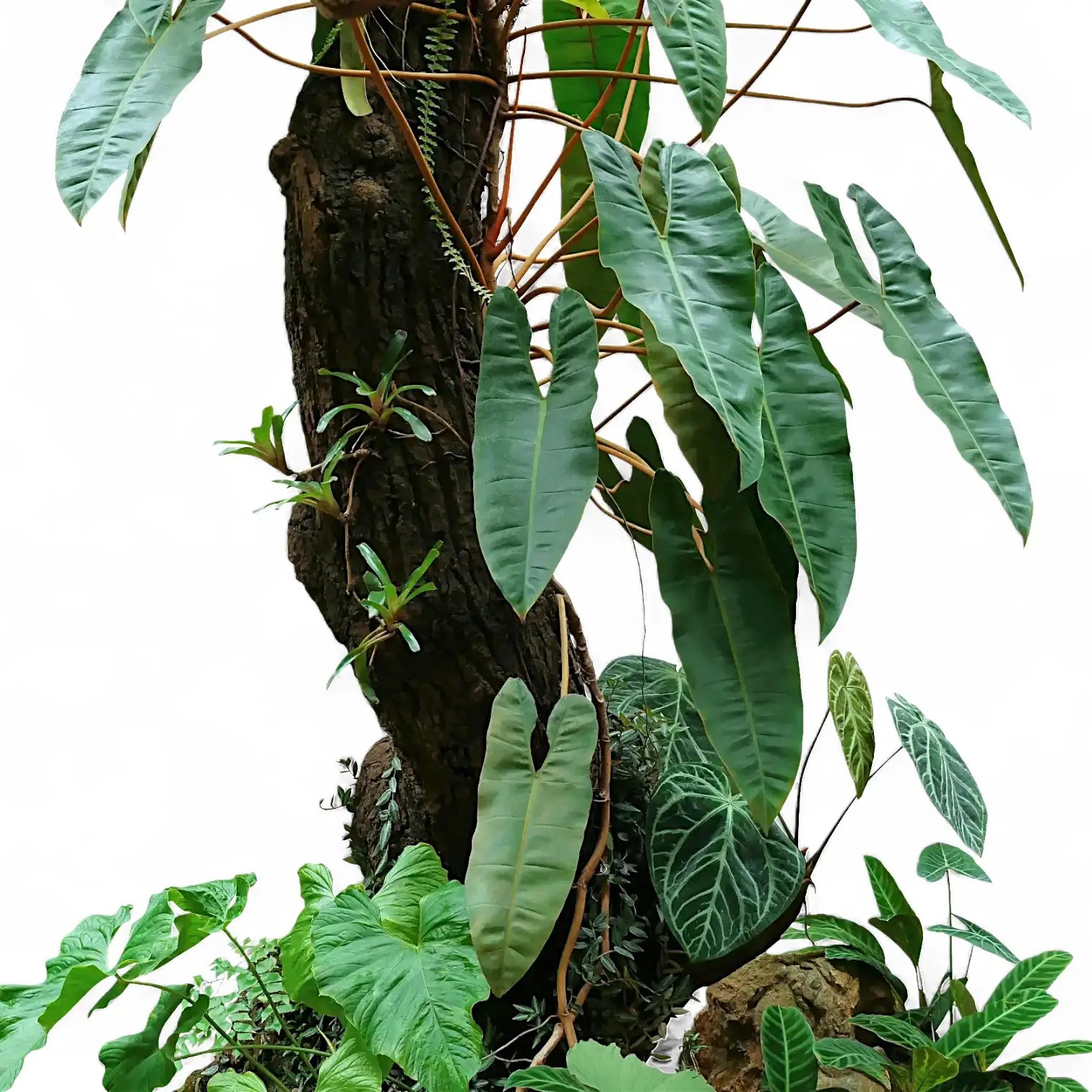
The Complete Aroid Substrate Guide: Match Mix to Roots
Stop chasing the perfect mix. Start building a responsive one.
You finally got your hands on that rare Philodendron. You gave it your best chunky “aroid mix.” At first, it looked fine. Then new leaves slowed down. Roots started to brown. The plant stalled out or died.
Chances are, the problem wasn’t your light, humidity, or pot — it was the substrate.
Most aroids don’t grow in dense soil. They sprawl across rainforest floors, climb bark, or root in floodplains — yet growers treat them all the same. That shortcut kills slowly.
Here’s what's important: Aroids evolved wildly different root systems for wildly different environments. And your mix has to match that.
Starting with structure: this Anthurium crystallinum is ready for a root-friendly mix that prioritizes airflow, texture, and adaptability.
Whether you're growing Anthurium veitchii, Philodendron gloriosum, Alocasia zebrina, or Colocasia esculenta — this is your root-first strategy for better plant health.
All great aroid care starts below the surface.
1. The 3 Golden Rules of Aroid Substrate Design
Before we talk ingredients or ratios, understand these three principles. They apply to every species and every setup.
➜ Airflow matters more than drainage
Most aroid roots don’t die from overwatering — they die from lack of oxygen. A dense or compacted mix holds moisture too long and cuts off airflow. Even “well-draining” mixes can suffocate roots if they collapse over time.
➜ Root traits determine what works
Velamen-covered roots need fast drying and surface grip. Rhizomes need a loose top layer. Dense feeder systems need biological activity. There is no universal recipe — only root-specific strategies.
➜ Observation beats recipes
The same substrate behaves differently in different homes. Factors like pot size, airflow, humidity, and watering frequency all affect how long a mix stays breathable. Observation — not online recipes — tells you when to adjust.
💡 Think of your substrate as a living system, not a static formula. It needs to evolve as your plant grows and your conditions change.
📌 Want to understand what makes aroids tick? Read our full guide on how these rainforest rebels grow and root: Aroids: The Fabulous Arum Family
Velamen-covered Anthurium roots with fresh tips and root hairs — a sign your mix is supplying oxygen and structure.
Even healthy leaves can hide root stress — matching your mix to root function is non-negotiable. That’s why substrate design has to begin with one principle:
📌 Root structure determines what works.
Aroids aren’t just foliage plants. Their roots evolved to solve different challenges: anchoring into bark, surviving flooding, crawling along soil, or breathing in saturated rainforest litter. Ramachandran et al. (2025) provide a detailed synthesis of how diverse root architectures across plant lineages, including Araceae, drive functional adaptation to these contrasting environments. Your mix should reflect that.
Gas exchange, attachment, occasional absorption; morphology and function can shift with humidity levels (Sheeran & Rasmussen 2023)
Bark-heavy, fast-drying, low organic fines
Rhizome roots
From horizontal stems (rhizomes)
Nutrient absorption, propagation
Loose top layer, shallow porosity, never sealed or soggy
Feeder-dense roots
Fine, fibrous, highly branched
High-capacity nutrient uptake
Moisture-retentive but breathable, biologically active
Aerenchyma roots
From swamp-adapted plants
Oxygen transport in low-oxygen environments
Moist but not stagnant, needs drainage and breathability in pots
What the Research Shows
Studies across multiple genera confirm that oxygen and porosity matter more than drainage alone.
Marino et al. (2022): Substrate density increases as small as 0.2 g/cm³ led to major reductions in Philodendron root growth.
McCready et al. (2020): In Anthurium and Alocasia seedlings, aeration had more impact than pot size — even with ideal moisture and light.
Ames & Lux (2022): Velamen-covered roots are highly sensitive to substrate texture, favoring bark-rich, fast-drying media.
💡 Good aroid mixes aren’t just about water flow — they’re about airflow. Bautista Bello et al. (2025) highlight how climbing aroids exhibit diverse root adaptation strategies even within the same genus, underlining the need to tailor substrates to growth form rather than taxonomy. Daawia et al. (2024) confirm that underground storage structures in corm-forming species demand stage-specific adjustments to aeration and moisture management.
Quick Guide: Matching Root Traits to Mix Priorities
Root Trait
Substrate Strategy
No velamen
Evenly moist, porous mix; avoid crusting or soggy surface
Velamen present
Fast-drying, airy mix with bark or charcoal; minimal peat or fines; consider humidity-driven morphology changes (Sheeran & Rasmussen 2023) when adjusting surface texture and moisture retention
Rhizomatous growth
Loose, breathable top layer; never bury the rhizome
Adventitious roots
Coarse structure with grip; promotes climbing and surface anchoring
Feeder-dense systems
Rich in compost, worm castings, or leaf mold; must still be aerated
Aerenchyma-rich roots
Moisture-retentive but breathable; even wet-tolerant roots need air
📌 Takeaway: One plant’s perfect mix can rot another. Know your root type before you blend.
For corm-forming aroids like Alocasia, substrate must support shallow anchoring and moisture without trapping soggy zones.
3. Growth Habits Define Substrate Needs — One Mix Doesn’t Fit All
Two Anthuriums. Same genus. One clings to bark five meters up a tree. The other pushes upright from the forest floor.
Their roots — and their substrate needs — couldn’t be more different.
That’s why this guide doesn’t group aroids by genus, but by how they grow. The way a plant lives in the wild — creeping, climbing, upright, or swamp-bound — tells you far more about what its roots need.
➜ Aroid Growth Types at a Glance
Creeping Terrestrial
Examples:Philodendron gloriosum, P. mamei
Grows from horizontal rhizomes that rest on or just below the surface.
No velamen. Extremely sensitive to compaction.
Needs a soft, airy top layer that retains moisture without sealing shut.
Growth form shifts with age — often creeping or upright at first, then climbing. Needs an adaptable substrate that evolves as the plant matures.
📌 These six growth habits are more reliable than genus when choosing a mix. Even within a single genus, species may have radically different substrate needs.
Aerial roots need structure to grip — bark-heavy mixes and rough supports mimic their natural climbing environment.
4. Function Before Ingredients — What Every Aroid Mix Must Do
A potting mix is an engineered environment. For aroids, a good mix must support six critical root functions — and most failures come from neglecting at least one.
➜ The Six Core Functions of a Healthy Substrate
Function
Why It Matters
Especially Needed By
Aeration
Keeps roots oxygenated; prevents hypoxia and root rot
Epiphytes, velamen-rooted species
Drainage
Removes excess water and salt buildup
Hemiepiphytes, appressed climbers
Moisture balance
Keeps hydration consistent without saturation or drying out
Creeping terrestrials, upright growers
Structure
Physically supports roots; prevents collapse as mix decomposes
Climbing, top-heavy, or large aroids
Biological activity
Hosts beneficial microbes and fungi that support root development
Feeder-dense species, terrestrial growers
Microbial synergy
Unlocks nutrients, suppresses pathogens, and boosts resilience in the root zone
Dense, fine-rooted and biologically active systems
📌 If your mix fails to do any of the above, the plant may struggle — no matter how often or carefully you water.
➜ Common Failures and What Causes Them
Mistake
What Happens
Why It’s a Problem
✗ Too fine / peat-heavy
Mix compacts, loses air space, stays wet too long
Root rot, fungus gnats, anaerobic decay
✗ Too chunky
Dries out too fast, especially in low humidity setups
Roots stall, toppling, poor nutrient uptake
✗ No structural support
Mix collapses as organics decompose
Roots lose grip, plant leans or shifts
✗ Excess compost without air
Creates stagnant zones and microbial imbalance
Sour smell, pH swings, pathogens
✗ Overloaded with LECA/perlite
Still fails if the base mix is fine and wet
Aeration is superficial, not systemic
💡 Airy bits won’t save a suffocating base — breathability must run through every layer.
➜ Function First — Then Choose Components
Instead of starting with what’s in the bag, reverse-engineer your mix based on what your plant’s roots actually need.
➜ Start by identifying root traits ➜ Determine which functions the substrate must perform ➜ Select materials that fulfill those needs (bark, compost, pumice, etc.)
📌 Not sure which ingredients to use? Here’s our full breakdown of houseplant substrate components and how to mix them right: Ultimate guide to houseplant substrates
➜ Substrate pH and EC — The Hidden Variables
Aroid roots don’t just need airflow and structure — they need the right chemical environment. If the pH drifts too high or too low, nutrient uptake stalls.
Ideal pH: 5.5–6.5 (slightly acidic to neutral)
High pH (>7): Iron, manganese, and phosphorus get locked out
Low pH (<5): Risk of toxicities, poor microbial activity
EC (electrical conductivity) tells you how salty your mix is. High EC = salt stress.
Avoid over-fertilizing in poorly buffered mixes like coco coir without compost.
💡 Tip: A neutral to mildly acidic mix with compost or castings buffers pH and feeds microbes — keeping everything balanced for root uptake.
➜ Bonus: Mixing for Cuttings & Propagation
Cuttings don’t need the same substrate as mature plants. Early root development depends more on oxygen than nutrition.
Propagation Mix Basics (by volume):
40% perlite or pumice — keeps the mix light and airy
30% fine bark or coco chips — helps anchor nodes without compaction
20% coir — holds enough moisture for rooting
10% worm castings or compost — optional, very mild feeding
💡 Tips:
For water-propagated cuttings, transition to this mix only once root tips reach 2–3 cm.
Keep humidity high, but avoid sealed environments that lead to rot.
Avoid feeding aggressively until new leaves appear.
New roots pushing beyond compacted zones — a clear signal it’s time to reassess substrate structure and breathability.
5. Root Traits and What They Tell You About Substrate Design
How to Build a Mix That Works in Your Space
A substrate that performs well in one home can fail in another. The pot you use, the room it’s in, how often you water — all of these shape how long a mix stays breathable.
This section helps you customize a blend that suits your actual conditions — not just your plant’s roots.
➜ Five Questions to Ask Before Mixing Anything
1. What is the plant’s natural growth habit?
➜ Creeper? Climber? Upright? Semi-aquatic? Each one demands different airflow, retention, and surface texture.
2. What kind of root system does it have?
➜ Velamen roots = fast-drying and airy. ➜ Rhizomes = loose top layer. ➜ Feeder roots = structured, microbe-rich.
3. Container Type and Its Impact on Substrate Performance
A. Container Material
Material
Water Behavior
Effect on Substrate
Terracotta
Porous; absorbs and wicks moisture through the walls
Substrate dries out faster, especially near edges; requires higher moisture retention
Plastic
Non-porous; retains water inside
Substrate stays moist longer; needs added aeration (e.g. more bark or perlite)
Glazed Ceramic
Non-porous; traps water like plastic, often with poor drainage
Risk of stagnation if no drainage holes; use airy, fast-draining mix
Metal
Conducts temperature; non-porous
Can cause substrate temperature swings; poor insulation and drainage risks
Fabric (grow bag)
Highly breathable; allows evaporation from all sides
Fastest drying; excellent aeration, but may require more frequent watering
B. Container Shape
Shape
Drying Pattern
Risk / Recommendation
Tall & narrow
Moisture settles near the base; slow drying at the bottom
Risk of soggy lower zones; add more drainage and structure (e.g. pumice at base)
Shallow tray
Dries from top down; edges dry faster than center
Crusting, uneven moisture; use chunkier surface layer or water more frequently
Wide & flat
Exposes large surface area; faster top drying
Good for creeping plants; monitor edge desiccation
Tapered pot
Narrows at the base; root space restricted
Mix may compact over time; avoid dense organics at the bottom
Straight-sided
Even moisture distribution top to bottom
Ideal for uniform substrate behavior
4. How fast does your mix dry in your home?
➜ Warm, dry rooms = faster drying ➜ Cool, still air = slower drying ➜ High humidity = mix may stay wet longer than expected
5. How often do you actually water?
➜ Daily checkers can use moisture-retentive blends ➜ Infrequent waterers need barkier, faster-drying mixes to avoid overwatering
💡 Your watering habit is one of the biggest drivers of success — more than the label on the substrate bag.
➜ Adjusting the Mix to Fit Your Conditions
If you have...
Adjust your mix by...
Very dry indoor air
Add more coir, compost, or fine bark to retain moisture
High humidity
Increase bark, perlite, or pumice to reduce water retention
Terracotta pots
Add moisture-holding components (coir, compost)
Shallow trays or bowls
Go chunkier to prevent compaction and surface drying
You water infrequently
Build in more bark and drainage — avoid slow-drying bases
You water often
Use slightly more compost or coir — but ensure top still dries
It’s not just the substrate — it’s what’s around it. Even a bark-heavy mix can stay wet for days in a still, humid room. Stagnant air slows evaporation, flattens moisture gradients, and increases the risk of compaction.
Want your mix to dry evenly? Improve room-level airflow. Even a small desk fan or open window can restore natural drying rhythms and help keep your substrate balanced.
📌 Substrate behavior isn’t static — it changes based on your space, your routine, and even your seasons. Watch how it dries. That’s your signal to adjust.
Building a responsive mix starts with intentional ingredients — tailored to support long-term root health where you actually grow.
6. When to Refresh, Replace, or Rebuild Your Substrate
Even the best-built mix won’t last forever. Organic components break down, airflow drops, and the structure that once supported healthy roots starts to collapse.
Just because the plant looks “fine” above ground doesn’t mean the root zone is still working.
➜ Typical Lifespan of Common Substrate Materials
Component
Breakdown Time
What Happens as It Ages
Fine bark
18–24 months
Loses structure, compacts, reduces airflow
Coco coir
12–18 months
Holds more water, collapses under pressure
Compost / leaf mold
6–12 months
Decomposes fastest, prone to anaerobic conditions
Perlite / pumice
5+ years
Inert; structural role only; can be crushed if mishandled
Akadama (hard-fired)
2–5 years
Holds porosity longer; still breaks down slowly
Horticultural charcoal
5–10 years
Inert; may accumulate salt; does not contribute to collapse
📌 Mixes become more compact and less breathable over time — even if they still “drain.” Airflow is the first thing to go.
➜ When to Refresh or Top-Up
Situation
What To Do
Top layer feels dense, crusty, or sealed
Loosen or replace top 2–5 cm
Roots escape the pot surface
Check for mix collapse or compaction inside
Mix stays wetter than it used to
Open the structure; add bark or pumice
Smell turns sour or swampy
Consider full repot — anaerobic decay has likely begun
Plant has stalled despite healthy care
Roots may be oxygen-starved — refresh and observe
💡 A mix that worked 12 months ago may be working against your plant today. Aging isn’t always visible — but root performance tells the truth.
➜ Repotting Frequency Guidelines
Plant Type
Suggested Refresh Interval
Creeping terrestrials
Every 12–15 months; top layer critical
Fast growers (Syngonium, Scindapsus)
Every 12 months or less
Epiphytes in bark-heavy mixes
Every 18–24 months
Semi-hydro / inert blends
24+ months (if roots stay healthy)
❗Don’t wait for a problem to appear. A proactive refresh keeps root zones breathable, prevents hidden stress buildup, and helps your plant grow without interruption.
Even a well-designed substrate can underperform if it isn’t aligned with your environment, watering habits, or the plant’s root type. When aroids decline, the substrate is often the silent culprit — compacted, waterlogged, or drying too unevenly.
This section helps you diagnose the problem based on real symptoms — and fix it before root damage sets in.
Problem
Likely Cause
What To Do
Mix dries out too fast
Too much bark, perlite, or scoria
Add coir or compost to retain more moisture; reduce coarse elements slightly
Mix stays soggy or heavy
Too much peat or fine coir; poor structure
Add bark, pumice, or perlite; reduce fines; ensure mix feels springy, not spongy
Roots aren’t developing
Low oxygen or nutrient depletion
Open the structure; add worm castings or compost; reassess watering schedule
Fungus gnats or sour smell
Anaerobic zones or decomposing organics
Let top layer dry fully between waterings; top-dress with bark to increase surface airflow
Yellowing leaves but roots look healthy
Nutrient imbalance or low porosity
Check porosity; apply slow-release fertilizer or fresh worm castings
Mix drains instantly but stays wet inside
Compaction or collapsed layers
Rebuild with varied particle sizes; break up top layer manually
Top layer crusts over quickly
Fine particles migrating upward
Use bark-based or gravel top-dressing; gently loosen surface weekly
Water runs off surface but bark stays dry
Hydrophobic bark – older bark has waxy, water-repelling surface
Soak bark for 12–24 h before use. For potted plants, apply slow top watering or use a surfactant (e.g. yucca extract). Re-wet thoroughly after dry periods
Growth stalls despite “healthy” appearance
Substrate aging or microbial imbalance
Refresh the mix or replace the top layer; add active components like worm castings or leaf mold
Roots circling or escaping the pot
Substrate breakdown or root-binding
Unpot and assess root health; refresh mix; trim or divide plant as needed
❗ Note: Hydrophobic bark is one of the most common causes of invisible under-watering in bark-based mixes, especially with epiphytic aroids like Anthurium veitchii or Monstera adansonii.
💡 A healthy mix should:
✓ Drain within 10–30 seconds ✓ Feel springy when squeezed, not muddy or dense ✓ Dry slightly at the surface within 48–72 hours
If your substrate fails any of these, it’s time to intervene.
➜ Bonus: The 3-Layer Rule of Thumb
Aroids respond best when the top, middle, and bottom layers of your mix each perform distinct roles:
Layer
Role
What to Use
Top
Dry slightly between waterings; airflow
Bark, fern fiber, coarse perlite
Middle
Hold moisture without saturation
Coir, compost, fine bark, worm castings
Bottom
Drain efficiently; prevent stagnation
Pumice, scoria, perlite, large bark
📌 Uniform mixes often fail because they don't account for how moisture behaves across a vertical column. Layering by function solves that.
A healthy root mass is no accident — it reflects a substrate that balances moisture, structure, and biological activity.
7. Custom Substrate Templates by Aroid Growth Form
Different aroids don’t just grow in different ways — they live in different underground realities. The structure, oxygen levels, and microflora around a Philodendron rhizome are nothing like what surrounds an Anthurium clinging to bark 3 m up a tree.
❗Important: These templates give you a starting point — not a fixed recipe — for building functional mixes based on how your plant grows.
All ratios are by volume. Adjust based on your pot type, watering habits, and drying speed.
40–50% bark – creates structure, mimics tree surface, dries quickly
20–30% pumice or perlite – increases airflow, reduces compaction
10–15% charcoal – optional but helps absorb impurities and prevent souring
Up to 10% worm castings or leaf mold – for microbial support and gentle nutrition
Why it works:
This mix reflects the natural canopy habitats studied by Ames & Lux (2022) and Zotz & Hietz (2001). Weichgrebe et al. (2021) also confirmed that oxygen availability and surface porosity are more important than water retention for root development in epiphytic aroids. Tay et al. (2022) further showed that root attachment in epiphytic Anthurium shifts with substrate surface roughness, highlighting the role of structural texture in aerial root success. Sheeran & Rasmussen (2023) found that aerial roots of high-humidity-adapted aroids adjust both morphology and physiology in response to indoor humidity levels, underscoring the need for mixes that balance aeration with surface grip.
Common Mistakes:
Overwatering, especially in low-light setups
Allowing bark to compact at the base of aerial roots (reduces oxygen exchange)
Using too much coir or compost, which holds water too long for velamen-covered roots
💡 Tip: For climbing Monstera or Anthurium, keep top substrate loose — never press the base down during potting. Roots grip better when the surface stays airy.
30% coco coir – retains moisture without sealing off oxygen
25% fine bark – creates air pockets while offering light anchoring
20% compost or leaf mold – adds organic richness and microbial activity
15% perlite or pumice – boosts drainage and prevents compaction
10% worm castings (optional) – supports feeder root development
Ⓘ Scientific Context:
Research by McCready et al. (2020) confirmed that shallow-rooted aroids perform best in well-aerated mixes with soft top layers. Ames & Lux (2022) also emphasized that creeping Philodendron species show root stalling or rhizome decay when buried or compacted.
📌 Key Care Note:
Never bury the rhizome. Leave it fully exposed or slightly raised above the surface. A compacted or crusted top layer can suffocate growth points and lead to rot.
Form adventitious roots at nodes that respond to humidity and texture.
Naturally climb tree trunks and bark, often starting in soil and transitioning to epiphytic growth.
Require both anchoring support and high aeration near root zones.
Sensitive to smooth, overly wet, or dense substrates — roots need texture to grip and oxygen to thrive.
Climbing or Appressed Hemiepiphytes – Recommended Substrate Mix:
35–40% bark – provides structure and tactile surface for anchoring roots
25–30% perlite – improves drainage and keeps the mix loose
20% coir or coco chips – offers moisture retention and fibrous support
10% worm castings or compost – adds nutrients and microbial activity
5% charcoal (optional) – supports long-term freshness and reduces compaction
Ⓘ Scientific Context:
Grubb & Coomes (1997) and De Toni & Mantovani (2021) found that hemiepiphytic aroids thrive in environments with shifting root functions — from soil-bound to aerial. Substrate aeration and physical anchoring both affect long-term health and climb initiation. Lehnebach et al. (2022) documented that some tropical climbing aroids develop microspines as a mechanical adaptation, enhancing grip on rough surfaces — an important consideration when selecting supports that complement substrate structure.
💡 Practical Tip:
Provide a moss pole or textured stake to help aerial roots anchor above soil level. Keep the upper mix aerated and avoid pressing down around the base — compaction here delays root development.
Upright growers like Spathiphyllum need stable, aerated mixes that support fibrous root systems without sealing off air.
Grow upright from a basal point or pseudostem, not by climbing or creeping.
Rely on thick, fibrous or fleshy basal roots for stability and nutrient uptake.
Lack velamen, making them more sensitive to oxygen-poor or soggy soil.
Thrive in well-aerated, biologically active substrates with moderate moisture retention.
Upright Terrestrials — Recommended Substrate Mix:
30% bark – supports aeration and prevents waterlogging
30% coir – retains moisture and supports fine root growth
20% compost – improves microbial activity and structure
10–15% perlite or pumice – enhances drainage and air flow
5–10% worm castings or leaf mold – adds nutrients and encourages feeder root activity
Ⓘ Scientific Context:
Studies by Chen et al. (2005) and Schumann et al. (2021) confirm that non-velamen root systems in upright aroids need microbially rich, well-structured media to maintain healthy growth. These species often experience root stagnation in sterile or overly dense substrates.
💡 Practical Tip:
Avoid planting too deep. Keep the crown (where leaf stalks emerge) above the substrate line, and don’t use overly loose mixes that fail to stabilize the plant.
Corm-Forming Geophytes
Genera examples:
Alocasia, Caladium, Xanthosoma
Growth Traits:
Grow from underground corms or modified storage bulbs.
Produce feeder roots from the corm base, often seasonally.
Extremely susceptible to rot if water stagnates near the corm.
Many species (especially Caladium) undergo natural dormancy cycles.
30% pumice – provides strong aeration and long-lasting structure
25–30% coir or akadama – retains moderate moisture while avoiding sogginess
20% compost – supports microbial life and improves texture
10% worm castings – gentle nutrient source for new growth
10% perlite – further improves drainage and structure stability
Ⓘ Scientific Context:
Research by Arifin et al. (2023), Daawia et al. (2024), and Krisantini et al. (2024) confirms that corm-forming and tuberous aroids show growth stage-specific substrate demands and morphological adaptations, with differences in corm size, feeder root density, and seasonal growth triggers influencing moisture and aeration requirements.
💡 Practical Tip:
For Caladium, reduce watering sharply as dormancy sets in and allow the substrate to dry fully.
For Alocasia, reduce watering gradually, but don’t let the substrate go bone dry unless the plant has dropped all foliage.
Always avoid burying the corm too deeply — a light layer of substrate over the top is often sufficient.
❗ Dormancy Doesn’t Mean You Stop Watching the Substrate
Some aroids — like Caladium or Hapaline — enter natural dormancy phases. But even dormant plants are at risk if their substrate goes wrong.
Dormant plants + wet mix = rot.
As roots stop actively absorbing water, poorly structured substrates collapse or stay soggy.
What to do:
Reduce watering gradually as growth slows — don’t wait for full dormancy.
Avoid sealed or compacted top layers during dormancy — surface airflow remains important.
Watch for hydrophobic behavior when resuming watering after dormancy.
Semi-Aquatic and Swamp-Edge Aroids
Genera examples:
Cyrtosperma, Colocasia, Lasia
Growth Traits:
Develop thick basal roots or corms capable of surviving saturation.
Contain aerenchyma tissue — specialized internal air channels that help them function in low-oxygen conditions.
Naturally adapted to seasonal flooding, yet sensitive to stagnant, anaerobic zones in containers.
Semi-Aquatic and Swamp-Edge Aroids — Recommended Potting Mix:
50% coir – ensures moisture retention without creating a heavy, airless medium
25% compost – enhances nutrient content and microbial activity
15% sand or fine gravel – improves weight, drainage, and mimics sediment-rich native soils
10% bark – adds porosity and helps resist fungal buildup
Ⓘ Scientific Context:
Milla-Moreno & Rivas-Torres (2021) highlight how swamp-dwelling aroids manage internal oxygen distribution via aerenchyma. However, this adaptation does not negate the need for air exchange in potted conditions. Even water-tolerant roots will rot if left in soggy, sealed containers.
💡 Practical Tip:
Always use containers with functional drainage holes — even for swamp-adapted species. Bottom-watering or water trays can mimic seasonal wetness, but avoid full submersion of the substrate unless propagating under controlled aquatic conditions.
Choosing the right components means understanding how each affects porosity, water retention, and root performance.
8. Quick Reference Table – Aroid Substrate Guidelines by Genus & Growth Form
This table outlines recommended substrate strategies for common aroid genera based on verified growth habits, root anatomy, and natural substrate interactions. Each entry considers the genus's dominant form of terrestrial, epiphytic, or hemiepiphytic behavior, typical root traits (e.g. velamen presence, rhizomatous growth, fibrous density), and how those traits respond to moisture, air, and microbial activity in container culture.
❗Note: Within genera like Philodendron and Anthurium, substantial growth-form diversity exists. Species like Philodendron gloriosum, P. mamei, and P. pastazanum are not a taxonomic group but share a creeping rhizomatous habit that justifies their care grouping here. Similarly, vertical-stemmed species like Philodendron erubescens or P. hederaceum functionally differ and are categorized under hemiepiphytic climbers.
Use this table to identify the right substrate approach based on both growth habit and root type. It's designed for growers who want a rapid overview without losing critical context.
Quick Reference – Substrate Strategies by Genus & Growth Form
Moisture-retentive but breathable; coir + compost + sand; never waterlogged
Colocasia (esculenta)
Wetland terrestrial
Thick basal roots, aerenchyma present
Coir + compost + sand + bark; drains well but stays evenly moist
Xanthosoma
Corm-forming terrestrial
Basal feeder roots
Similar to Alocasia; coir + pumice + compost; sharp drainage
➜ Bonus: Alternative Substrate Systems – Semi-Hydro & Inert Setups
Not all aroids grow in soil-based substrates. In low-humidity homes, closed environments, or collector setups, semi-hydroponics offers a powerful alternative.
Using mineral substrates like pon, LECA, or pumice in self-watering pots or reservoirs can create stable, oxygen-rich environments — but only if managed correctly.
What works:
Inert media like pon, pumice, or mineral mixes create lasting structure and excellent airflow.
Self-watering pots or passive hydro setups reduce watering guesswork.
Semi-hydro is ideal for velamen-rooted species (like Anthurium veitchii or Monstera) that benefit from fast drying and consistent access to moisture.
What to watch:
You must supply all nutrients via hydro fertilizer — there’s no organic matter to feed microbes.
Without flushing, salts build up fast.
The transition from soil to semi-hydro can shock roots.
Don’t force it. Semi-hydro isn’t plug-and-play — but for the right setup and plant type, it’s a game-changer.
💡 Shanthanu et al. (2024) found that controlled-release fertilizers can significantly influence vegetative growth and nutrient uptake in Philodendron under varied root-zone environments — a reminder that nutrition strategies must be adjusted for inert media.
Substrate success isn’t just in the mix — it’s how you observe, adjust, and respond to your plant’s real-time feedback.
9. Aroid Substrate Questions
Q1: Can I grow aroids in pure coco coir?
A: Not a good idea. While coir is more sustainable than peat, it holds water too long, compacts easily, and restricts oxygen over time. Aroids need airflow at the roots. Always mix in chunky, porous materials like bark, perlite, or pumice to keep things breathable.
Q2: Should I cover the rhizome on creeping species like Philodendron gloriosum?
A: No. Creeping aroids grow from surface-level rhizomes that need exposure to air. Burying them — especially in dense or soggy substrate — traps moisture and often leads to rot. Keep the rhizome slightly raised or flush with the surface. In dry homes, use a loose top layer like bark to protect humidity without sealing it in.
Q3: Why do people use orchid mixes for aroids?
A: Because both orchids and epiphytic aroids need lots of air around their roots. But orchid bark alone dries too quickly and lacks nutrients. For aroids like Anthurium veitchii or Monstera, it’s just a starting point — you’ll need to add ingredients like coir, compost, or worm castings to meet their needs.
Q4: What mix should I use if I don’t know the plant’s identity?
A: Start with a balanced all-rounder:
30% orchid bark
30% coir
20% perlite
10% compost
10% worm castings or leaf mold
Then observe. If roots stay healthy but growth is slow → increase nutrition. If roots rot or smell → boost drainage and aeration. Let the plant's feedback guide your tweaks.
Q5: Can I use garden soil or off-the-shelf potting mix indoors?
A: Not recommended. Garden soil is too dense for containers and often carries pests or pathogens. Most retail mixes are also too peat-heavy for aroids unless amended. You’ll need to loosen them with coarse materials and improve structure to avoid suffocating the roots.
Q6: Do I have to sterilize my substrate before potting?
A: Usually not. Healthy microbes in compost or worm castings support root development. Only consider sterilizing if you’re reusing old mix from a sick plant, dealing with persistent fungus gnats, or treating active root rot. Otherwise, use fresh components and good airflow to stay ahead of problems.
Q7: Is semi-hydroponics (like LECA or pon) suitable for aroids?
A: It can be — but success depends on setup. Semi-hydro mixes require:
Steady air movement at the base
Full-spectrum liquid nutrients
Routine flushing to remove salts
Many climbing or upright aroids adapt well, but rhizomatous creepers may struggle in fully inert media without careful adjustment.
Q8: When should I change or refresh my substrate?
A: Watch for these early warning signs:
Soil stays soggy or smells funky
Water flows through but roots stay dry
Bark feels mushy or degraded
Roots creep out of the pot
Growth stalls despite good care
If you notice two or more, it’s time to top up, refresh, or fully repot with a fresh blend.
Q9: Is a chunky mix always better for aroids?
A: Not always. Bark-heavy blends work well for epiphytes, but terrestrial species like Dieffenbachia or Philodendron gloriosum often need finer, moisture-holding substrates. There’s no universal answer — the mix must reflect the plant’s root type and habitat, not what’s trending on Instagram.
Q10: What's the difference between aerial, feeder, and adventitious roots?
Feeder roots grow underground and absorb nutrients and moisture. They're the fine, fibrous backbone of most aroid root systems.
Aerial roots grow above the soil — from stems or nodes — and help the plant climb, stabilize, or grip surfaces. Some absorb moisture from the air in humid conditions.
Adventitious roots form from non-root tissue, like stems or petioles. Both aerial and soil roots can be adventitious — the term just refers to where they originate, not what they do.
📌 In short:
Feeder roots = absorb water and nutrients
Aerial roots = climb, grip, and sometimes absorb moisture
Adventitious roots = form from stems or other unusual locations
This wild Monstera deliciosa reveals its true nature — aerial roots span meters in search of structure, airflow, and moisture.
10. Final Thoughts – Aroids Don’t Want a Mix. They Want a Strategy.
Your aroid isn’t asking for a “chunky mix.”
It’s asking for:
Enough oxygen to breathe
Balanced moisture — not soaked, not bone dry
A root environment that mimics how it grows in the wild: bark crevices, rainforest litter, floodplain sediment
Substrate isn’t just something to hold the plant in place — it’s the foundation of everything that happens above the soil line. If it fails, nothing else works — no matter how good your light or humidity is. And aroid roots are dynamic. They evolve as the plant grows, as seasons shift, and as your home environment changes. Your mix needs to keep up.
Build a Smarter Approach
Instead of copying someone else's formula, build yours around five steps:
Learn how your plant naturally grows — creeping, climbing, upright, or mixed
Understand the root system — is it velamen-covered, rhizomatous, fibrous, or corm-based?
Read the plant’s signals — new growth, root tips, and drying speed all tell you something
Adjust one variable at a time — airflow, water retention, structure, or nutrition
Treat your mix as a living system — not a static bag of ingredients
💡 A flexible mix outperforms a “perfect” one — every time.
What to Do Next
Review your current substrate setups
Identify each plant’s growth form and root type
Tweak the blend using the three core pillars: airflow, water balance, and structural support
Monitor how the mix dries, how roots behave, and whether new growth improves
And if a plant starts declining?
📌 Don’t assume it’s your fault. Check the root zone first.
Often, that’s where the real problem, and the real solution, lies.
Roots growing from stems, nodes, or internodes; used for climbing, anchoring, and exploration; common in vining aroids.
Aerenchyma
Sponge-like tissue that transports oxygen within roots under low-oxygen conditions; typical in swamp-adapted aroids such as Colocasia.
Basal Roots
Roots emerging from the base of the stem or corm; provide stability and absorb water and nutrients.
Bulk Density
Measurement of how compact a substrate is (g/cm³); high density reduces air space and restricts root growth.
Dormancy Triggers
Environmental or physiological cues that initiate dormancy in certain aroids, influencing watering and substrate requirements (Daawia et al. 2024; Krisantini et al. 2024).
Drainage
The ability of a substrate to release excess water quickly, preventing stagnation and root rot.
Epiphyte
A plant that grows on trees or rocks without soil, absorbing moisture from rain, air, or organic debris.
Feeder Roots
Fine, highly branched roots responsible for nutrient and water uptake; require loose, aerated, microbe-rich substrates.
Hemiepiphyte
An aroid that starts life in soil and later climbs trees; needs versatile substrate conditions (e.g., Monstera, Philodendron).
Inert Substrate
Non-organic material such as pumice or perlite; improves structure and aeration but does not supply nutrients.
Coconut Coir
Fiber from coconut husks; retains moisture but can compact without coarse structural components.
Creeping Rhizome
Horizontally growing stem at or above the substrate surface; must remain exposed for air exchange; e.g., in Philodendron gloriosum.
Leaf Mold
Decomposed leaf material rich in beneficial fungi and microorganisms; improves soil biology and structure.
Microspines
Small, rigid outgrowths found on some climbing aroids (Lehnebach et al. 2022) that improve grip on textured surfaces.
Organic Matter
Substrate components that decompose over time (e.g., compost, worm castings), providing nutrients and microbial support.
Porosity
Percentage of air space in a substrate; crucial for oxygen flow and root health (ideal: 60–75%).
Response to Surface Roughness
Variation in root attachment and structure depending on substrate texture (Tay et al. 2022).
Rhizome
Stem that grows horizontally at or above the substrate surface; should remain exposed to avoid rot.
Structure
The physical texture of a mix; determines how well it supports roots while maintaining aeration.
Substrate
The growing medium in which roots develop; must provide support, oxygen, moisture, and nutrients.
Velamen
Spongy outer layer on aerial roots that aids water and gas exchange; common in Monstera and Anthurium.
Worm Castings
Organic fertilizer made from earthworm excrement; nutrient-rich, gentle, and full of microorganisms.
Root Rot
Damage to roots caused by poor drainage and low oxygen; results in decayed, non-functional root tissue.
12. References and Further Reading
For those interested in exploring the topic more deeply, the following sources provide scientific insights, background studies, and relevant literature.
Ramachandran P, Ramirez A, Dinneny JR. Rooting for survival: how plants tackle a challenging environment through a diversity of root forms and functions. Plant Physiol. 2024 Dec 23;197(1):kiae586. 10.1093/plphys/kiae586.
Gerhard Zotz, Peter Hietz, The physiological ecology of vascular epiphytes: current knowledge, open questions, Journal of Experimental Botany, Volume 52, Issue 364, 1 November 2001, Pages 2067–2078, https://doi.org/10.1093/jexbot/52.364.2067
Mantovani, André & Pereira, Thais & Mantuano, Dulce. (2016). Allomorphic growth of Epipremnum aureum (Araceae) as characterized by changes in leaf morphophysiology during the transition from ground to canopy. Brazilian Journal of Botany. 40. 10.1007/s40415-016-0331-6
Daawia, Daawia & Kartika, Juang & Krisantini, Krisantini & Rahayu, Megayani & Sri Asih, Ni Putu & Matra, Deden. (2024). Study of Morphology and Growth of Alocasia spp. from Papua, Indonesia. HAYATI Journal of Biosciences. 32. 367-373. 10.4308/hjb.32.2.367-373
Bautista Bello, Alma Patricia & López-Acosta, Juan & Zotz, Gerhard. (2025). Climbing aroids in a Mexican lowland forest. Journal of Tropical Ecology. 41. 10.1017/S0266467425100096.
Kurakula, Divya & Prasanth, P. & Kumar, A. & Salma, Zehra & Vijaya, D. & Chary, Darshanoju. (2022). Effect of Different Inorganic Fertilizers on Growth and Development of Dieffenbachia seguine (Jacq.) Schott. International Journal of Environment and Climate Change. 1723-1731. 10.9734/ijecc/2022/v12i1131165
Sheeran L, Rasmussen A. Aerial roots elevate indoor plant health: Physiological and morphological responses of three high-humidity adapted Araceae species to indoor humidity levels. Plant Cell Environ. 2023 Jun;46(6):1873-1884. 10.1111/pce.14568
De Toni, K. & Mantovani, André & Filartiga, Arinawa Liz & Mantuano, Dulce & Vieira, Ricardo & Vasques, Gustavo. (2021). Root morphophysiology changes during the habitat transition from soil to canopy of the aroid vine Rhodospatha oblongata. Annals of Botany. 127. 347-360. https://doi.org/10.1093/aob/mcaa182
KEATMETHA, Wararat & Suksa-Ard, Padungsak. (2004). Effects of Rooting Substrates on In Vitro Rooting of Anthurium andraeanum L. cv. Avanti. Walailak Journal of Science and Technology. 1. 10.2004/wjst.v1i2.185
Brito, Carolina & Mantuano, Dulce & De Toni, K. & Mantovani, André. (2022). Untangling Leaf Expansion Triggers: A New Experimental Study with Epipremnum aureum (Araceae). SSRN Electronic Journal. 10.2139/ssrn.4067102
Romain Lehnebach, Cloé Paul-Victor, Elisa Courric, Nick P Rowe, Microspines in tropical climbing plants: a small-scale fix for life in an obstacle course, Journal of Experimental Botany, Volume 73, Issue 16, 12 September 2022, Pages 5650–5670, https://doi.org/10.1093/jxb/erac205
Ördögh, Máté. (2019). The effect of substrates on different characteristics of Philodendron erubescens cuttings. Review on Agriculture and Rural Development. 8. 53-59. 10.14232/rard.2019.1-2.53-59
Melissa M. Arcand, Bobbi L. Helgason, Reynald L. Lemke, Microbial crop residue decomposition dynamics in organic and conventionally managed soils, Applied Soil Ecology, Volume 107, 2016, Pages 347-359, https://doi.org/10.1016/j.apsoil.2016.07.001.
Verdonck, O., Penninck, R. and De Boodt, M. (1984). THE PHYSICAL PROPERTIES OF DIFFERENT HORTICULTURAL SUBSTRATES. Acta Hortic. 150, 155-160 https://doi.org/10.17660/ActaHortic.1984.150.16
Shanthanu R, Keisar Lourdusamy D, Kavino M, Chitra R, Prabu P C, Vanitha K. Impact of control release fertilizers on vegetative, gas exchange attributes and nutrient status of Philodendron erubescens. Plant Sci. Today. 2024 Oct. 1;11(4). https://horizonepublishing.com/journals/index.php/PST/article/view/4666
Zotz, G., Kappert, N., Müller, L.-L.B. and Wagner, K. (2020), Temperature dependence of germination and growth in Anthurium (Araceae). Plant Biol J, 22: 184-190. https://doi.org/10.1111/plb.13063
Vitor Tenorio, Cassia Mônica Sakuragui, Ricardo Cardoso Vieira, Structures and functions of adventitious roots in species of the genus Philodendron Schott (Araceae), Flora, Volume 209, Issue 10, 2014, Pages 547-555, https://doi.org/10.1016/j.flora.2014.08.001.
Krisantini, Rahayu, M. S., Kartika, J. G., Dinarti, D., Putri, Y. S., Matra, D. D., Daawia, Asih, N. P. S., & Fabillo, M. (2024). Comparative Analysis of Vegetative Development and Leaf Morpho-Anatomy in Three Taxa of Ornamental Alocasia (Araceae). Horticulturae, 10(8), 778. https://doi.org/10.3390/horticulturae10080778
Tay, J. Y. L., Kovalev, A., Zotz, G., Einzmann, H. J. R., & Gorb, S. N. (2022). Holding on or falling off: The attachment mechanism of epiphytic Anthurium obtusum changes with substrate roughness. American Journal of Botany, 109(6), 874–886. https://doi.org/10.1002/ajb2.16000
Dragon Alocasias aren’t a botanical group — they’re trade names for baginda-based cultivars and hybrids like Black Dragon and Dragon Moon. Compare types side by side, learn ID clues, and follow car...
Many top houseplants are epiphytes or hemiepiphytes, built for air, mist, and debris—not peat-heavy soil. This guide explains epiphyte types, canopy adaptations, and the indoor setup: airy substrat...
Die Pflanzen waren prima verpackt und ein heatpack war im Paket enthalten. Die Lieferzeit hat 2 bis 3 Tagen gedauert, was aus meiner Sicht wirklich gut ist. Alle drei Pflanzen haben die Lieferung gut überstanden. Ich habe mich auf Hoyas spezialisiert und habe schon die nächsten Pflanzen meiner Wunschliste auf der Website gefunden. Daher wird die nächste Bestellung nicht lange auf sich warten lassen.
Marion
★★★★★
I received perfectly heathy and absolutely beautiful plants, even bigger than expected. The delivery within Europe was really fast. I think Foliage Factory has one of the best plant web shops in the internet. It‘s just great to get so much informations about the plants. I will definitely order again :)
Walkerova
★★★★★
Envoie très rapide (2 jours), plantes parfaitement emballées et super offres ! Je suis une habituelle j'ai passé 6 ou 7 commandes et je n'en peut être plus satisfaite du service client et de la qualité et variété des plantes offertes
Iris
★★★★☆
Die Sendung kam leider in keinem guten Zustand bei mir an, kann passieren. Habe mich darauf hin sofort an Foliage Factory gewandt und habe selten einen so guten, schnellen, freundlichen und kulanten Kundendienst erlebt.
Frauke
★★★★★
The plants have arrived in perfect condition, the roots and the foliage so so healthy! I had problem with 1 plant out of 16 and they have responded to my email almost instantly and the issue was resolved straight away. I'm really impressed and satisfied, definitely getting more plants from them again!
Patricija
★★★★☆
Very healthy and well packed plant. Unfortunately there was one plant that ordered couldn’t be delivered as it was out of stock hence 1 star less.
Sam
★★★★★
Everything arrived in good condition and very well packed - it wasn't easy with a fragile plant and a heavy bag of substrate. I recommend it!
Lia
★★★★★
Bester online-Pflanzenhandel den ich kenne (habe davor 4 andere ausprobiert). Eine teure Pflanze wurde beim Transport beschädigt und mir ersetzt. Der Kontakt dabei war auch sehr nett (danke Jan) und hat mir gut geholfen. Die anderen Pflanzen sind in einem sehr guten Zustand, keine Schädlinge, super Bewurzelung. Nur zu empfehlen! :)
C L
★★★★★
Super Service, Gute Auswahl, Preise sind fair. Eine Pflanze kam kaputt an, hab sofort Ersatz bekommen. Danke an den unkomplizierten (und blitzschnellen) Kundenservice!!
Sarah
★★★★★
The plants are carefully packaged and arrive in great conditions (I’m based in Spain) and they’re always there to help in any way they can with your purchase.I have and will always recommend Foliage Factory to every friend I can. I’m not only satisfied with their plants and prices, but their customer service is exceptional.