
All About the Dragons: A Complete Guide to Dragon-Named Alocasias
Dragon Alocasias – Why These Jewel Plants Rule Modern Collections
Thick, quilted leaves that look like armor. Metallic overlays that shimmer like dragon scales. No wonder Dragon Alocasias have become some of the most coveted plants among collectors. Of course there’s no official botanical group called “Dragon Alocasias.” The term exists purely in the trade to describe cultivars and hybrids with dragon-like textures and colors—most derived from species like Alocasia baginda, melo, and reginula.
In this guide we will do our best to bring you some clarity. It explains the wild species behind these plants, how selective breeding shaped today’s cultivars, and what traits make each hybrid unique. Our goal is to help you compare Dragons side by side, understand their care needs, and avoid common naming pitfalls.
What This Guide Covers
- The wild species behind every Dragon Alocasia and how their native habitat influences indoor care
- Key differences between core cultivars and advanced hybrids like Dragon Moon and Black Dragon
- How tissue culture changed availability and what that means for plant identification
- Care tips for watering, humidity, substrate, and light
- How to avoid naming pitfalls and mislabeling (including the infamous “Pink Dragon” confusion)
Whether you’re comparing Dragon Scale vs Silver Dragon, looking for care strategies for rare hybrids, or trying to identify your plant, this guide delivers a complete, fact-checked reference for every Dragon Alocasia enthusiast.

Contents:
- Species Origins & Traits
- Core Cultivars: Dragon Scale, Silver, Green
- Rare Variegates
- Hybrids
- Other cultivars & Named Selections
- Dragon Alocasia Care Basics
- Propagation Tips
- Troubleshooting Common Problems
- Dragon Alocasia FAQs
- Final Takeaways
- Sources & Further Reading
Species Origins – The Blueprint Behind Every Dragon Alocasia
Every Dragon-named Alocasia owes its striking form to wild species from Southeast Asia. These plants evolved in specific environments — limestone outcrops, humid rainforest floors, or ultramafic soils—which explains why their hybrids demand stable humidity, chunky substrates, and warm, draft-free conditions indoors. Knowing their origins isn’t trivia — it’s the foundation for proper care.
Alocasia baginda
|

The genetic cornerstone of Dragon cultivars like Dragon Scale and Silver Dragon. |

Adds structural thickness and rugged texture to hybrids such as Dragon Moon. |
Alocasia melo
|
Alocasia reginula
|

Source of velvety depth in hybrids like Black Dragon. |

Contributes arrowhead form and silver accents to Dragon’s Tooth. |
Alocasia longiloba
|
Alocasia heterophylla
|

Parent species of Dragon’s Breath — sleek and elongated aesthetics. |

Gives hybrids like Dragon Wings their slender, refined profile and texture. |
Alocasia scalprum
|
Alocasia cucullata
|

Cultural icon in Asia—known as Buddha’s Hand and prized for its symbolic value. |
Collector Takeaways
- Bullation = baginda genes → needs high humidity and loose, airy substrate
- Hybrids with melo → thicker, slower leaves, slight drought tolerance
- Hybrids with reginula → compact, velvety, but very root-sensitive
- Size spread: Jewel types (15 cm leaves) vs longiloba-based forms (up to 80 cm)
Meet the Core Cultivars – Dragon Scale, Silver Dragon & Green Dragon
When collectors talk about “Dragon Alocasias,” they usually mean cultivars of Alocasia baginda. These plants share the armored, bullate leaf texture that made the series famous—but subtle differences in color, sheen, and growth behavior set them apart.
Alocasia 'Dragon Scale'
|

The 'original Dragon' — classic bullate texture and rich emerald tones. |

Frosted silver contrast makes this a collector favorite. |
Alocasia 'Silver Dragon'
|
Alocasia 'Green Dragon'*
|

A softer take on the Dragon aesthetic — lush green tones with subtle highlights. |
*Note on Dragon Scale vs. Green Dragon
There is ongoing debate among growers about whether Green Dragon is a distinct cultivar or simply Dragon Scale expressing greener tones under different conditions. Environmental factors—such as light intensity, humidity, and nutrient balance — can significantly influence color depth and metallic sheen in A. baginda types. Until there’s genetic verification, treat these names as horticultural selections rather than formally separate cultivars.
Variegated Dragons – Why They’re Collectors' Favorites
Occasional tissue-culture mutations have produced stunning variegated versions of Alocasia baginda cultivars. These aren’t just color variations — they are genetic quirks that dramatically alter growth speed and care requirements.
Alocasia 'Dragon Scale' Albo Variegata
|

Rare variegated mutation with unstable marbling — highly sought after. |

Mint tones for advanced collectors — delicate and unpredictable. |
Alocasia 'Dragon Scale Mint'
|
Alocasia 'Silver Dragon' Aurea Variegata
|

Golden variegation over frosted silver — among the rarest Dragon forms. |
What to Expect Before Buying
- Variegation Stability: Patterns are not stable and unexpected, expect a lot leaf-to-leaf variation.
- Light Requirements: Bright, indirect light is critical — not to increase variegation, but to prevent reversion and maintain contrast.
Bottom Line on Variegates
If patience and consistency are your strengths, variegated Dragon Alocasias are worth it. They grow slower, need careful attention, and command premium prices — but few plants match their visual impact.
Hybrids & Advanced Crosses – The Signature Dragons Explained
Not all “Dragons” are baginda cultivars. Some are true interspecific hybrids, combining traits that don’t occur naturally. These crosses change leaf texture, growth rate, and even care requirements.
Alocasia ‘Black Dragon’
|

Velvet meets armor — dramatic and root-sensitive hybrid. |

Combines melo’s rugged form with Silver Dragon’s metallic frost. |
Alocasia ‘Dragon Moon’
|
Alocasia ‘Dragon Wings’
|

Latest hybrid introducing sculptural, wing-like leaf shape. |
Other Cultivars & Named Selections in the Dragon Series

Confused often? Learn the real difference between Aurora and Morocco. |
Alocasia 'Pink Dragon' – A Name With Two IdentitiesWhy the confusion? The nickname “Pink Dragon” is widely used in the plant trade, but it doesn’t belong to just one plant. Both Alocasia ‘Aurora’ and Alocasia ‘Morocco’ are frequently sold under this name — despite being distinct in origin, appearance, and growth behavior. This mix-up traces back to the early 2000s when Aurora was introduced in Europe under the Pink Dragon label. Later, as hybrids like Morocco gained popularity for their compact form and glossy leaves, the same name was applied to them too. |
Alocasia ‘Aurora’
- Background: Believed to be an undescribed species or natural hybrid from Southeast Asia, first circulated via Bangkok Flower Market. Became the genetic base of the Safari Series.
- Leaf Traits: Matte green with green abaxials (undersides) that may darken to burgundy in low light.
- Petiole: Bright pink, usually solid without heavy streaking.
- Growth: Taller and more open than Morocco — 50–60 cm in a 15 cm pot; prefers consistent humidity like other jewel Alocasias.
Alocasia ‘Morocco’ (ALO3)
- Parentage: Aurora × Polly; hybridized by Marian Osiecki in 2007; patented by Oglesby Plants International (USPP25803P2).
- Leaf Traits: Dark green glossy leaves with a silver shadow along veins; glossy burgundy undersides for striking contrast.
- Petiole: Pale pink with green or brown streaks; thicker than Aurora’s petioles.
- Growth: Compact and symmetrical — 30–35 cm in a 15 cm pot. Vigorous, stress-tolerant, and a strong basal shoot producer.
✔ Quick ID Tip:
Glossy leaves + burgundy undersides + streaked pale pink petioles = Morocco.
Matte leaves + green undersides + vibrant solid pink petioles = Aurora.
Alocasia heterophylla ‘Dragon’s Breath’
|

Distinct from baginda types — sleek leaves with subtle sheen. |

Arrowhead silhouette — classic longiloba influence. |
Alocasia longiloba ‘Dragon’s Tooth’
|
Alocasia 'Dragon Tail'
What We Know:
* Personally we don't think it's the same plant. 'Crinkles' has very different blade colouration (much lighter) and more 'regular' curled edges. 'Dragon Tail' leaves seem more erratic, the margin undulation is quite irregular and the leaf blades are very dark in comparison. But this is just our observation |

Possibly linked to cucullata mutations |

Not a jewel Alocasia — massive hybrid for bold indoor displays. |
Alocasia ‘Golden Dragon’
|
Dragon Alocasias – Complete Comparative Matrix
| Name | Parentage / Type | Leaf Traits | Mature Size | Growth Speed | Care Sensitivity |
|---|---|---|---|---|---|
| Dragon Scale | A. baginda cultivar | Deep green, strong bullation, armored texture | Leaves 30–40 cm | Moderate | Root-sensitive; needs 70% humidity |
| Silver Dragon | A. baginda cultivar | Frosted silver overlay, dark venation | Leaves 30–35 cm | Slow | Light-sensitive; dislikes fluctuations |
| Green Dragon | A. baginda cultivar | Rich green with soft metallic undertones | Leaves 30–40 cm | Faster than Silver Dragon | More forgiving than other baginda forms |
| Dragon Scale Albo Variegata | A. baginda mutation | White marbling on deep green bullate leaves | Leaves 20–30 cm | Very slow | Needs bright, indirect light for contrast |
| Dragon Scale Mint | A. baginda mutation | Mint-green tones with faint silver sheen | Leaves 20–30 cm | Very slow | Same as Albo; avoid stress |
| Silver Dragon Aurea Variegata | A. baginda mutation | Golden marbling over frosted silver base | Leaves 20–25 cm | Ultra slow | Delicate roots; strict humidity control |
| Black Dragon | Hybrid (Silver Dragon × reginula) | Almost black leaves with velvety matte finish | Leaves 20–30 cm; plant 40 cm | Very slow | Highly root-sensitive; stable humidity critical |
| Dragon Moon | Hybrid (A. melo × Silver Dragon) | Rugged, stone-like texture with frosty silver overlay | Leaves 30–45 cm | Slow | Handles mild neglect better than Black Dragon |
| Dragon Wings | Hybrid (Dragon Scale × scalprum) | Lanceolate blades with partial bullation | Estimated 25–40 cm leaves | Likely moderate | Requires high humidity and airflow |
| Pink Dragon (Aurora) | Natural hybrid or undescribed species | Matte green leaves with bright pink petioles | Leaves 30–50 cm | Moderate | Prefers stable humidity like jewel types |
| Pink Dragon (Morocco) | Hybrid (ALO3) | Glossy green tops, burgundy underside, pink petioles | Leaves 30–50 cm | Moderate | Sensitive to light shifts; check petiole ID |
| Dragon’s Breath | A. heterophylla selection | Long, spear-shaped leaves with smoky silver wash | Leaves 25–35 cm | Faster than baginda types | Easier; tolerates slightly lower humidity |
| Dragon’s Tooth | A. longiloba selection | Arrowhead shape, silver midrib, purple underside | Leaves 30–45 cm | Faster than jewel Alocasias | Requires bright light and space |
| Dragon Tail | Likely A. cucullata mutation | Narrow, inward-curled leaves resembling a tail | Leaves 20–30 cm | Moderate | Growth stability unclear; needs warmth |
| Golden Dragon | Hybrid (A. sarian × A. new guinea gold) | Semi-pinnate leaves, golden venation, striped petioles | Full plant 2–2.5 m indoors | Fast if well-fed and bright | Needs strong light, large container, heavy feeding |

Care Essentials for Dragon Alocasias
Dragon Alocasias demand conditions that mimic their native rainforest understory: high humidity, consistent warmth, and bright, diffused light. Below is a general care framework for these jewel plants and their hybrids. For full details — including botanical background, native habitat, troubleshooting, and in-depth care—check each plant’s dedicated page in our shop.
1. Light – Bright, Indirect, and Steady
- Ideal: Bright, filtered light near an east-facing window or under quality grow lights (~10,000–15,000 lux).
-
Avoid:
- Harsh midday sun → burns leaves.
- Low-light spots → stunts growth, dulls color, and reduces silver or variegation contrast.
- Variegated & Silver Forms: Need extra brightness (never direct sun) to keep color stable.
- Collector Tip: If leaves start turning flat green, increase brightness — not fertilizer.
💡 Struggling to define “bright, indirect light”? It’s one of the most misunderstood terms in plant care—and a critical factor for keeping your Dragon Alocasias healthy. We’ve broken it down into clear, practical guidelines with real lux values and placement tips.
So how much light is “Plenty of Bright, Indirect Light” exactly?
2. Watering – Controlled, Not Scheduled
- Rule: Water when the top 15–20% of the mix feels dry. In a 20 cm pot, that’s about 3–4 cm down.
- Why: Prevents oxygen loss and fungal rot — the #1 killer of baginda types.
-
Hybrid nuances:
- Black Dragon: Roots are extra sensitive; allow slightly longer drying intervals.
- Dragon Moon: Thicker leaves tolerate short dry gaps but still hate extremes.
- Avoid: Standing water in saucers, full saturation routines, or “calendar watering.”
3. Humidity – Stability Over Tricks
- Target: 60–80% relative humidity.
- Why: Prevents crispy edges on bullate leaves.
-
Best Methods:
- Room humidifier for consistency.
- Moderate airflow to prevent fungal issues.
- Myths to Ditch: Pebble trays and daily misting do almost nothing for humidity and often cause spotting.
💡 Wondering how to keep humidity in the sweet spot for Dragons? Stable humidity is just as important as light for these jewel Alocasias. Learn practical, myth-free methods that actually work — no pebble trays, no daily misting. Mastering Humidity for Healthier Houseplants
4. Temperature – Warm, Draft-Free
- Optimal: 20–28 °C (68–82 °F).
- Critical Low: Below 15 °C = growth stop and root stress.
- Tip: Keep away from heaters, cold glass, and AC vents — sudden fluctuations kill these plants faster than steady suboptimal light.
5. Substrate – Open, Aerated, and Moisture-Balanced
-
Ideal Mix:
- 40% fine orchid bark
- 20% perlite
- 20% coco coir
- 10% horticultural charcoal
- 10% sphagnum moss
- Why: Mimics loose rainforest soils; prevents compaction while holding moderate moisture.
- Advanced Option: Semi-hydro or mineral substrates work for experienced growers — but monitor nutrient flow and oxygen balance.
6. Fertilizing – Consistent, Not Seasonal
- Frequency: Every 4–6 weeks during active growth.
- Strength: Balanced liquid feed at 25–50% dilution (e.g., NPK 3:1:2 or 20-20-20).
- Variegated Forms: Feed lightly — forcing growth can damage weaker marbled tissue.
- Myth Check: “Stop feeding in winter” applies only if growth truly halts. In stable indoor setups, plants often keep growing year-round.
Want to dive deeper into feeding routines? Fertilizing isn’t just about adding nutrients — it’s about timing, dilution, and avoiding common mistakes. Explore practical, science-based tips in our dedicated series: Fertilizing Houseplants
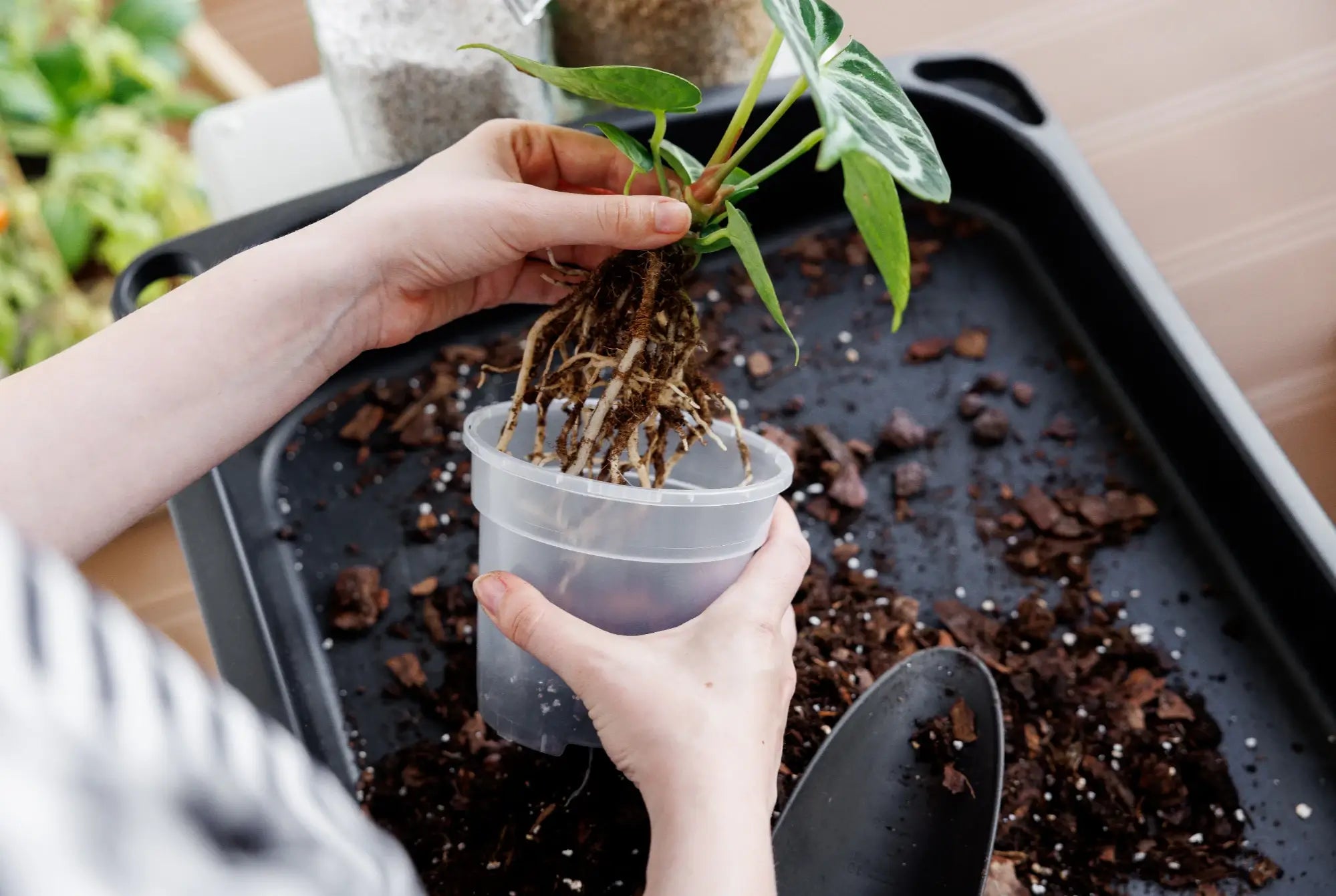
7. Repotting – Minimal Upsizing
- Only repot when roots circle the pot or mix compacts.
- Increase pot size by 2–3 cm max to avoid soggy soil zones.
Thinking about upsizing your Dragon’s pot? Repotting can make or break these sensitive Alocasias. Learn when and how to do it without stressing your plant: Repotting Houseplants – A Complete Guide
8. Health Watch – Pests & Stress Signals
- Common Pests: Spider mites (especially on velvety hybrids), thrips, mealybugs.
- Prevention: Weekly underside checks; use neem-based soap or systemic insecticide if needed.
Struggling with spider mites or thrips? Here’s how to win that battle. All Pest Control Guides
9. Quick Troubleshooting Table
| Symptom | Likely Cause |
|---|---|
| Brown leaf edges | Low humidity or fertilizer buildup |
| Yellowing leaves | Overwatering or compacted soil |
| Silver fading to green | Insufficient light |
| Sudden leaf collapse | Cold stress or root rot |

10. Dormancy – Reality vs Myth
- True dormancy rarely occurs indoors unless temps drop below 18 °C and light declines drastically.
- What looks like dormancy is often stress from cold or recent repotting.
- Do not force a “dry rest.” If the plant keeps producing leaves under grow lights, keep care steady.
11. Toxicity Warning
All Dragon Alocasias contain calcium oxalate crystals — harmful to pets and humans if ingested. Sap can irritate skin — wear gloves when repotting.
12. Best Environment – Controlled Microclimates Win
-
Why collectors use cabinets or vitrines:
- Locks in 60–80% humidity without constant humidifier use.
- Maintains warmth and stable airflow (add a small fan to avoid stagnant air).
-
Who benefits most:
- Jewel Alocasias like Silver Dragon and Black Dragon — both react strongly to fluctuations.
- Variegated forms — they grow slower and are less tolerant of stress.
While these plants can survive in open rooms with consistent care, enclosed setups give a huge advantage in drier homes or during winter.
Want to dive deeper into Alocasia care beyond Dragons?
Check out our Ultimate Alocasia Care Guide for complete tips on light, watering, substrates, and troubleshooting.

Propagation Techniques for Dragon Alocasias
Why Propagation can be tricky for Dragons
- Compact Rhizomes: Baginda cultivars rarely create easy division points.
- Slow Pups: Offsets are uncommon, appearing only on very mature plants.
- Root Fragility: These species have delicate roots prone to rot when disturbed.
Most Reliable Method: Corm Propagation
Corms are the go-to propagation strategy for Dragon Alocasias because they naturally detach from the mother plant without major trauma.
Where to Find Corms:
- Typically hidden in the substrate around the rhizome base.
- Often discovered during repotting or soil refresh.
How to Propagate Corms:
- Collect: Gently remove corms during repotting, ensuring no damage to the mother plant.
- Clean: Rinse off old substrate and treat with a mild fungicide or cinnamon dust to prevent rot.
- Pre-Sprout Setup: Place corms in moist (not wet) sphagnum moss inside a ventilated container.
-
Ideal Conditions:
- Temperature: 24–28 °C
- Humidity: 80–90% RH
- Light: Low to medium indirect light — no direct sun during sprouting.
-
Timeframe:
- Sprouting usually takes 4–8 weeks, sometimes longer for baginda types.
- Transition: Once roots and a small shoot appear, transfer to a chunky aroid mix or semi-hydro setup.
Success Tip: Monitor moisture carefully — soggy moss = rot. A barely damp environment works best.
Rhizome Division – Only for Mature Plants
- When: Only attempt if your plant is extremely well-established and has multiple clear growth points.
- Risks: High stress; divisions often sulk for months or fail if conditions aren’t perfect.
- Why Rare: Baginda types grow slowly, and dividing too early can permanently stunt the plant.
What Doesn’t Work
- Leaf Cuttings: Impossible — no nodes = no plant.
- Water-Only Propagation: Leads to rot before root initiation.
- Petiole Cuttings: Unlike some aroids, Dragon Alocasias cannot regenerate from petiole segments.
Reality Check for Collectors
Propagation of Dragon Alocasias is a slow, patient process. Expect corm sprouting to be your main strategy — anything else is high-risk without guaranteed results. Most new plants in trade come from tissue culture, not hobbyist propagation.
Dragon Alocasia Troubleshooting Guide – Symptoms, Causes, and Fixes
| Symptom | Likely Causes | Solutions |
|---|---|---|
| Brown leaf edges |
- Low humidity (below 50%) - Fertilizer salt buildup - Inconsistent watering |
- Maintain 60–80% RH with a humidifier or enclosed cabinet - Flush soil to remove salts - Keep watering even |
| Yellowing lower leaves |
- Overwatering - Compacted or poorly draining soil - Root rot |
- Check roots for rot; trim damaged tissue - Repot into chunky aroid mix - Adjust watering schedule |
| Silver turning green |
- Insufficient light - Light spectrum too warm (for grow lights) |
- Increase brightness (10,000–15,000 lux) - Use full-spectrum grow light if natural light is weak |
| Sudden leaf collapse |
- Cold stress (below 15 °C) - Severe root rot |
- Move plant to 20–28 °C zone - Remove rotting roots, repot in fresh substrate, use systemic fungicide |
| Leaf curling inward |
- Low humidity - Underwatering - Temperature fluctuations |
- Stabilize RH at 60–80% - Water when top 15–20% of soil is dry - Keep away from drafts or AC vents |
| Leaves shrinking in size |
- Light deficit - Nutrient imbalance - Root restriction |
- Provide brighter light - Fertilize with balanced liquid feed at 25–50% strength - Repot if rootbound |
| Brown spots on leaf surface |
- Fungal/bacterial infection from poor airflow - Misting habits |
- Increase airflow (small fan) - Stop misting - Remove affected leaves, treat with fungicide |
| Slow or stalled growth |
- Low temperature - Light too weak - Nutrient deficiency |
- Keep 20–28 °C range - Ensure bright indirect light - Feed monthly during active growth |
| Pale or faded leaves |
- Iron or magnesium deficiency - Overwatering reducing oxygen uptake |
- Use a complete fertilizer with micronutrients - Improve drainage and avoid waterlogging |
| Petiole rot at base |
- Water sitting in crown - Poor drainage and stagnant air |
- Water soil directly, avoid wetting crown - Improve substrate aeration - Add airflow in growing space |
Why Light Changes Dragon Alocasia Color
Color shifts in Dragon Alocasias aren’t magic — they’re driven by plant physiology:
- Silver & Frosted Tones - These effects come from a combination of thicker cuticles and air spaces in leaf tissue that scatter light. In low light, the plant produces more chlorophyll, which masks the silver overlay and makes leaves appear greener.
- Dark or Black Pigmentation (Black Dragon) - This intense color comes from high concentrations of anthocyanins in the upper epidermis. These pigments act as a natural sunscreen, protecting leaves from excess light while reducing water loss.
- Pink Petioles & Vein Highlights - Caused by anthocyanins rather than chlorophyll. They persist even under slightly lower light but fade if the plant is stressed or nitrogen-heavy.
Key Takeaway:
- Silver fade? It’s not genetics — it’s light deficit. Increase filtered brightness.
- Variegation stability? Genetics set the pattern. Light only helps maintain contrast, not create new variegation.
Want to dive deeper into how variegation and pigments shape plant colors? Read our Guides to Variegation, Pigmentation & Leaf Color.

Dragon Alocasia FAQs – Your Top Questions Answered
1. Why is my Silver Dragon turning green?
This is almost always a light issue — not a fertilizer problem. When Silver Dragon receives insufficient brightness, the frosted overlay fades and leaves develop a flat green tone.
Fix: Move the plant to a brighter spot with filtered light or use a quality grow light (~10,000–15,000 lux). Avoid direct midday sun, which burns delicate tissue.
2. Do Dragon Alocasias need a winter rest period?
Not necessarily. These plants don’t go into true dormancy indoors unless temperature and light drop significantly. If your setup maintains warmth (20–28 °C) and bright indirect light, they can grow year-round.
Tip: Never “force” a dry rest. If leaves are still forming, continue regular care — scaled to growth speed.
3. Why are my Dragon Alocasia leaves curling inward?
Common causes:
- Low humidity (below 50%)
- Underwatering or compacted mix
- Sudden temperature drops Solution: Check humidity first, then inspect soil moisture. Curling from cold stress may also follow shipping or drafts.
4. How often should I water Dragon Scale or Silver Dragon?
There is no fixed schedule. Water when the top 15–20% of the mix is dry. For a 20 cm pot, that’s about 3–4 cm deep. Always let excess drain completely — never leave water in saucers.
5. Why do new leaves emerge smaller than older ones?
Usually caused by one of three factors:
- Insufficient light → weak photosynthesis
- Nutrient imbalance → especially low nitrogen or micronutrients
- Root restriction → plant needs repotting
Fix: Improve light, feed with a balanced liquid fertilizer (25–50% dilution), and check root space.
6. Are Dragon Alocasias pet-safe?
No. All Alocasias, including Dragons, contain calcium oxalate crystals. Ingestion can cause severe irritation in pets and humans. Sap contact may irritate skin — wear gloves when pruning or repotting.
What’s the Rarest Dragon Alocasia?
At the top of the rarity scale are variegated cultivars (e.g., Silver Dragon Aurea Variegata or Dragon Scale Albo) and new-generation hybrids like Dragon Wings. These plants often exist only in private collections or limited-release batches.
However, rarity is changing. Tissue culture (TC) is gradually making some previously unattainable Dragons more accessible, which also lowers prices over time.
💡 Tip: If you’re not in a hurry, waiting for a tissue-cultured (TC) release can save you hundreds of euros. While there’s no absolute guarantee that a specific cultivar will enter TC production, high-demand plants almost always make it into propagation eventually.
8. How do I boost variegation on Dragon Scale Albo or Mint?
Variegation is genetic. You can’t “create” it with care, but you can maintain strong contrast by:
- Providing bright, indirect light (never full sun)
- Avoiding excessive nitrogen, which pushes green tissue faster than white
- Keeping care stable to prevent stress reversion
9. Why is my Dragon Alocasia leaf collapsing suddenly?
Two likely causes:
- Cold shock (below 15 °C)
- Root rot from waterlogged soil Action: Check roots immediately — healthy roots should be firm and pale. Remove damaged roots, repot into a chunky aroid mix, and stabilize temperature.
10. Can Dragon Alocasias grow in semi-hydroponic systems?
Yes, with proper monitoring. Inert substrates (e.g., LECA or mineral media) work if:
- You keep consistent water levels (never let roots dry completely)
- Use a complete nutrient solution and flush regularly to avoid salt buildup
- Maintain high humidity to offset faster evaporation
Semi-Hydro and Dragon Alocasias – What You Should Know
Thinking about using semi-hydro for your jewel Alocasias like Silver Dragon or Dragon Moon? This method offers stable moisture balance, fewer pests, and clearer control — but only if executed correctly. Explore our semi-hydro guides here: Semi-Hydro

Final Thoughts – Your Complete Dragon Alocasia Reference
Dragon Alocasias aren’t just “pretty leaves”—they represent decades of selective breeding rooted in wild genetics. From the armored bullation of A. baginda to the rugged density of A. melo and the velvety sheen of A. reginula, every trait reflects adaptation to rainforest environments. This guide brings all that diversity together in one place—so you can compare species origins, identify hybrids, and choose the right cultivar for your collection. Whether you favor the iconic Dragon Scale, the shimmering Silver Dragon, or rare hybrids like Dragon Wings, success comes from precision: bright filtered light, stable humidity, and an airy, mineral-balanced substrate. Use this article as your benchmark, and let every future purchase be an informed one.
Ready to add a Dragon Alocasia to your collection?
Explore our full Alocasia lineup — from classic cultivars like Dragon Scale and Silver Dragon to rare hybrids and variegated treasures. Each plant comes with detailed care guidance and collector insights to help you succeed.
➜ Shop Alocasias Now
Sources and Further Reading:
The following references provide authoritative taxonomic data, ecological context, and propagation insights for Alocasia species and cultivars discussed in this guide. They include peer-reviewed studies, botanical monographs, and reputable digital herbarium resources for further exploration.
Aroid Society. (n.d.). Aroideana, Volume 7, Issue 3. Retrieved from https://www.aroid.org/aroideana/aroideana-v7n3
Aroid Society. (n.d.). Aroideana article archive. Retrieved from https://www.aroidsociety.org/aroideana/artpage.php?key=MDA3MzQwMQ==E
Aroidia Research. (n.d.). Alocasia cucullata information. Retrieved from https://aroidiaresearch.org/acucull.htm
Aroidia Research. (n.d.). Alocasia reginula information. Retrieved from https://aroidiaresearch.org/reginula.htm
Aroidpedia. (n.d.). Alocasia genus profiles and species accounts. Retrieved from https://www.aroidpedia.com/alocasia
Boyce, P. C., & Kurniawan, A. (2011). Studies on the Alocasia Schott (Araceae-Colocasieae) of Borneo II: Alocasia baginda, a new species from East Kalimantan, Indonesian Borneo. Acta Phytotaxonomica et Geobotanica, 61, 123–130. Retrieved from https://www.researchgate.net/publication/308522698_Studies_on_the_Alocasia_Schott_Araceae-Colocasieae_of_Borneo_II_Alocasia_baginda_a_new_species_from_East_Kalimantan_Indonesian_Borneo
Hay, A. (1999). The genus Alocasia (Araceae-Colocasieae) in the Philippines. The Gardens' Bulletin, Singapore, 51(4), 1–41. Singapore: Singapore Govt. Print. Off. Retrieved from https://biostor.org/reference/140161
Hay, A. (1998). The genus Alocasia (Araceae-Colocasieae) in West Malesia and Sulawesi. The Gardens' Bulletin, Singapore, 50(4), 221–334. Singapore: Singapore Govt. Print. Off. Retrieved from https://biostor.org/reference/140160
IPNI / Plants of the World Online. (n.d.). Alocasia baginda. Retrieved from https://powo.science.kew.org/taxon/urn:lsid:ipni.org:names:995487-1
IPNI / Plants of the World Online. (n.d.). Alocasia cucullata. Retrieved from https://powo.science.kew.org/taxon/urn:lsid:ipni.org:names:84151-1
IPNI / Plants of the World Online. (n.d.). Alocasia heterophylla. Retrieved from https://powo.science.kew.org/taxon/urn:lsid:ipni.org:names:1006568-1
IPNI / Plants of the World Online. (n.d.). Alocasia longiloba. Retrieved from https://powo.science.kew.org/taxon/urn:lsid:ipni12.org:names:84179-1
IPNI / Plants of the World Online. (n.d.). Alocasia reginula. Retrieved from https://powo.science.kew.org/taxon/urn:lsid:ipni.org:names:1010791-1
IPNI / Plants of the World Online. (n.d.). Alocasia scalprum. Retrieved from https://powo.science.kew.org/taxon/urn:lsid:ipni.org:names:84195-1
Philippine Alocasia Project. (n.d.). Alocasia heterophylla species profile. Retrieved from https://sites.google.com/view/philippinealocasias/species-groups/ph-species-groups/heterophylla-ph/a-heterophylla?authuser=0
Philippine Alocasia Project. (n.d.). Alocasia scalprum species profile. Retrieved from https://sites.google.com/view/philippinealocasias/species-groups/ph-species-groups/scabriuscula-ph/a-scalprum
Smithsonian National Museum of Natural History. (n.d.). Botany collection search. Retrieved from https://collections.nmnh.si.edu/search/botany/
Wong, S. Y., Hay, A., & Boyce, P. C. (1997). Studies on the Alocasia of Borneo. Retrieved from https://www.biodiversitylibrary.org/page/43578420#page/42/mode/1up
Yusuf, M., et al. (2023). In vitro propagation of Alocasia baginda ‘Silver Dragon’ through direct and indirect organogenesis. Retrieved from https://www.researchgate.net/publication/381947962_In_vitro_Propagation_of_Alocasia_baginda_%27Silver_Dragon%27_through_Direct_and_Indirect_Organogenesis