

Dioscorea
Indoors, Dioscorea can mean two quite different things: twining ornamental yams grown for their leaves, or caudiciform species grown for corky exposed bases and seasonal vines. A patterned foliage vine behaves very differently from a slow caudex project plant, but both bring climbing growth from a storage organ and usually some degree of seasonal rhythm.
That contrast is part of the draw. Dioscorea suits people who enjoy a visible life cycle and a bit more character than a fixed evergreen houseplant. Sometimes that comes through patterned leaves, sometimes through a sculptural caudex, and sometimes through a rest period that asks you to pay attention instead of repeating the same routine all year.
About Our Filters
Filters help you narrow things down fast and without guessing. We put a lot of time and effort into keeping filter values consistent across the shop by cross-checking references and validating them against real-world indoor growing and handling.
Use them as guidance, not guarantees. Homes vary a lot, so for the full context (and any exceptions), open the product page and read the description.
How filtering works
- Filters stack: each selection narrows results.
- Multiple picks in one filter are usually either/or within that filter.
- Undo anytime: click a selected option again (or clear filters).
Safety
- Non-toxic: not known for relevant chemical toxicity for common pets (chewing can still cause irritation).
- Non-toxic & Pet Friendly: stricter shortlist that also avoids many physical hazards like spines, sharp tips, thorns, and bristles.
Common care filters
- Light level: Low indirect → Full sun/direct.
- Water Needs: Low / Medium / High.
- Humidity Level: Normal (40–50%) / Moist (50–60%) / Humid (60–80%+).
Growth & size
- Growth Habit: climbing, trailing, crawling, upright, self-heading, clumping, rosette.
- Needs support? none / optional / needed.
- Delivered size: pot size + plant height at shipping.
- Max size indoors: realistic long-term height + spread indoors.
Looks & botanical browsing
- Leaf Shape & Size + Foliage Colour: quick visual categories.
- Plant Type / Genus / Family: browse by broad group or taxonomy.
If you want to see the references we use, Plant Care Resources is simply a curated list of source links (POWO, Kew, and more).
Sort by
Filters


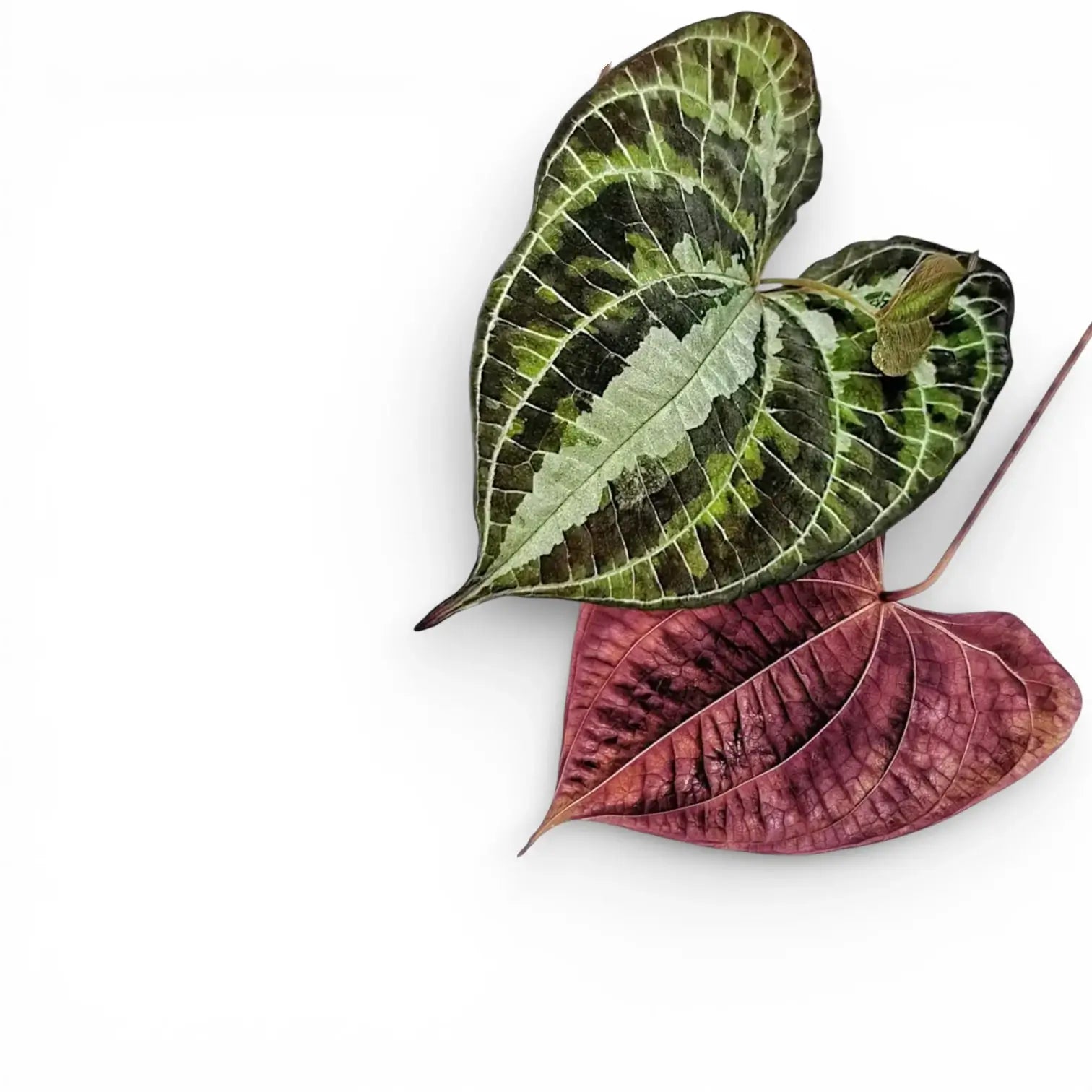
Dioscorea discolor
Sold out

Dioscorea sp Borneo (narrow leaf)
Sold out

Dioscorea sp. Peru
Sold out
Dioscoreaceae
Dioscorea
Quick Overview
Dioscorea: sculptural caudex with seasonal vines
- Role: showpiece caudex (swollen base) with fine climbing vines; foliage makes a lacy backdrop above a woody “rock”.
- Light: bright light with some direct sun keeps rosettes compact and vines leafy; low light gives weak stems and tired caudex.
- Watering: in leaf, water deeply then let gritty mix dry most of the way; leafless caudex rests almost dry, only light sips if it wrinkles.
- Substrate: flourishes in very mineral, fast-draining soil; dense, wet compost around the caudex is the quickest way to lose it.
- Support: twining vines need a trellis, hoop or frame; without it they tangle and leaves sit where you cannot see them.
- Toxicity: ornamental forms are not grown as food; assume caudex and foliage are not safe to eat.
Botanical Profile
Dioscorea: botanical profile for yams and caudiciform vines
Dioscorea is the type genus of Dioscoreaceae, described by Linnaeus in 1753 and later lectotypified with Dioscorea villosa. The name commemorates the physician Dioscorides. Around 600 species are recognised worldwide, ranging from staple food yams to xeric, caudiciform ornamentals such as Dioscorea elephantipes and related taxa.
- Order: Dioscoreales
- Family: Dioscoreaceae
- Tribe: Dioscoreeae
- Genus: Dioscorea L.
- Type species: Dioscorea villosa L.
- Chromosomes: Base numbers x = 9, 10 and 12 are documented, with many species showing multiple ploidy levels (e.g. 2n = 40, 60, 80 in cultivated yams).
Range & habitat: Dioscorea has a near-pan-tropical distribution with extensions into warm temperate regions. Species occur in forest margins, thickets, savannas and rocky slopes, often climbing through surrounding vegetation; some, especially caudiciform lineages, occupy seasonally dry shrubland or semi-desert with shallow, stony soils.
- Life form: Tuberous or rhizomatous perennial lianas, many strictly dioecious; a subset forms thickened caudices partly exposed above ground.
- Leaf attachment: Alternate leaves on twining stems, frequently cordate to sagittate; some sections show opposite or whorled phyllotaxy when young.
- Leaf size: Typically 5-20 cm long in many species, with larger blades in vigorous tropical yams and smaller leaves in drought-adapted caudiciform taxa.
- Texture & colour: Thin to moderately firm green blades; some species display subtle glaucous tints, undersurface pubescence or variegation associated with particular habitats.
- Notable adaptation: Substantial underground storage organs buffer dry seasons and allow rapid regrowth of vines when moisture and temperature again favour active growth.
Inflorescence & fruit: Separate male and female inflorescences are produced on different plants, usually as slender spikes or panicles with small, greenish to yellowish flowers. Fruits are typically three-winged capsules containing flattened, winged seeds adapted for wind dispersal; a minority of species bear berries instead.
Details & Care
Dioscorea care, growth rhythm and buying tips
What makes Dioscorea such a collector’s plant
Dioscorea brings together two extremes in one pot: a slow, armoured caudex that swells year after year and fine twining vines that can cover a support in a single season. Species such as Dioscorea elephantipes and Dioscorea mexicana build cracked, woody domes, while tuberous climbers like Dioscorea discolor focus on intricate foliage patterns above ground. This contrast between stored energy and fast seasonal growth makes Dioscorea a natural focal point in a collection.
Indoors, Dioscorea rewards patience and observation. Growth does not follow calendar rules as much as the plant’s own rhythm: vines surge, rest and sometimes disappear entirely while energy is packed back into the caudex. If you are comfortable letting a plant look “quiet” for a few months and are willing to adjust watering to its phases, Dioscorea offers long-lived, almost sculptural companions.
Natural habitats and what they tell you about Dioscorea
Dioscorea is a large yam genus with hundreds of tuberous, climbing species spread across tropical and warm-temperate regions in Africa, the Americas and Asia. Many cultivated forms for houseplant use come from rocky, seasonally dry habitats in South Africa and Mexico or from tropical forest edges and clearings in South America. In the wild, roots and caudex sit in very free-draining, often stony ground, while vines reach up into brighter layers of vegetation.
Indoors, that translates into three priorities: strong light for vines, a coarse, mineral-rich substrate for caudex and roots, and a watering pattern that alternates between deep soaks and genuine drying, especially when growth slows. Treat the caudex as a water tank evolved for irregular rainfall rather than a typical pot plant root ball.
Light that keeps vines dense and caudex compact
Dioscorea grown indoors should sit in as much light as you can offer without burning foliage. Caudex-focused species from arid zones cope well with several hours of gentle direct sun near a bright south- or east-facing window, ideally with a bit of shade over the caudex itself so the corky plates do not overheat. Foliage-focused species like Dioscorea discolor prefer bright, filtered light; intense midday sun quickly bleaches patterns and crisps leaf edges.
Very low light is a bad match for this genus. Vines stretch towards windows, internodes become long and bare, and leaves shrink and lose their colour. If you are guessing rather than measuring, use our bright-indirect light guide as a reality check: if your room never produces the sharper shadows shown there, Dioscorea probably needs to move closer to the glass or under a grow lamp.
Watering and substrate strategy for Dioscorea
Link watering directly to what Dioscorea is doing above the pot. When vines carry firm, turgid leaves, water in a clear “drench and dry” cycle: soak the substrate until water runs from drainage holes, then let the mix dry out well again before you reach for the watering can. In a very airy mineral mix that usually means the pot feels noticeably lighter and the substrate feels dry across most of its depth, not just at the surface. Repeated severe drought while the plant is in full leaf can trigger sudden defoliation and a shrinking caudex; keeping mix cool and damp for long stretches is the fastest way to rot.
Once vines yellow and die back and no new growth appears, most Dioscorea are moving into a rest phase. At that point, leave the substrate dry for long periods and only give a small drink when the caudex wrinkles more deeply than usual. Never keep a leafless plant standing in damp soil “just in case” - that is when caudex and roots are most vulnerable. If you want a deeper explanation of how pot size, mix texture and watering interact across houseplants, have a look at our in-depth guide to watering houseplants and adapt those principles to Dioscorea’s drought-tolerant nature.
For substrate, think cactus rather than typical tropical mix: a lean base of fine bark or coco coir combined with a high proportion of pumice, lava rock, coarse sand or grit and perlite. Shallow, wide pots are common in cultivation, and many people use shallow, wide pots so the caudex can spread horizontally; a mineral top-dressing helps keep the surface dry and protects the upper caudex. Poorly draining peat-heavy soil in a deep pot almost guarantees rot over time.
Temperature, humidity and airflow for Dioscorea
Dioscorea is comfortable in typical warm indoor temperatures of about 18-28 °C. Short dips a bit below that are rarely fatal if the substrate stays dry, but a combination of cold and wet soil is dangerous. Keep plants away from draughty doors, single-glazed winter windows and unheated windowsills where pots stay cold long after the room warms up.
Humidity requirements are modest. Caudiciform species from arid zones are happy in average to quite dry indoor air; ornamental vines such as Dioscorea discolor appreciate slightly higher humidity to keep foliage from crisping but do not need terrarium-level moisture. What matters most for all types is gentle, continuous airflow around caudex and vines. Stagnant corners with dense plant groupings and no air movement increase the risk of fungal issues and spider mites.
Growth pattern and feeding for Dioscorea
Most Dioscorea grown as houseplants are caudiciform perennials: a woody or corky caudex stores water and nutrients, while seasonal vines twine around supports in a counter-clockwise or clockwise direction depending on species. Vines may appear from one portion of the caudex one year and from a different eye the next, and they often die back completely between growth phases. Indoors, mature caudex of some species enlarge only a few millimetres per year, so apparent “stasis” is normal.
Train vines onto a hoop, mesh, branch or moss pole rather than letting them sprawl. This keeps foliage compact and reduces the risk of accidentally snapping stems near the caudex. Feed lightly whenever Dioscorea is clearly in active growth with new leaves and stems: a balanced liquid fertiliser at reduced strength every few waterings is usually enough in a mineral-rich mix. Avoid heavy feeding into cold, very dry or dormant plants; substrate structure and good light will do more for caudex growth than strong fertiliser. If you want to get comfortable with fertiliser basics across your collection, this fertiliser overview gives a clear starting point without tying feeding to calendar months.
Toxicity and safe handling of Dioscorea
Several Dioscorea species have a history as food crops after careful processing, but many wild and ornamental forms contain steroidal saponins and alkaloids that are irritating or outright poisonous when eaten raw. Tubers of some species have been used traditionally as arrow or fish poison, and Dioscorea material was a key source for early steroid drugs. Ornamental Dioscorea in a houseplant collection is not intended for consumption, and toxicity can vary between species and even plant parts.
As a precaution, treat all Dioscorea as potentially toxic if chewed. Place them out of reach of pets and children, avoid ingesting any part of the plant, and wash hands after handling fresh cuts or repotting. If sap gets on skin, rinse with water and mild soap; keep it away from eyes and mouth. When in doubt, choose a different genus for spaces where chewing pets roam freely.
What you may notice from Dioscorea after delivery
Dioscorea often ships in one of two phases: either with actively growing vines or in a resting state with bare caudex and little or no foliage. A firm, heavy caudex in dry substrate is a good sign, even if stems look tired or have been trimmed back for shipping. Slight wrinkles on arrival are normal; deep soft spots are not and should prompt a check of roots and substrate.
Some cosmetic leaf damage-torn tips, slight creasing or a few yellowed older leaves-is common on climbing species after transit and does not affect long-term growth. Once home, choose a bright position, give the plant a day to warm up, then water thoroughly if the mix is dry and vines are in leaf. If the plant arrived dormant, place it in bright light, keep the mix almost dry and wait for fresh buds to swell on the caudex before resuming regular watering.
Dioscorea troubleshooting guide
- Caudex shrivels strongly while vines are still leafy: Usually a sign of chronic underwatering during active growth. Increase watering volume, letting the mix fully soak and then dry down well again rather than giving frequent shallow sips, and check that substrate is not pulling away from pot edges.
- Soft, mushy areas on caudex or a sour smell from the pot: Rot from a long spell in cold, wet mix. Unpot carefully, cut away all soft tissue and dead roots, dust cuts with a dry fungicidal powder if you use one, and repot into a much airier blend. Keep almost dry until new roots and buds form; for general principles, the steps in this root-rot guide are a useful checklist.
- Vines run long with tiny, pale leaves: Light is too weak or too one-sided. Move Dioscorea closer to a bright window or under a grow lamp, rotate the pot regularly and give the vines a vertical or circular support so growth stays dense rather than stringy.
- Leaves scorch, bleach or develop crispy margins: Foliage-first species like Dioscorea discolor are receiving too much direct sun or heat, often at midday through glass. Shift the plant to bright but filtered light, introduce sheer curtains or move it a little back from the window, and keep watering consistent so leaves do not dehydrate at the same time.
- Vines yellow and die back suddenly outside the usual rest period: Check the caudex and substrate. A firm caudex in a dry or just slightly moist mix often indicates an early or stress-induced dormancy; reduce watering and wait for the next growth cycle. A soft caudex or foul smell points to rot, which needs immediate intervention as described above.
Back to top and choose the Dioscorea that matches your light and the level of attention you want to give ↑
Frequently Asked Questions About Dioscorea
Are all Dioscorea houseplants cared for the same way?
No. Dioscorea is a huge genus that includes food yams, leafy climbers, and caudiciform species such as Dioscorea elephantipes, so one care template is not honest enough for the whole genus.
Does Dioscorea need something to climb?
Many of the houseplant ones do. The ornamental species most often sold indoors are twining climbers, so a hoop, pole, or trellis usually keeps them neater and easier to manage.
How often should I water indoor Dioscorea?
It depends on the type. Leafy twining species usually want watering around the point when the top 20–40% has dried, while caudiciform types such as Dioscorea elephantipes are usually watered only after most or nearly all of the pot has dried during active growth. Once a dormant type drops its vine, keep it much drier until growth restarts.
Why did my Dioscorea vine die back?
That can be completely normal in dormant types. Dioscorea elephantipes is a deciduous climber and normally loses its vine in dormancy, while evergreen or longer-active indoor yams usually need a care check if the vine collapses unexpectedly.
Are houseplant Dioscorea edible like food yams?
No, not by default. Some Dioscorea are edible yams, but ornamental species should never be treated as food from the genus name alone. Dioscorea elephantipes, for example, is only edible after significant processing to remove toxic compounds.


Limited discounts, extras, and bundle deals for subscribers.
Get points with every order to redeem them for discounts.
Give your friends 10 € off and get 200 Foliage Points.
Use your 10% code on plants when you're ready to order.