
The Science and Allure of Black-Leaved Plants
Nature’s Noir Palette: Why Black Houseplants Stop Us in Our Tracks
Black leaves are the rebels of the plant world. Place one among a sea of green and it immediately pulls your eye, like a velvet curtain closing on a stage. Alocasia reginula ‘Black Velvet’ with its silver veins, the glossy jet-black of Zamioculcas zamiifolia ‘Raven’, or the neon-striped drama of Goeppertia ‘Dottie’ — they all feel less like houseplants and more like living art.
The fascination isn’t just aesthetic. These shades are rare in nature because plants “prefer” green — it’s the most efficient way to capture light for photosynthesis. So when a plant decides to cloak itself in near-black, it means something unusual is going on. Evolution has traded efficiency for drama, and we get to enjoy the result on our shelves.

Contents
- What Makes Leaves Look Black? – Pigments and Illusions
- Why Plants Wear Black – Biological Functions of Dark Leaves
- How Plants Switch on the Dark Mode – Genetics & Biochemistry
- Black vs. Green Leaves – What’s Happening Under the Surface
- Cultivation & Care – How to Keep Black Leaves Dark Indoors
- 15 Rare and Iconic Black Houseplants
- Why We Love Black Houseplants – Aesthetics, Design, and Symbolism
- Frequently Asked Questions About Black Houseplants
- Conclusion – Function Meets Fascination
- Sources and Further Reading
1. What Makes Leaves Look Black? – Pigments and Illusions
When you first see a black-leaved Alocasia or a Scindapsus treubii ‘Dark Form’, it almost looks like nature dipped the plant in ink. But here’s the trick: there’s no such thing as a naturally black pigment in leaves. What we’re really seeing is a clever layering of anthocyanins — the same pigments that make cherries red or autumn leaves purple.
Stack enough of those pigments on top of the green chlorophyll, and the eye reads it as black. It’s a bit like putting tinted lenses over a green filter. One pair of sunglasses, and things look burgundy. Stack several pairs, and suddenly the view is almost pitch-black.
That’s why “black” plants are never truly black. Hold them in bright light and you’ll often notice flashes of deep purple or mahogany. The darkness is an optical effect — pigments, tissue thickness, and surface texture all working together. Velvety leaves like Alocasia ‘Black Velvet’ absorb and scatter less light, intensifying their shadowy appearance, while glossy foliage such as ZZ Raven reflects a dark green-black shine.
Even though anthocyanins dominate what we see, chlorophyll is still there, quietly running photosynthesis beneath the surface. It just hides under that thick filter, letting only a muted fraction of light through. That’s part of why these plants intrigue collectors: they’ve turned what is essentially a survival mechanism into an aesthetic superpower.
And if you’ve ever noticed your “black” plant looking greener in dim rooms, you’ve seen this biology at work. Without strong enough light to trigger anthocyanin production, chlorophyll takes over visually, and the foliage shifts back toward green. Good placement — bright but not scorching — is what keeps their colors saturated. 🔗 If you’re curious how window direction changes what your plants actually see indoors, we’ve broken that down in detail in our guide to window orientations.

2. Why Plants Wear Black – Biological Functions of Dark Leaves
If green is the default, why would a plant take the “slower” route and load itself with so much pigment that photosynthesis efficiency drops? The answer is survival. Black foliage is not an accident of breeding — it’s a set of strategies evolved to deal with stress.
Filtering light like armor
Imagine standing in a rainforest understory: most of the time you’re in shadow, but every so often the sun bursts through the canopy like a spotlight. For a thin green leaf, that flash of radiation can be damaging, flooding the cells with more energy than they can process. Black-toned leaves, on the other hand, act like they’re wearing sunglasses. Anthocyanins absorb a portion of that blast, giving the chloroplasts beneath time to recover.
This same “filter” works at high altitudes, where UV radiation is intense. Alpine species often show darker pigmentation for exactly that reason — it’s a shield, not a fashion choice.
More than light management
Anthocyanins are multitaskers. Beyond controlling how much light reaches the photosynthetic machinery, they also serve as antioxidants, neutralizing harmful molecules (ROS — reactive oxygen species) that build up when a plant is stressed by drought, cold, or pathogens. In cherries, for instance, leaves turn darker during cold spells as pigments rush in to protect vulnerable tissues.
Even in aging leaves, anthocyanins buy time: while chlorophyll is breaking down, the red-purple pigments protect cells long enough for the plant to recycle valuable nutrients before the leaf drops.
Trade-offs worth making?
Of course, making these pigments isn’t free. It costs energy — sugars that could have gone into faster growth. That’s why you rarely see black foliage in open grasslands where speed is everything. But in risky environments — shaded understories, alpine ridges, or unpredictable tropics — the slower growth pays off. Survival beats speed.
Snapshot: Green vs. Black Leaves in Nature
|
Habitat |
Green foliage strategy |
Black foliage strategy |
|---|---|---|
|
Open grasslands |
Grow fast, dominate competitors |
Rare — pigment cost too high |
|
Shaded understory |
Risk of sudden sunflecks |
Pigment shield buffers the shocks |
|
Alpine / high UV |
Vulnerable to radiation |
Anthocyanins filter and protect |
|
Indoors (with us) |
Tend to stretch and fade if dim |
Hold color in bright, indirect light |
What’s fascinating is that the very same adaptations that keep plants alive in harsh habitats also make them so striking in our homes. When a ZZ Raven darkens leaf by leaf, or an Alocasia ‘Black Velvet’ holds its inky tones under steady light, we’re seeing survival strategies translated into design.
3. How Plants Switch on the Dark Mode – Genetics & Biochemistry
The near-black tones of Raven ZZ or Black Velvet Alocasia aren’t random — they’re the result of genetic switches that decide how much pigment a plant produces and where it’s stored. Think of it as a factory line running inside each leaf: some plants run it at idle speed (burgundy tones), others crank it up until the green is drowned out entirely.
The pigment factory
At the heart of this process is the anthocyanin biosynthetic pathway. Sugars feed into a chemical conveyor belt where enzymes like chalcone synthase and anthocyanidin synthase assemble red-purple pigments. Once built, these pigments get packed into vacuoles — storage bubbles inside cells — where they pool and show up as visible color.
In black-leaved plants, that conveyor belt runs at overdrive. Vacuoles flood with pigment until the underlying chlorophyll is no longer visible. That’s why young Raven ZZ leaves emerge lime-green, then “switch” to black as pigment production catches up.
The master switch: MBW complex
The genes don’t flip on their own. A protein team — known as the MYB–bHLH–WD40 complex (MBW) — acts like a light switch for pigment production.
- When MBW is “on,” the enzymes in the pigment pathway fire up, anthocyanins accumulate, and leaves darken.
- When it’s “off,” chlorophyll takes center stage and the plant stays green.
Breeders exploit this mechanism: cultivars like Raven are selections where pigment switches stay active longer, ensuring consistent dark foliage.
Different routes, same black
Not all plants get to “black” the same way. Some crank up pigment production; others shut down competing pigment pathways. In black dahlias, for example, a gene that normally makes pale flavones is silenced, leaving anthocyanins unchallenged. The result: petals so saturated they appear black.
This diversity explains why two plants that both look black — say, Scindapsus ‘Dark Form’ and Alocasia infernalis — might respond differently to light, nutrients, or stress. Their pathways are tuned differently.
📌 Takeaway for growers:
- “Black” isn’t a default — it’s a genetic program.
- New leaves often start green or burgundy, then darken as pigment genes switch on.
- Environment still matters: low light or heavy nitrogen can silence pigment production, leaving foliage greener.
- Breeders are essentially “coding” these switches, which is why new black cultivars keep appearing on the market.
If you’re curious about how this differs from other color tricks — like white patches on variegated Monsteras — the short answer is: completely. Variegation comes from missing pigments or altered tissues, not from piling anthocyanins on top. 🔗 We’ve broken that down in our variegation explainer.

4. Black vs. Green Leaves – What’s Happening Under the Surface
Black foliage feels mysterious, but physiologically it’s just another strategy. Compare it to solar panels: green leaves are the clear, unshaded panels designed for maximum efficiency, while black leaves are tinted panels — they produce slightly less at peak, but they’re more stable when the sun hits hard and fast.
Photosynthesis trade-offs
Green leaves are specialists in speed. They absorb light in the red and blue spectrum almost without filter, which drives photosynthesis at full throttle. Black leaves, layered with anthocyanins, block part of that spectrum. Their maximum rate of photosynthesis is lower — but that’s not the whole story.
In shaded forest understories, where light is already limited, the playing field evens out. Both green and black leaves are working under constraint. The difference emerges when the light shifts suddenly: the black leaf cushions the shock and recovers faster, while the green leaf risks damage.
How light moves differently inside
It’s a common misconception that green light simply “reflects” off leaves. In reality, it scatters through tissues, bouncing around before leaving again. In a black leaf, anthocyanins soak up much of that scattered light, creating steeper internal gradients. Research on black mondo grass (Ophiopogon planiscapus ‘Nigrescens’) shows that this filtering reduces stress on photosystems — less flare, more control.
The hidden cost of pigment
Loading a leaf with anthocyanins isn’t free. The plant invests sugars that could have been used for growth. That’s why in open fields and farms, green leaves dominate — they outpace darker neighbors. But in stress-prone environments, the trade-off works: slower growth, but higher resilience.
Why it matters indoors
Indoors, these same rules translate surprisingly well. Black-leaved plants usually thrive in bright, indirect light, where they can keep pigments active without frying. Give them too little light, and chlorophyll takes over, fading them green. Give them too much harsh sun, and they scorch just like their green relatives.
Snapshot: Efficiency vs. Resilience
|
Trait |
Green leaves |
Black leaves |
|---|---|---|
|
Photosynthesis rate |
Higher in full sun |
Lower max, but steady under shifts |
|
Stress recovery |
Slower after sudden light stress |
Faster, less photoinhibition |
|
Energy investment |
Minimal (fast growth) |
Higher (pigment production costs) |
|
Habitat advantage |
Open fields, high-resource zones |
Shade, high-UV, stress-prone niches |
|
Indoor preference |
Can take more direct light |
Thrive in filtered, indirect light |
📌 Key insight: Black foliage isn’t better or worse — it’s tuned differently. It sacrifices speed for stability, which is why these plants often seem tougher than expected indoors. Once you know the trade-off, their care makes more sense: steady light, moderate feeding, no extremes.

5. Cultivation & Care – How to Keep Black Leaves Dark Indoors
The drama of black foliage doesn’t take care of itself. These shades are the result of pigment pathways that only stay active when conditions are right. Give a Raven ZZ too little light and its new growth comes out lime green. Overfeed an Alocasia ‘Black Velvet’ with nitrogen, and the silver veins glow while the rest of the leaf softens to greenish tones. Keeping the color deep means giving the plant the same triggers that would activate those pigments in nature: light, balance, and consistency.
Light: the make-or-break factor
Black foliage is born in bright conditions. Without enough light, anthocyanins switch off and chlorophyll dominates. That’s why a Scindapsus ‘Dark Form’ looks inky on a well-lit moss pole but fades toward olive in the back of a dim room.
- Best choice: bright, indirect light — think a spot near a sheer-covered south or east window.
- Too much: direct summer sun will bleach or crisp edges.
- Too little: new leaves emerge soft green, never darken.
Grow lights with a strong red/blue spectrum can substitute if your space is shaded. In fact, many jewel Alocasia only achieve their richest tones under consistent artificial light.
🔗 For placement tips, see our breakdown of what “bright indirect light” really means for houseplants.
Temperature and seasonal rhythm
Cooler nights often deepen pigment, mimicking the small shifts tropical plants would experience in the wild. Constant warmth isn’t harmful, but it can soften tones. A brief dip is fine; prolonged cold, though, will damage tissue.
Nutrition and substrate balance
Black foliage thrives on balance, not abundance. Too much nitrogen fuels fast, green growth that overrides pigment. A steady, moderate feed keeps anthocyanins in play.
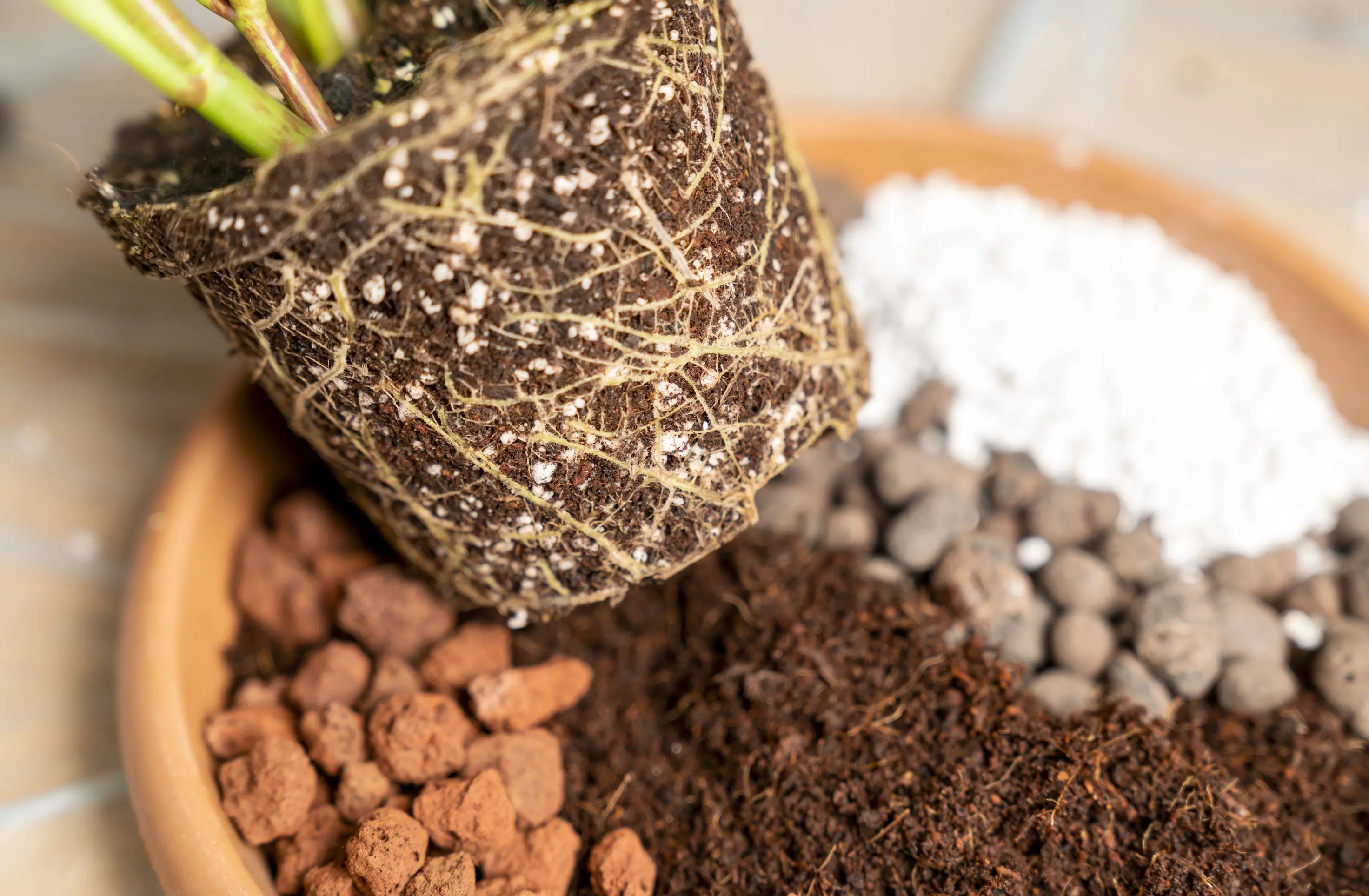
The substrate matters too. Compacted or soggy soil stresses roots, which weakens pigment production. A loose, airy mix — or mineral/semi-hydro blends — keeps roots oxygenated and pigments stable.
🔗 For deeper substrate options: The ultimate guide to houseplant substrates
Water and humidity
These plants don’t need exotic rituals; they need consistency. Even moisture keeps pigment pathways running. Extended drought can sometimes darken tones temporarily, but it also risks leaf loss and root damage. Overwatering, especially in Alocasias or Ficus elastica, is a fast track to rot.
Humidity plays more of an aesthetic role. Jewel Alocasias and Goeppertia ‘Dottie’ hold their black-on-pink contrasts best above 60%. In dry rooms, the pigment doesn’t vanish, but brown edges ruin the look.
Why black plants turn green indoors
If your “black” plant is slowly going jade, one of these is usually to blame:
- Insufficient light → anthocyanins never build up.
- Excess nitrogen → chlorophyll floods the tissues.
- Poor aeration or root stress → pigment production collapses.
- Immature leaves → new growth often starts lighter, then darkens over time.
📌 Fix light first. Most black houseplants recover their color once their environment matches their biology.
Quick Care Recap
- Place in bright, indirect light or under quality grow lights.
- Allow mild night temperature drops if possible.
- Fertilize moderately — avoid heavy nitrogen.
- Keep substrate airy, evenly moist, never waterlogged.
- Humidity above 60% keeps tropicals crisp and dramatic.
- Expect young leaves to start lighter and darken with age.
📌 Key insight: Black plants aren’t harder — they’re just less forgiving of extremes. Treat the pigment as a signal: if the color is fading, the plant is telling you something about its light, feed, or roots.
6. Rare and Iconic Black Houseplants
Not all “black” plants are built the same. Some are tissue-cultured staples you’ll find in garden centers, others are collector pieces that move slowly through trade because they take years to propagate. What unites them is how they play with light — matte velvet, glossy lacquer, metallic sheen, or neon-on-black contrast. Here are fifteen of the most talked-about dark-leafed houseplants, from forgiving beginners to high-maintenance treasures.
Anthurium ‘Queen of Hearts’Compact to medium Anthurium with heart-shaped leaves that flush deep red to chocolate on emergence, then mature to dark green/brown (can read nearly black in strong light). Texture is semi-matte; size stays moderate, making it a manageable statement for shelves or stands.
|

|

|
Alocasia reginula ‘Black Velvet’Velvety, heart-shaped leaves etched with silver veins — this is the gateway black plant for many collectors. Endemic to Borneo, it’s compact but demanding: too much water and it collapses overnight. With stable humidity and an airy substrate, though, it rewards with leaves that look like embroidered fabric.
|
Philodendron ‘Black Cardinal’Broad, leathery leaves that flush deep burgundy before hardening into a glossy, near-black. Unlike vining Philodendrons, ‘Black Cardinal’ stays compact and bushy, making it ideal for tabletops or floor pots where you want drama without constant pruning. It’s easier than jewel Alocasias but still striking enough for collectors who want something unusual.
|

|

|
Alocasia infernalis ‘Black Magic’The glossy sibling to Black Velvet, with leaves so dark they look lacquered. Native to Sarawak, it tolerates brighter light than most jewel Alocasias, but slow growth and sensitivity make it a collector’s piece rather than a casual buy.
|
Zamioculcas zamiifolia ‘Raven’Every Raven leaf is a performance: it unfurls lime-green, then darkens over weeks until it shines jet-black. Almost unkillable, this is the plant for anyone who wants black tones without fuss. Low light tolerant, drought resistant, and now mass-produced through tissue culture, it’s the opposite of a diva.
|

|

|
Ficus elastica ‘Abidjan’Leaves that emerge burgundy and harden into near-black with a gloss finish. Easier than any jewel Alocasia, but still dramatic enough to anchor a room. Grows into a tree indoors with time, making it one of the few “black” plants that can dominate a corner.
|
Goeppertia roseopicta ‘Dottie’Pink neon streaks across a black canvas. Among Calatheas, ‘Dottie’ is one of the most striking, though also one of the thirstiest for humidity. In low air moisture, edges brown and the contrast fades. Safe for pets, which makes it one of the few dramatic black plants you can grow without worry if you have cats or dogs.
|

|

|
Begonia rex ‘Dark Mambo’ (‘Black Mambo’)No plant catches light quite like this Begonia. Its asymmetrical leaves appear black until you move around them — then the metallic purple-blue highlights reveal themselves. Perfect for terrariums or bright shade indoors.
|
Scindapsus treubii ‘Dark Form’One of the slowest climbers in trade, but worth every millimeter. Its thick, glossy leaves are so saturated they look black under most conditions. Best trained on a moss pole, where light can reach each leaf surface.
|

|

|
Pilea metallica ‘Colombiana’A compact terrarium gem: metallic black-green leaves with a silver midrib. Unlike most on this list, it’s safe for pets and thrives in enclosed, humid spaces. Under dry air, its tones fade, but give it a glass box and it gleams.
|
Polyscias scutellaria ‘Fabian’Not every black plant is small. Fabian is a compact indoor tree whose rounded leaves shift from olive to burgundy-black as they age. Tough, architectural, and forgiving — a dark statement piece for people who don’t want fussy jewel Alocasias.
|

|

|
Alocasia ‘Antoro Velvet’One of the more unusual jewel Alocasias, ‘Antoro Velvet’ carries dark, almost black leaves with a glossy finish. Unlike many other jewel forms, the foliage is pubescent (fine-haired), giving it a soft, textured feel rather than a true velvet surface. The blades are heart-shaped to oval without a sharply contrasting midrib, so the effect is a uniform deep tone. As with other small Alocasias, it’s sensitive to excess water and thrives only in airy substrates and steady humidity.
|
Geogenanthus ciliatus ‘Midnight Pearl’Almost otherworldly, this compact plant forms nearly circular leaves that shine in shades of deep purple-black with metallic iridescence. Native to South America, it thrives in terrarium-like conditions where humidity is high and light is steady. Its jewel-like sheen makes it one of the most unique black foliage accents available.
|

|

|
Hoya krohniana ‘Black Leaves’A dark twist on the normally green Hoya krohniana, this cultivar produces small, heart-shaped leaves that harden into a glossy near-black. Like other Hoyas, it tolerates neglect, prefers to dry between waterings, and can bloom with clusters of fragrant, star-shaped flowers — a dramatic contrast against its dark foliage.
|
Alocasia ‘Balloon Heart’A rare hybrid distinguished by its rounded, inflated heart-shaped leaves with a dark satin finish and pale contrasting midribs. Unlike many jewel Alocasias, it doesn’t grow large but keeps a compact, collectible size. Sensitive to overwatering and root stress, it needs an airy, well-draining substrate and stable humidity. Mostly found in small collector batches rather than mainstream trade.
|

|
Best Black Indoor Plants at a Glance (incl. Pet-Safe Picks)
|
Plant |
Difficulty |
Best For |
Toxicity |
Highlight Feature |
|---|---|---|---|---|
|
Alocasia ‘Antoro Velvet’ |
Advanced |
Collectors with terrariums/ cabinets |
Toxic |
Glossy, near-black pubescent leaves |
|
Alocasia infernalis ‘Black Magic’ |
Advanced |
Experienced growers |
Toxic |
Glossy black surface with red underside |
|
Alocasia reginula ‘Black Velvet’ |
Intermediate |
Collectors with stable humidity |
Toxic |
Silver veins on velvety black background |
|
Alocasia ‘Balloon Heart’ |
Advanced |
Collectors wanting oversized form |
Toxic |
Rounded, balloon-like heart-shaped leaves with dark satin tones and pale midribs |
|
Anthurium ‘Queen of Hearts’ |
Intermediate–Advanced |
Collectors seeking statement foliage |
Toxic |
Red/chocolate emergent leaves maturing to deep green/brown (near-black in strong light) |
|
Begonia rex ‘Black Mambo’ |
Intermediate |
Beginners with bright shade |
Mildly toxic |
Iridescent metallic black-purple foliage |
|
Geogenanthus ciliatus ‘Midnight Pearl’ |
Intermediate |
Terrarium or high-humidity growers |
Treat as potentially toxic |
Metallic round leaves with purple-black sheen |
|
Goeppertia (Calathea) ‘Dottie’ |
Intermediate |
Pet owners; humid homes |
Non-toxic |
Neon pink venation on near-black leaves |
|
Ficus elastica ‘Abidjan’ |
Beginner |
Low-maintenance plant lovers |
Toxic |
Leathery leaves that darken from burgundy to black |
|
Hoya krohniana ‘Black Leaves’ |
Beginner–Intermediate |
Growers wanting dark but easy vines |
Non-toxic (mild sap irritation) |
Tiny glossy heart-shaped leaves that harden to black |
|
Philodendron ‘Black Cardinal’ |
Intermediate |
Growers wanting a compact statement |
Toxic |
Glossy near-black self-heading Philodendron |
|
Pilea metallica ‘Colombiana’ |
Intermediate |
Terrarium keepers |
Non-toxic |
Compact metallic black-green with silver midrib |
|
Polyscias scutellaria ‘Fabian’ |
Beginner |
Beginners wanting an indoor tree |
Mildly toxic |
Rounded leaves that deepen in color as they age |
|
Scindapsus treubii ‘Dark Form’ |
Advanced |
Collectors; patient growers |
Toxic |
Thick glossy leaves with an almost-black sheen |
|
Zamioculcas zamiifolia ‘Raven’ |
Beginner |
Anyone; thrives on neglect |
Toxic |
New lime-green leaves that mature to jet black |
📌 Quick picks for skimmers:
- Easiest starts: Raven ZZ, Ficus ‘Abidjan’
- Collector challenges: Alocasia infernalis, Scindapsus ‘Dark Form’, Alocasia ‘Balloon Heart’
- Pet-safe choices: Goeppertia ‘Dottie’, Pilea metallica, Hoya krohniana ‘Black Leaves’
- Unique textures: Geogenanthus ‘Midnight Pearl’ — jewel-like iridescence in a compact form
- Best bridge plant: Philodendron ‘Black Cardinal’ — tougher than jewel Alocasias, darker than most Philodendrons, compact enough for smaller homes
Choosing the right black plant
If you want low-effort drama, start with Raven ZZ or Ficus elastica ‘Abidjan’. If you’re craving iridescent texture, Begonia ‘Black Mambo’ or Geogenanthus ‘Midnight Pearl’ deliver sheen that shifts with the light. For flowering spectacle, Anthurium ‘Queen of Hearts’ brings sculptural, near-black spathes that last for weeks. And if you’re a collector chasing rarity and difficulty, Scindapsus ‘Dark Form’, Alocasia infernalis ‘Black Magic’, or Alocasia ‘Balloon Heart’ will test your patience but reward you with obsidian tones.

7. Why We Love Black Houseplants – Aesthetics, Design, and Symbolism
Black leaves feel like a quiet rebellion. In a world where green is the universal signal for growth and abundance, a plant that cloaks itself in near-black seems rare, defiant, even a little magical. That’s why they grab us: place a Raven ZZ against a pale wall or slip an Alocasia ‘Black Velvet’ into a cluster of green foliage, and it doesn’t blend in — it dominates the scene like a lead actor under a spotlight.
The psychology of darkness
Part of the fascination is cultural. Black carries layers of meaning that we instantly recognize: elegance, mystery, luxury, modernity. We’re conditioned to associate it with sophistication in fashion, architecture, even technology. When those same qualities show up in a leaf, our brains treat it differently from ordinary green. A black-leaved Begonia doesn’t feel like “just a plant” — it reads as a statement piece, living jewelry, an object meant to be admired.
Black also disrupts our expectations. We instinctively read green as alive; when a plant opts for dark tones, it forces a double-take. Is it natural, or designed? That moment of tension is exactly what makes these plants so memorable.
A designer’s tool for contrast
In displays, black foliage acts the way shadows do in art — it makes everything around it brighter. Set Goeppertia ‘Dottie’ beside a lime-green Philodendron, and its pink-on-black veins flare like neon. Pair a Raven ZZ with a silver Scindapsus, and suddenly the arrangement feels intentional, not accidental.
- Pot pairings: White or terracotta pots push contrast, while matte black or smoked glass containers deepen the mood.
- Wall backdrops: Pale walls turn black foliage into sculpture; dark walls let it disappear into atmosphere, giving spotlight to brighter neighbors.
- Foliage companions: Chartreuse tones electrify, silver foliage adds shimmer, and pink leaves create drama-on-drama. (See our 🔗 Pretty in Pink plant guide and 🔗 Silver Houseplants Guide for ideas.)
Some growers use black plants as anchors in chaotic collections — grounding the eye and providing structure. Others prefer them as solo pieces, where one Raven ZZ in a clean, modern room can read as minimalist art.
Cultural echoes
Our obsession with black plants isn’t new. In the 17th century, the pursuit of a “black tulip” symbolized horticultural prestige. By the 19th century, black roses became emblems of rarity and breeding mastery. Today, Alocasias and Scindapsus fill the same role: proof of rarity, a touch of the unattainable.
Across cultures, black foliage carries symbolism:
- In Japanese gardens, dark plants balance the fire of red maples or flowering shrubs.
- In European horticulture, black tones embodied triumph and rarity.
- In modern interiors, they align with minimalism, gothic moods, and even protective symbolism — some traditions view them as grounding, absorptive, or talismanic.
Are they harder to grow?
It’s tempting to think that something this unusual must be high-maintenance. In reality, it depends on the species. Raven ZZ and Ficus elastica ‘Abidjan’ are famously tough — almost harder to kill than to grow. Jewel Alocasias and Calatheas, by contrast, demand humidity, stable conditions, and patience.
That’s the spectrum of black foliage: it looks untouchable, rare, mysterious, but in practice it ranges from beginner-proof to collector-only diva. Which is exactly the point — whether you want a low-effort sculptural statement or a finicky terrarium gem, there’s a black plant that fits.
8. Frequently Asked Questions About Black Houseplants
Why does my black plant look green again?
Black coloration depends on anthocyanins. If your plant isn’t making enough, chlorophyll dominates and the foliage looks greener. The usual culprits are low light, excess nitrogen, or immature leaves that haven’t darkened yet. Fix the light first — pigments follow.
Do black plants grow slower than green ones?
Yes, often. Producing anthocyanins costs energy, so black-leaved plants usually grow at a slower pace than their bright-green relatives. The upside is that they’re often more resilient to sudden stress like light shocks or cold snaps.
Are black houseplants harder to care for?
Not always. Some are famously tough — the Raven ZZ and Ficus elastica ‘Abidjan’ are practically bulletproof. Others, like jewel Alocasias or Goeppertia ‘Dottie’, are more demanding, needing high humidity and stable conditions. The care difficulty depends more on the species than the color itself.
Are black plants naturally black or bred that way?
Both. Some species — like Ophiopogon ‘Nigrescens’ (black mondo grass) — occur naturally. Others, like ZZ Raven, were selected cultivars where breeders amplified existing dark traits. What we call “black” is almost always very dark purple or maroon layered so densely that our eyes read it as black.
Are black houseplants toxic?
Many are. Raven ZZ, Alocasia, and Ficus elastica all contain compounds that are harmful if ingested. On the safe side, Goeppertia ‘Dottie’ and Pilea metallica ‘Colombiana’ are non-toxic and pet-friendly. Always double-check before bringing a new plant into a pet household.
🔗 If you’re specifically looking for safe picks, see our guide to houseplants safe for cats.
Do black plants need special soil?
No — there’s no such thing as a “black plant mix.” What matters most is drainage and aeration. Roots that sit compacted or waterlogged can’t support pigment production, and the plant fades greener. A loose aroid mix or a semi-hydro setup works perfectly.
Will grow lights help keep leaves black?
Yes. Anthocyanins respond strongly to red and blue light, which is why leaves darken well under quality grow lights. Just avoid blasting them with harsh light for too long — balance matters as much as intensity.
Can black plants live in low light?
Some can survive (Raven ZZ will live almost anywhere), but the trade-off is that they’ll look greener. To keep foliage truly dark, bright, indirect light is non-negotiable.
📌 Key takeaway: Most questions about black houseplants boil down to one thing — pigment is conditional. If you understand the balance of light, nutrients, and environment, keeping the leaves dark is no harder than caring for their green cousins.

9. Conclusion – Function Meets Fascination
Black-leaved plants sit at the intersection of survival strategy and human fascination. In the wild, their dark tones are not about beauty at all — they’re shields against bursts of light, UV spikes, or stress. Anthocyanins act like armor, filtering radiation and buying resilience at the cost of raw speed. What evolution designed for function, we prize indoors for aesthetics.
That’s why Raven ZZ feels like sculpture, why Alocasia ‘Black Velvet’ looks embroidered in silver, why Begonia ‘Black Mambo’ shifts colors like silk under changing light. They remind us that plants are more than background greenery — they’re living experiments in adaptation, sometimes producing shades so rare they look impossible.
For growers, the lesson is simple: keep the biology in mind. Black tones aren’t permanent paint; they’re signals. If your plant is fading green, it’s telling you something about light, nutrients, or stress. Get those balances right, and the foliage stays as dark and dramatic as the day you fell for it.
For designers, these plants are mood-setters. They ground chaotic displays, frame brighter foliage, or stand alone as sculptural pieces. Whether you pair them with pink Calatheas and Philodendrons, silver Scindapsus and Pileas, or chartreuse accents, black leaves give your collection depth.
📌 Final takeaway: black houseplants prove that function and beauty are never separate. The same pigments that protect a leaf in the jungle can transform an apartment shelf into a gallery.
Next steps
If you’re just starting, anchor your collection with easy keepers like ZZ Raven or Ficus elastica ‘Abidjan’ — they deliver dark tones without the drama. Once you’ve dialed in light and substrate, branch out into jewel Alocasias or Scindapsus ‘Dark Form’ for the collector’s thrill.
Ready to add drama to your space? Explore our full collection of black houseplants and find the perfect dark accent for your home.
Ready to expand beyond black? Explore our contrasting guides:
- Pretty in Pink – 10 Stunning Pink Foliage Plants
- Silver Houseplants Guide
- White Variegation in Houseplants
- Variegation Explained: Why Light Doesn’t Create Variegated Leaves
10. Sources and Further Reading
Abdel-Aal, E.-S. M., Young, J. C., & Rabalski, I. (2006). Anthocyanin composition in black, blue, pink, purple, and red cereal grains. Journal of Agricultural and Food Chemistry, 54(13), 4696–4704. https://doi.org/10.1021/jf0606609
Chalker-Scott, L. (1999). Environmental significance of anthocyanins in plant stress responses. Photochemistry and Photobiology, 70(1), 1–9. https://doi.org/10.1111/j.1751-1097.1999.tb01944.x
Congming, L., Qingtao, L., Zhang, J., & Kuang, T. (2001). Characterization of photosynthetic pigment composition, photosystem II photochemistry and thermal energy dissipation during leaf senescence of wheat plants grown in the field. Journal of Experimental Botany, 52(362), 1805–1810. https://doi.org/10.1093/jexbot/52.362.1805
Deguchi, A., Ohno, S., Hosokawa, M., Tatsuzawa, F., & Doi, M. (2013). Endogenous post-transcriptional gene silencing of flavone synthase resulting in high accumulation of anthocyanins in black dahlia cultivars. Planta, 237(6), 1325–1335. https://doi.org/10.1007/s00425-013-1841-9
Glagoleva, A. Y., Shoeva, O. Y., & Khlestkina, E. K. (2020). Melanin pigment in plants: Current knowledge and future perspectives. Frontiers in Plant Science, 11, 770. https://doi.org/10.3389/fpls.2020.00770
Gould, K. S., Neill, S. O., & Vogelmann, T. C. (2002). A unified explanation for anthocyanins in leaves? In J. A. Callow (Ed.), Advances in Botanical Research (Vol. 37, pp. 167–192). Academic Press. https://doi.org/10.1016/S0065-2296(02)37049-6
Hatier, J.-H., Clearwater, M. J., & Gould, K. S. (2013). The functional significance of black-pigmented leaves: Photosynthesis, photoprotection and productivity in Ophiopogon planiscapus ‘Nigrescens’. PLoS ONE, 8(6), e67850. https://doi.org/10.1371/journal.pone.0067850
Hatier, J.-H., & Gould, K. S. (2007). Black coloration in leaves of Ophiopogon planiscapus ‘Nigrescens’: Leaf optics, chromaticity, and internal light gradients. Functional Plant Biology, 34(2), 130–138. https://doi.org/10.1071/FP06220
Lobato, A. K. S., Gonçalves-Vidigal, M. C., Vidigal Filho, P. S., Andrade, C. A. B., Kvitschal, M. V., & Bonato, C. M. (2010). Relationships between leaf pigments and photosynthesis in common bean plants infected by anthracnose. New Zealand Journal of Crop and Horticultural Science, 38(1), 29–37. https://doi.org/10.1080/01140671003619308
Lu, W., Wang, R., Ahmad, S., Liu, Z., Peng, D., Tang, J., & Chen, J. (2023). Research progress on anthocyanin-mediated regulation of “black” phenotypes of plant organs. Current Issues in Molecular Biology, 45(9), 7242–7256. https://doi.org/10.3390/cimb45090458
Virtanen, O., Constantinidou, E., & Tyystjärvi, E. (2020). Chlorophyll does not reflect green light – How to correct a misconception. Journal of Biological Education, 56(5), 552–559. https://doi.org/10.1080/00219266.2020.1858930
Vošnjak, M., Sircelj, H., Hudina, M., & Veberič, R. (2021). Response of chloroplast pigments, sugars and phenolics of sweet cherry leaves to chilling. Scientific Reports, 11, 7210. https://doi.org/10.1038/s41598-021-86732-y
Wolff, K., & Pucker, B. (2025). Dark side of anthocyanin pigmentation. Plant Biology. Advance online publication. https://doi.org/10.1111/plb.70047